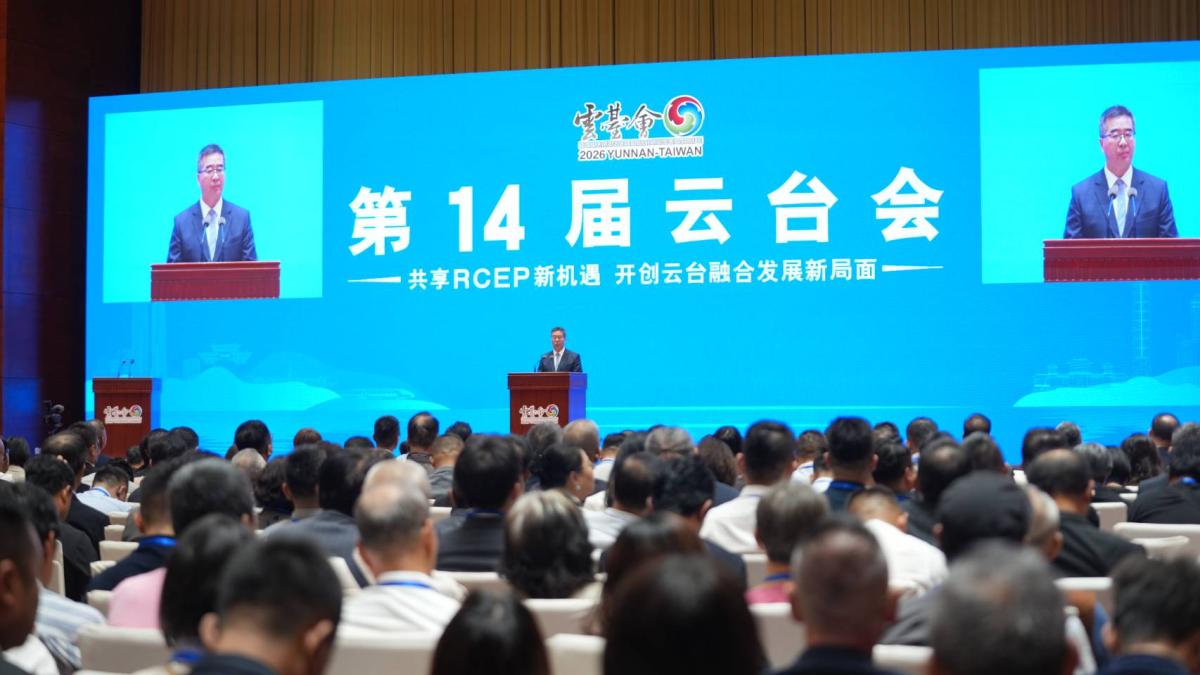
The 14th Yuntai Conference opened on the morning of the 8th in Kunming, Yunnan Province. Despite ongoing cross-strait tensions, over 600 individuals from various sectors in Taiwan attended, according to organizers. KMT Vice Chairman Hsiao Hsu-chin, who led a delegation at the invitation, delivered a speech at the opening ceremony.
Hsiao stated that recent public opinion polls in Taiwan show that the vast majority of Taiwanese society identifies as part of the Chinese nation, indicating that any so-called 'de-sinicization' efforts are unpopular among the general public because they contradict the nature and interests of the Taiwanese people.
Hsiao pointed out that Yunnan is a frontier and radiation hub for China's Belt and Road Initiative and a key node for Taiwanese businesses expanding into Southeast and South Asia. After 13 editions, the Yuntai Conference has become an important platform for promoting cross-strait exchanges and cooperation. China aims to promote cross-strait integrated development, while Taiwan seeks to maintain prosperity—both require peace, as only peace can foster integration and revitalize Taiwan. The KMT, rooted in the deep historical ties between Taiwan and the mainland, bears an inescapable responsibility for 'Peaceful Revitalization of Taiwan.'
On national identity, Hsiao emphasized that 'both sides of the strait belong to the Chinese nation and are one family.' The histories of Yunnan and Taiwan demonstrate that the Chinese nation is a diverse yet unified family, sharing bloodlines, culture, and historical memory. We speak Chinese, read Chinese books, celebrate Chinese festivals, and worship Chinese deities. We carry Chinese blood—we are authentic Taiwanese and proud Chinese.
Hsiao stressed that recent polls in Taiwan confirm that most people identify as part of the Chinese nation, further proving that de-sinicization is unpopular. He noted that over the past 30-plus years, Taiwan has experienced several party alternations, and cross-strait relations have fluctuated accordingly. However, historical experience shows that national identity, combined with political trust based on the '1992 Consensus and opposition to Taiwan independence,' remains the fundamental guarantee for peaceful cross-strait development.
Hsiao added that both sides' laws, regulations, and systems define cross-strait relations under a 'One China' framework, not as state-to-state relations—a clear reality. Opposing Taiwan independence aligns with Taiwan's legal provisions. As long as both sides respect the non-state-to-state nature of the relationship and maintain political trust, dialogue and negotiations can proceed on a solid foundation.
FACT BOX
- Source: PR Times
- Category: Event