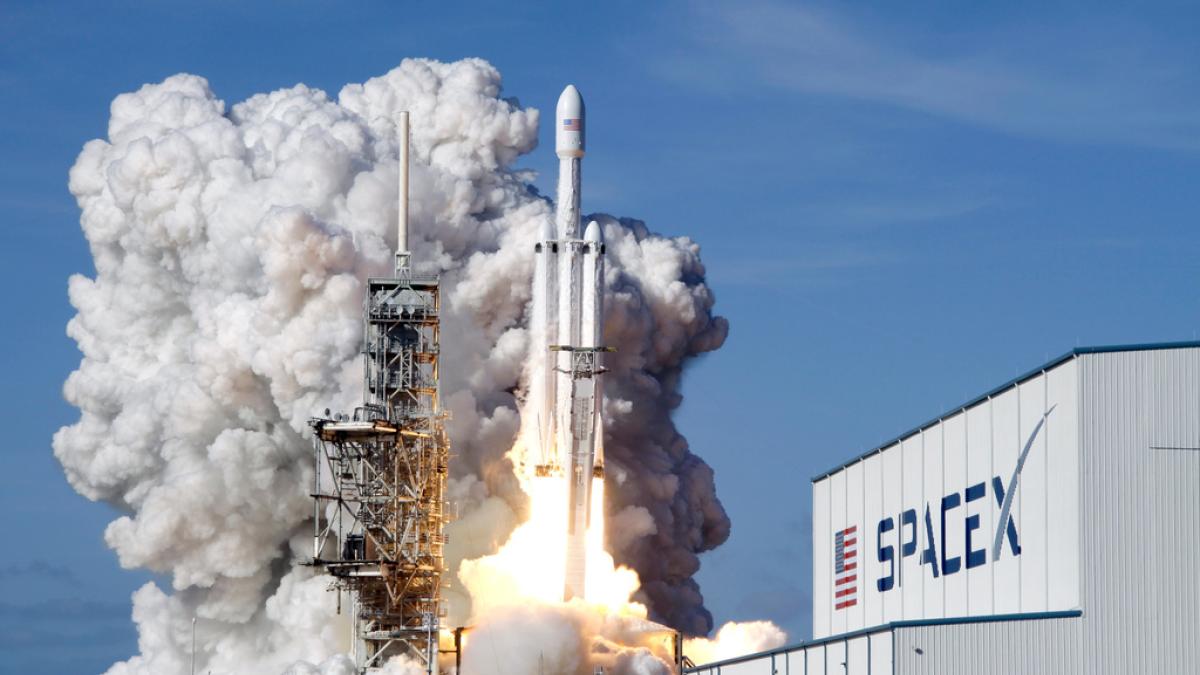
U.S. space technology company SpaceX has been swiftly added to the Nasdaq-100 index (Nasdaq-100) following its public listing, making its stock a core holding for numerous index-tracking funds, mutual funds, and retirement portfolios. This means that the asset allocations of millions of American investors are now directly exposed to fluctuations in SpaceX's stock price.
However, Jeremy Grantham, the well-known investor and co-founder of asset management firm GMO—long recognized for his bearish market views—has raised strong concerns about SpaceX's current valuation and the surrounding market frenzy. He suggests the company could become one of the most iconic bubble cases in financial history.
After completing its initial public offering (IPO), SpaceX was quickly included in the Nasdaq-100 index. This inclusion mandates that all funds tracking the index—such as ETFs, mutual funds, and pension assets—must purchase SpaceX shares according to the index's weighting. Given the massive scale of such passive investment flows, the market widely expects sustained buying pressure on SpaceX's stock, further amplifying its market influence.
Nonetheless, Grantham recently voiced sharp criticism during an interview on Morningstar's podcast program, "The Long View." He argued that financial institutions are now almost uniformly encouraging investors to buy the stock, calling the current situation "the craziest IPO in human history."
Grantham believes that decades from now, financial markets will look back on SpaceX's IPO and find the vision described in its prospectus almost unbelievable. He predicts that when the market eventually reverts to fundamentals, investors will reassess this moment and regard SpaceX as a defining event in financial history.
He bluntly stated that if SpaceX avoids a major correction and maintains its current sky-high valuation, it would mean that artificial intelligence (AI) has advanced far beyond anyone's current expectations—so much so that it fundamentally transforms societal operations. In his view, only an extraordinary breakthrough in AI could possibly justify the market's current premium on SpaceX.
Grantham also criticized Wall Street's recent push to recommend SpaceX shares to clients. He warned that even if the stock's valuation is ultimately proven correct, humanity may already be living in a radically different world—one dominated by highly intelligent automated systems or machines, unlike anything we know today.
Despite these concerns, several major Wall Street investment banks continue to express strong optimism about SpaceX. The company officially went public on June 12, with an opening price of $150 per share, above its IPO price of $135. As of Wednesday's trading, the stock hovered around $149—still above the IPO price but down nearly 7% since the beginning of the month.
Even with this slight pullback, major banks like Goldman Sachs, JPMorgan Chase, and Morgan Stanley have issued bullish forecasts, with target prices ranging from $205 to $300, according to Fortune magazine. This indicates that mainstream financial institutions still see significant growth potential in the company.
Regarding SpaceX's rapid inclusion in the Nasdaq-100, Grantham pointed out that the move itself generates massive passive buying demand. Any fund tracking the Nasdaq-100 or related tech indices is legally or contractually obligated to hold SpaceX shares, creating a surge in mandatory purchases.
He explained that under conditions of limited supply and rapidly increasing demand, prices can rise far beyond fundamental value. From a supply-demand perspective, he finds it hard to imagine the stock price not continuing to climb—and potentially exceeding market expectations by a wide margin.
Market analysts note that inclusion in major indices typically brings substantial passive inflows, providing short-term support for the stock. However, many investors worry that if capital becomes overly concentrated in a few large tech firms, high-valuation stocks like SpaceX could face severe correction risks if market sentiment reverses.
SpaceX's IPO raised a total of $75 billion, setting a new global record for fundraising and surpassing Saudi Aramco's $29.4 billion IPO in 2019. It now stands as one of the largest IPOs in history.
Editor: Hsu Yung-hsiang More exclusive news from Wind Media: - Multiple investment banks set target prices above $200—Why isn't SpaceX rising? Market still shows strong confidence - After initial gains are nearly erased—Two signals from SpaceX restore some investor confidence - Sending AI computing power into orbit is real—Musk unveils design model of 'space data center'—Experts: Major boost for SpaceX
FACT BOX
- Source: PR Times
- Category: Funding
- Organizations: GMO / Goldman Sachs / JPMorgan Chase
- Products / services: Starlink