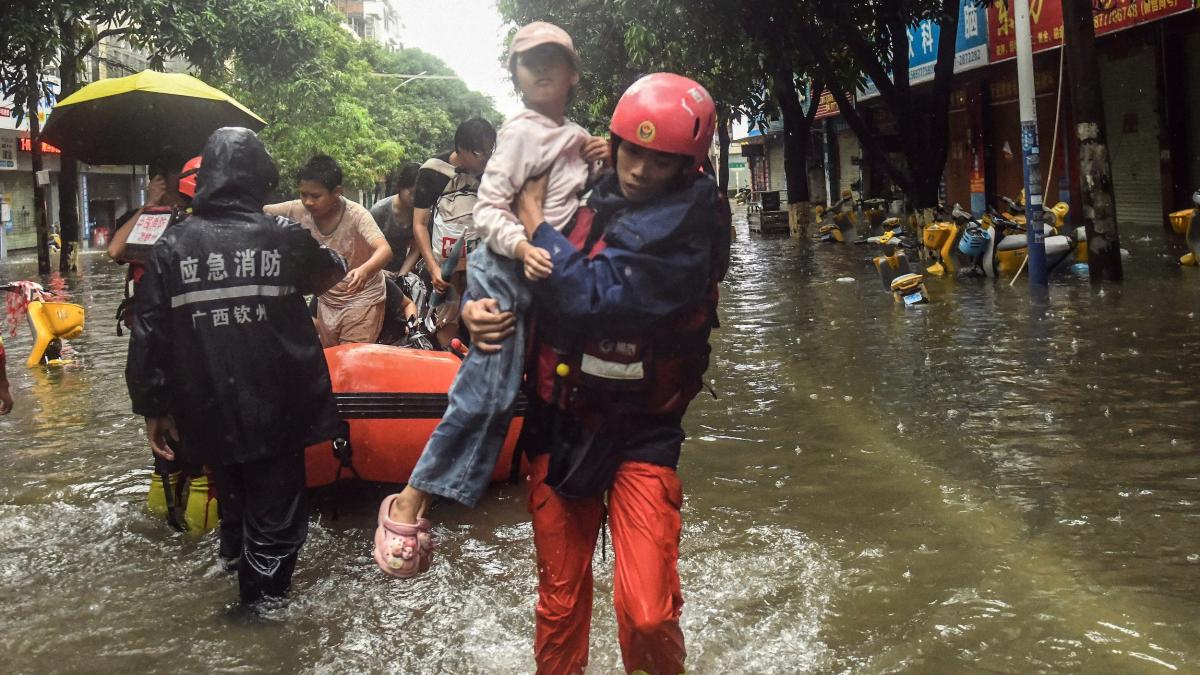
In early July, Typhoon Maysak (known in China as Mekkhala) made landfall in Guangxi, and its residual low-pressure system brought historic extreme rainfall, rapidly plunging many areas in central and southern Guangxi into a deep flood crisis. Rivers in Nanning, Guigang, and Hengzhou exceeded warning levels and even broke historical records. Urban streets turned into rivers, while farmland, villages, and school buildings were submerged. Official data shows that rainfall in multiple areas exceeded 600 millimeters in 24 hours, with some approaching or surpassing 700 millimeters—far exceeding previous extreme cases.
China's National Meteorological Center predicts that the strong typhoon 'Bavi' will affect the eastern coastal regions of China from July 10 to 12, potentially transporting massive amounts of moisture all the way to North China, Northeast China, and the Yangtze River basin. This will place immense pressure on already saturated rivers, reservoirs, and embankments. The Ministry of Water Resources has warned that Bavi could trigger cascading flood risks across multiple river basins.
The flood in Guangxi is not merely a localized natural disaster but rather a concentrated test of China's extreme climate patterns, aging water infrastructure, and local governance capabilities.
Extreme rainfall is becoming the new normal in China
Viewed over a longer timeframe, the Guangxi flood is not an isolated incident. In recent years, China has faced record-breaking heavy rains almost every summer.
In 2021, the extreme rainfall in Zhengzhou, Henan, caused significant casualties; in 2023, floods in the Beijing-Tianjin-Hebei region sparked controversy over water release decisions; from 2024 to 2025, the Pearl River and Yangtze River basins repeatedly experienced flood peaks exceeding warning levels; and in 2026, Guangxi once again became the epicenter of extreme rainfall.
Chinese authorities have acknowledged that both northern and southern regions will face extreme rainfall during this year's main flood season, with northern areas potentially experiencing widespread heavy rains as Bavi moves northward, creating a scenario where 'the south has not yet recovered, and the north is hit again.'
Numerous climate studies indicate that under global warming, the atmosphere can hold more moisture, making intense rainfall more likely to occur in short bursts. In other words, what China will face in the future is not just more typhoons, but more frequent 'extreme rainfall events.'
Severe flooding has struck multiple areas in Guangxi, China. The image shows distress messages posted by locals on social media. (Sourced from Weibo and Xiaohongshu, compiled and produced by Tian Chang)
In the North China region where the reporter is based, temperatures have risen significantly compared to previous years. Extreme heat exceeding 40 degrees Celsius has become commonplace, accompanied by several short-lived hailstorms. Additionally, thunderstorms and strong wind events have noticeably increased in Beijing this summer. In areas along the western Taihang Mountains in Hebei, extreme weather has become frequent. In historically dry foothill plain cities such as Baoding, Hebei, the intensity of precipitation this year began nearly half a month earlier than usual.
However, in Guangxi, the disaster caused by extreme rainfall has highlighted the vulnerability of small and medium-sized reservoirs—many of which were built in the mid-20th century. Although some have undergone renovations, they struggle to withstand rainfall events of a 'once-in-a-century' magnitude.
Liulan Reservoir breach: Legacy of history and renovation challenges
The most severe disaster in Hengzhou centered on the breach of the Liulan Reservoir. Built in 1958 during the 'Great Leap Forward' by 35,000 laborers using manual methods, this medium-sized reservoir is the largest water source project in the region. The dam stands 42 meters high and controls a watershed of 195 square kilometers, serving extensive irrigation and water supply needs.
Parts of Guangxi's reservoirs were constructed in the 1950s and 1960s during the 'Great Leap Forward,' now over half a century old. Although about 300 million RMB has been invested in recent years for renovations, major risks have not been fully eliminated. When aging infrastructure faces rainfall far exceeding design standards, its safety margins are severely tested.
Since 2024, the reservoir has received 380 million RMB in funding from China's Ministry of Water Resources for irrigation district upgrades. Authorities claim that 'flood control and safety capabilities have significantly improved.' However, during the recent downpour, the reservoir still developed a major breach, releasing floodwaters that inundated downstream villages. Footage from Chinese social media and messages from affected locals show residents trapped on upper floors, cut off from water, electricity, and food supplies. Pigpens and fish ponds were destroyed, and crops were completely lost.
Although officials emphasize timely evacuation of some residents, civilian distress signals indicate that rescue efforts remain inadequate in remote villages and low-lying areas. Several boarding schools in Guigang's education district were severely affected. Over 10,000 teachers and students from Guigang High School and Dajiang International School were trapped for two days, with water levels reaching up to the third floor, resulting in power, water, and food outages.
A student pleaded for help on a social platform: '22 boys sharing 10 steamed buns.' Parents waited anxiously, and some residents attempted self-rescue by wading through floodwaters.
'Private disaster relief equals rebellion': Systemic challenges facing civilian rescue efforts
During the Guangxi flood, strong public calls emerged urging, 'Turn some attention to the disaster zone.' Many people shared photos of former Chinese leaders Jiang Zemin and Hu Jintao inspecting disaster areas on social media. Some even circulated historical images of Chiang Kai-shek inspecting flood sites during the Republic of China era, hoping to prompt higher-level attention from the Chinese Communist Party.
Notably, in previous similar disasters, civilian rescue groups have faced strict controls. Chinese political commentator Xiang Dongliang wrote on social media: 'Local governments obstruct news reporting and suppress independent media coverage under the pretext of maintaining social order, resulting in a severe mismatch between what disaster victims see in official reports and their lived experiences, and between the severity of the disaster and public attention.'
A similar situation occurred during the Hunan Shimen County flood in May this year. Three teams from the Henan Blue Sky Rescue Team—Yichuan, Yiyang, and Songxian—crossed regional boundaries to provide aid without prior approval or registration. They gave media interviews and released videos at toll stations, then were publicly criticized by the Henan Blue Sky Rescue Supervision Department for 'unauthorized cross-regional deployment' and 'privately filming and releasing videos, triggering online public opinion and causing extremely negative social impact.' They were ordered to withdraw immediately and issued written warnings.
In China, where 'stability above all' and information control are prioritized, civilian forces must strictly operate within official command frameworks; otherwise, they are deemed 'disrupting order.' At the Guangxi rescue site, although teams like the Blue Sky Rescue from other provinces participated, most were required to 'report immediately to local authorities' and operate under centralized command.
Xiang Dongliang pointed out: 'The most surreal aspect is that many voices criticizing media coverage for causing chaos actually come from disaster-affected communities. This is not to blame the victims—they are double victims, suffering both from natural disasters and from the long-standing extreme ideology of 'stability above all.''
Xiang also stated: 'Those who constantly worry that media coverage will undermine social stability are often truly afraid that public scrutiny will threaten their own job security.'
The Guangxi flood will eventually subside. But as Typhoon Bavi approaches China's coast, this disaster may mark only the beginning, not the end, of China's 2026 flood defense efforts.
FACT BOX
- Source: PR Times
- Category: News