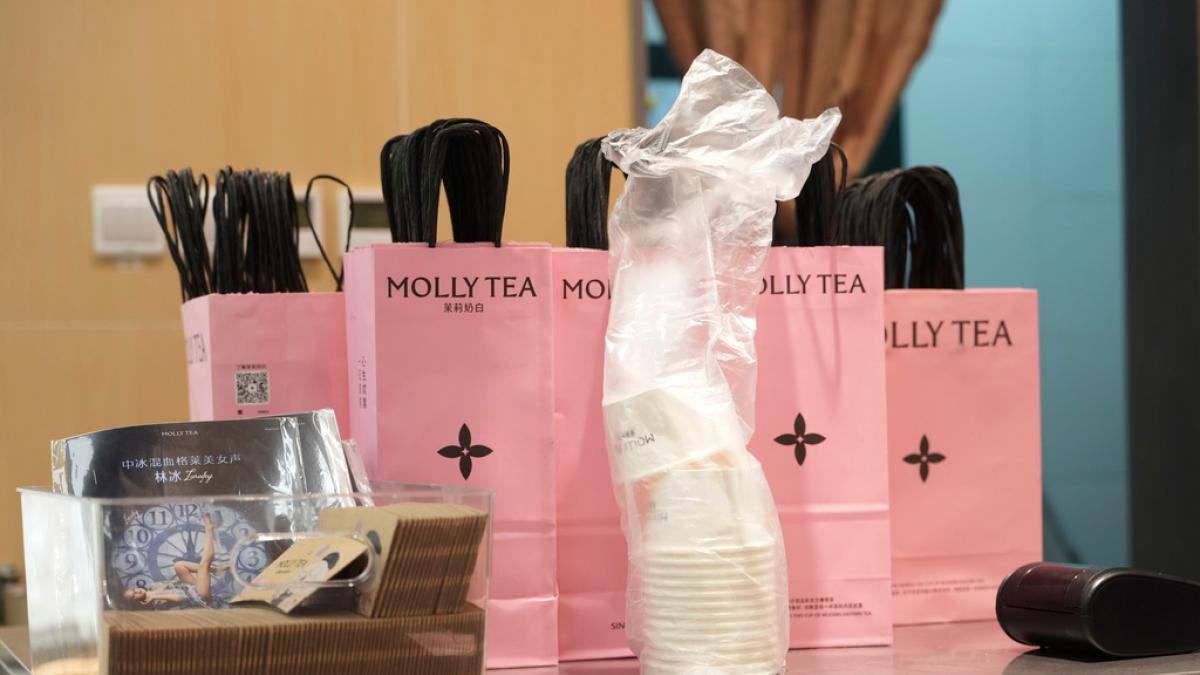
A street bubble tea brand, with an average price under 100 TWD per cup, has landed in a cross-border legal battle—and been hit with a near 50 million TWD fine—over a fashionable pattern on its packaging. This lawsuit involves Molly Tea, a rising tea beverage brand from China, and French luxury giant Louis Vuitton (LV), who clashed in court over a black 'four-leaf floral' motif used in the brand's logo.
According to the BBC, Molly Tea has rapidly risen in popularity, expanding to over 2,000 stores across China and globally. Its signature product is a fresh floral-scented milk tea, paired with a modern minimalist black-and-white visual design that quickly gained traction on social media.
However, the black four-leaf floral pattern on its logo drew a trademark infringement lawsuit from LV. Recently, the Intermediate People's Court of Suzhou, Jiangsu Province, issued a first-instance ruling, determining that Molly Tea had seriously infringed on LV's registered trademark rights. The court ordered the tea company to immediately cease using the logo and pay 10.3 million RMB (approximately 48.67 million TWD) in damages to the LV group within 10 days.
Following the verdict, widespread controversy erupted across Chinese social media. Keywords related to the case attracted over 400 million views in just a few days, with massive online debates erupting among netizens, legal scholars, and influencers across various platforms.
17 Trademark Applications Fully Rejected, Yet Still Used
Could this be LV maliciously targeting a small brand or overreaching its trademark interpretation? According to the court's judgment, Molly Tea—founded in Shenzhen in 2021—was on shaky legal ground from the start, as this was a case of 'knowing violation.'
The court ruling stated that LV's multiple 'four-leaf floral' graphic trademarks were officially registered in China's National Intellectual Property Administration as early as January 1986 and have since been legally recognized as 'well-known trademarks' with high legal standing.
In contrast, starting in 2022, Molly Tea submitted 17 applications for similar four-leaf floral graphic trademarks. However, after examination by the trademark office, all were rejected on the grounds that 'the design is too similar to LV’s classic trademark.' As a result, all graphic trademarks under the brand’s name are either invalid or under appeal in the government registration system, with only the plain text 'Molly Tea' successfully registered.
Based on these facts, the first-instance judge ruled that the tea brand, fully aware that the design could not be approved and that infringement risks existed, still insisted on extensive commercial use—on signage, takeaway cups, and delivery promotional materials—across over 2,000 chain stores. The court found the brand subjectively demonstrated clear malicious intent to 'ride on LV’s coattails' and cause consumer confusion, justifying a punitive, high-value compensation.
Was an Ancient Chinese Pattern Monopolized by the West?
Yet, this legally clear-cut ruling ignited strong nationalist anger among many Chinese netizens. A large number of Molly Tea fans cried foul, even searching historical records to defend the brand, arguing that cross-symmetrical four-leaf floral patterns have long existed in Chinese culture—such as the Tang Dynasty's Baoxiang flower patterns, traditional Chinese architectural motifs, and window lattice designs featuring four-petal flowers and shidi patterns.
On Weibo and Xiaohongshu, many supporters passionately protested: 'This geometric pattern has been used by our ancestors for thousands of years—why can a Western luxury brand register it and claim exclusive ownership?'
In response to such emotional arguments, many lawyers and law professors published rebuttals, urging people to first consult trademark laws. They emphasized that the core of trademark law is not about who invented a pattern thousands of years ago, but rather 'who legally registered it first' and commercially established it with high public recognition.
Since LV legally registered the design over 40 years ago, no subsequent brand has the right to use 'cultural heritage' as an excuse for malicious imitation and brand association across industries. Allowing such behavior, they warned, would lead to the complete collapse of market order.
In addition to the 10.3 million RMB fine, the court also ordered Molly Tea to publish a formal public apology on the homepage of its official website, Weibo, WeChat official account, online app, Xiaohongshu, and Douyin—six major official social platforms—for a continuous period, to eliminate the negative impact caused by the illegal infringement.
FACT BOX
- Source: PR Times
- Category: News
- Organizations: Louis Vuitton