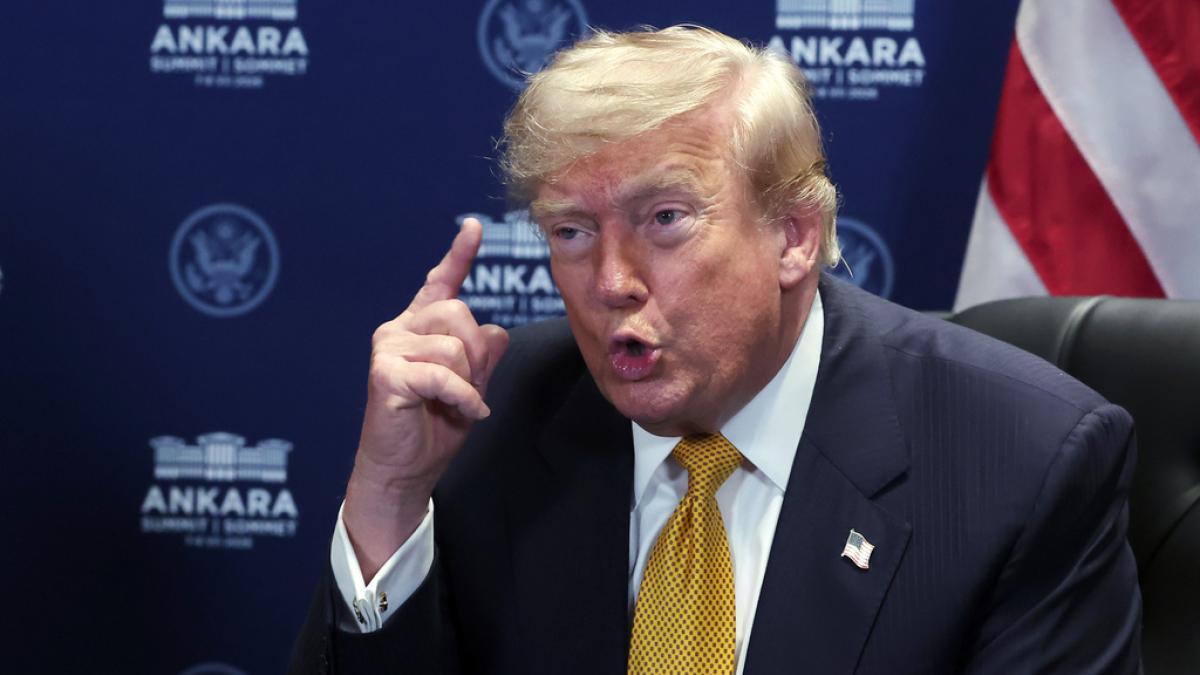
US President Trump officially declared on July 8, Eastern Time, that the ceasefire agreement brokered by the United States and reached with Tehran authorities has "completely ended." Subsequently, US forces immediately launched a new round of large-scale airstrikes against military targets inside Iran, signaling a full escalation of Washington's military response to Iran's recent attacks on commercial ships in the Strait of Hormuz.
This operation marks the second consecutive day that US forces have struck targets within Iran. Following Iran's firing upon three commercial vessels transiting the strategic waterway, Washington accused Tehran of severely violating the Memorandum of Understanding (MoU) reached last month, prompting the US military to resume military operations. US officials stated that the scale of the operation on the 8th was broader than the previous night's actions, focusing on military infrastructure supporting Iran's operations in and around the Strait of Hormuz.
Intense explosions reported across southern coastal regions of Iran
The US Central Command (CENTCOM) released a statement saying: "At the direction of the Commander-in-Chief, US Central Command forces have begun additional strikes against Iran to further degrade its ability to threaten the freedom of navigation in the Strait of Hormuz." The statement emphasized that the US is holding Iran accountable for its unprovoked aggression against commercial vessels and civilian crew members freely navigating international waterways.
Trump later confirmed on the social platform 'Truth Social' that these airstrikes were "retaliation for Iran destroying ships yesterday," and warned: "If this happens again, the consequences will be far worse!"
According to official Iranian media reports, loud explosions were heard in multiple southern coastal areas of Iran near the Strait of Hormuz, including Bandar Abbas, Sirik, Chabahar, Konarak, and Lavan Island, with air defense systems activated in several locations.
A US official told Axios that the airstrikes targeted Iran's coastal radars, anti-ship missile sites, and air defense missile systems. Another US official confirmed to Reuters that the scope of the strikes on the 8th was indeed broader than the previous night's operations.
Earlier on the 8th, during a sideline meeting with Ukrainian President Zelenskyy at the NATO summit in Ankara, Trump had already hinted that US forces might strike Iran again that night. When asked whether the ceasefire agreement was effectively over, Trump responded: "For me, I think it's over. I don't want to deal with them anymore. They are thugs, a sick group of people, their leadership is sick, and they are brutal and violent. If they had nuclear weapons, they would absolutely use them."
Trump noted that Iran had previously launched drones and missiles at vessels in the strait and indicated a high likelihood of further military action: "We might hit them hard again tonight. I'm giving them a warning—we will launch a fierce offensive tonight." He defended the administration's hardline strategy, emphasizing: "They attacked several ships, so we hit back harder. When they strike, we return tenfold."
Vice President JD Vance also voiced strong support for the administration's Middle East policy, stating that the previous understanding between Washington and Tehran was very clear: if Iran stopped attacking commercial ships, the US would lift its maritime blockade; but if such attacks resumed, the US would respond with even greater force. Vance said: "They promised to stop firing on ships, but 24 hours ago, they started shooting again. If you fire on ships, we will destroy them completely."
Following the new round of US airstrikes, Iranian officials immediately issued threats of retaliation. Nour News, affiliated with Iran's Supreme National Security Council, cited military sources saying Tehran "will soon launch a large-scale attack on US military bases in the region."
Iranian Deputy Foreign Minister Kazem Gharibabadi stated that Trump's rhetoric does not demonstrate strength but "admits the failure of policies based on force, sanctions, and threats." Gharibabadi said: "Facing the criminal and cold-blooded Trump, we must speak the language he understands. Clearly, he understands the language of force better."
Iranian Foreign Minister Abbas Araghchi also responded on social platform X on the 8th, writing that Iran "will not respond to vulgarity with vulgarity, but with concrete actions."
Meanwhile, Pakistan, which previously mediated the MoU between Washington and Tehran, urgently called for restraint as the conflict expanded. The Pakistani Foreign Ministry issued a statement emphasizing: "Resuming conflict serves no one's interests," urging all relevant parties to exercise restraint and avoid actions that could further undermine regional peace and stability.
The night before the latest operation on the 8th, US Central Command had announced that US forces used precision-guided weapons to destroy over 80 Iranian military targets. The first wave of attacks targeted Iran's air defense systems, command and control networks, coastal radar stations, anti-ship missile facilities, and more than 60 small speedboats belonging to Iran's Islamic Revolutionary Guard Corps (IRGC) deployed inside and outside the Strait of Hormuz.
According to CENTCOM's investigation, Iran attacked three commercial vessels in the Strait of Hormuz earlier this week: the Marshall Islands-flagged tanker 'Al Rekayyat,' the Saudi Arabian-flagged tanker 'Wedyan,' and the Liberian-flagged cargo ship 'Cyprus Prosperity.'
Trump stated that both the ceasefire and the MoU are now invalid. These maritime attacks have drawn strong condemnation from multiple Persian Gulf Arab nations, prompting the US Treasury to swiftly revoke temporary licenses previously issued under the MoU that allowed Iran to sell oil.
The MoU, reached in June, aimed to ease US-Iran tensions, restore freedom of navigation for commercial vessels in the Strait of Hormuz, and create space for future negotiations on Iran's nuclear program and other unresolved issues. However, with Iran repeatedly attacking commercial vessels in the strategic waterway, the US military has resumed military operations and reimposed oil sanctions. On July 8, Trump clearly stated that, in his view, both the ceasefire and the MoU are now invalid, meaning that unless Tehran changes its stance, the situation could revert to the dangerous brink of direct military confrontation.
FACT BOX
- Source: PR Times
- Category: News