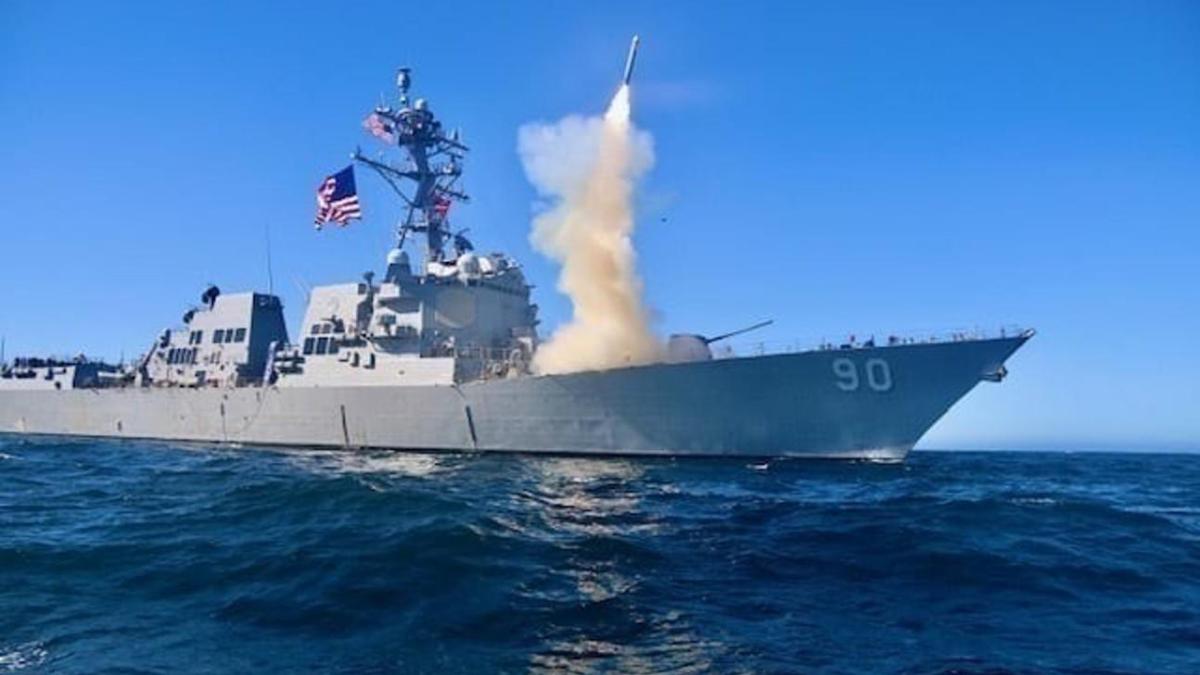
The U.S. military announced on the 8th that it has launched a new round of airstrikes against Iran, aiming to ensure the critical Strait of Hormuz remains open for navigation. Hours earlier, former U.S. President Donald Trump declared the temporary war-ending agreement with Iran had been 'terminated.'
According to Reuters, the latest strikes were in response to an attack on three cargo ships transiting the Strait of Hormuz the previous day. The U.S. attacks shook several cities along Iran’s southern coast and caused localized power outages.
U.S. Central Command (CENTCOM), the military’s Middle East command, stated on social platform X: 'U.S. Central Command forces have begun additional strikes against Iran to further degrade their ability to threaten freedom of navigation in the Strait of Hormuz.'
'The United States is holding Iran accountable for recent unprovoked attacks on commercial vessels and civilian crews freely navigating vital international waterways,' CENTCOM added.
A U.S. official, speaking anonymously to Reuters, said the number of attacks on Iran today would exceed those from yesterday.
Trump wrote on his social platform 'Truth Social': 'This is retaliation for Iran bombing ships yesterday. If this happens again, the consequences will be far more severe!'
Before the February 28 U.S.-Israel joint airstrikes on Iran triggered open conflict, about one-fifth of the world’s oil supply passed through the Strait of Hormuz. Control of the strait gives Tehran significant leverage, effectively allowing Iran to deadlock with the world’s most powerful military. Although Iran has not claimed responsibility for the ship attacks, analysts suggest Tehran uses such actions to strengthen its negotiating position.
The escalation in U.S.-Iran tensions has undermined hopes of transforming the memorandum of understanding signed on June 17 into a permanent peace agreement. Iran announced today it had launched attacks on U.S. military bases in Bahrain and Kuwait in retaliation for prior U.S. strikes on infrastructure—actions themselves in response to the ship attacks.
Asked at a press conference before attending the NATO summit in Turkey whether the memorandum was now void, Trump said: 'That’s a very interesting question. For me, I think it’s terminated. I don’t want to deal with them anymore.'
Trump added: 'If we make a deal with Iran, I’m not sure they’ll honor it. I find them to be very untrustworthy people.'
Despite repeatedly threatening to escalate military action, Trump later adopted a more restrained tone. He said he does not expect a return to full-scale war, and it remains unclear whether negotiations toward a permanent agreement will continue.
At a press conference later on the 8th, Trump stated he does not believe war will reignite. 'Whatever happens, it will end quickly… and make things safer—not just overall, but for oil as well,' he said.
The U.S. strikes caused oil prices to rise more than $1 per barrel in after-hours trading. The international benchmark Brent crude futures were last quoted at $79.28 per barrel. Even so, prices remain well below the April peak of over $120 per barrel.
FACT BOX
- Source: PR Times
- Category: News