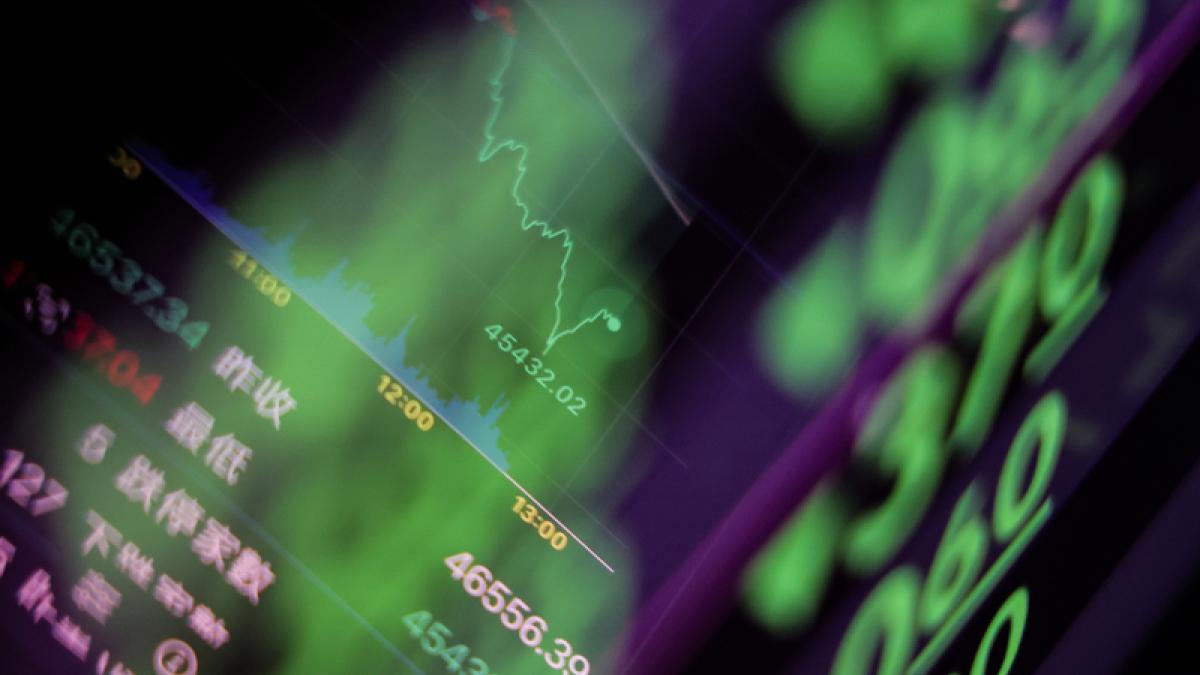
On the 7th, Taiwan's stock market plunged over 1,000 points, triggering strong market concerns about whether the AI-driven rally is reversing. In response, investment advisor expert Jiang Guo-Zhong pointed out that this sharp decline is not due to fundamental problems in the AI industry, but rather a correction driven by overheated market positioning. At this stage, investors should be vigilant about stocks that have surged in the short term, where retail investors are blindly chasing prices and shareholding structures are disorganized—these eight stocks should be avoided for now.
Asian equities were hit by negative news, but Jensen Huang stated: 'AI fundamentals remain unchanged.' Jiang Guo-Zhong, analyst at Moore Investment Advisory, noted that recently, South Korean semiconductor stocks faced profit-taking pressure, causing local markets to briefly trigger circuit breakers. Samsung Electronics and SK Hynix saw their share prices plummet simultaneously, dragging down Asian tech stocks broadly. Coupled with market concerns over overheated AI infrastructure investment and deleveraging, global AI-related stocks collectively corrected.
However, Jiang mentioned that NVIDIA CEO Jensen Huang recently clearly stated that AI demand remains strong and HBM (High Bandwidth Memory) continues to face supply shortages. This indicates that the fundamentals of the AI industry have not changed; this round of correction mainly reflects cooling market sentiment, not the disappearance of AI demand.
A 20.4 billion NT dollar reduction in margin financing triggered a 'long squeeze.' Experts warn: Do not rush to average down. Notably, Taiwan's margin financing dropped sharply by 20.4 billion NT dollars on the 7th, marking the third-largest margin reduction in history. Jiang analyzed that during the recent market rally, the increase in margin financing significantly outpaced the index rise by about 32%, indicating that retail investors were heavily using margin to chase prices.
When external markets face negative news (such as the plunge in South Korean stocks or the pullback in U.S. tech stocks), once the market breaks key support levels, it easily triggers margin calls and stop-loss selling, further creating a 'long squeeze' effect. Therefore, this correction is less about an AI bubble bursting and more about a cleansing of market positions.
Jiang specifically reminded investors:
- Do not rush to average down: If the market breaks key support zones, the short-term trend is likely already damaged. - Adjust investment portfolios: Prioritize moderately reducing holdings and increasing cash positions. - Switch from margin to cash holdings: Investors holding margin positions may consider switching to cash holdings to reduce operational risk.
Strategy: Avoid high-deviation passive components; wait for memory stocks to pull back. Regarding future strategies, Jiang emphasized that not all AI-related stocks should be avoided. A 'cut the weak, keep the strong' approach is recommended. Stocks to be cautious of and temporarily avoid include:
Passive component stocks (excessively high short-term deviation): Such as Walsin Technology, MiraMate, Nippon Electric Works, Hwa Hong, and Chien You. Although benefiting from third-quarter price hike themes, their short-term surges, retail frenzy, and disorganized shareholding make them vulnerable to being the first targets of institutional profit-taking when market sentiment weakens.
Memory stocks (positive news already priced in): Such as Winbond and Nanya Technology. While long-term demand for high-end memory will be driven by AI servers, HBM, and next-gen AI platforms, short-term stock prices have already priced in much of the good news. Without a pullback and consolidation, sharp volatility is likely—investors should patiently wait.
Jiang stressed focusing on fundamentally solid large-cap leaders such as TSMC, Hon Hai, and Quanta. High-performing companies genuinely benefiting from AI servers and advanced packaging, as long as industry fundamentals remain intact, present excellent opportunities for medium- to long-term repositioning during every market correction.
More exclusive insights from Feng Media: · Are memory and passive component rallies cooling? Experts name 8 AI dark horses for the second half: the new blue ocean for market capital · Can regular investment in 0050 not capture Taiwan's bull market? Experts recommend this 'low-cost, better performance' stock: the perfect time to buy · Could Trump's 'chip reshoring' dream collapse? Experts reveal the biggest crisis facing the U.S. semiconductor industry: TSMC, Micron, and Samsung cannot escape
FACT BOX
- Source: PR Times
- Category: News