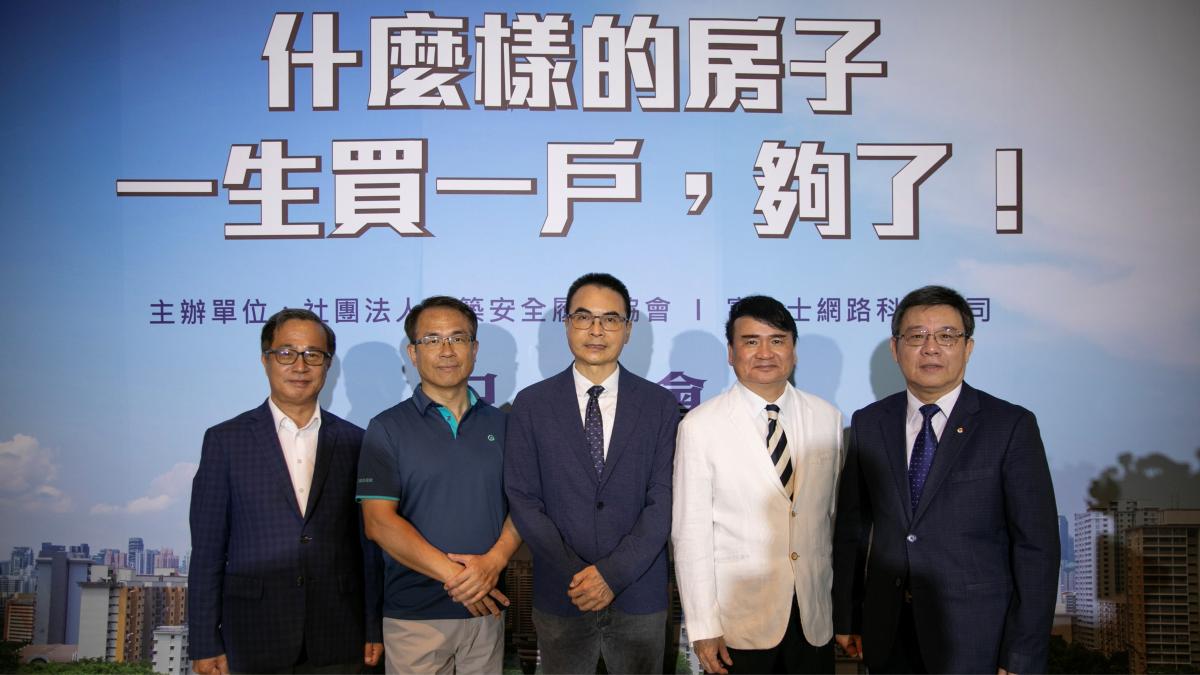
According to statistics from the Ministry of the Interior's Real Estate Information Platform, there are 5.16 million homes in Taiwan aged over 30 years, 980,000 vacant units, and 112,000 unsold new homes—three indicators that have all reached historic 'three new highs.' Especially under extreme climate conditions and frequent earthquakes, homes face severe challenges in appearance, structure, equipment, and planning. The question 'What kind of home can you buy once and live in for life?' has become a critical new topic.
Functional Obsolescence and the Need for Comprehensive Optimization
According to analysis by the Central Weather Administration, Taiwan experiences approximately 40,000 earthquakes of varying magnitudes each year, often causing cracks or 45-degree diagonal fissures in a building's beams, columns, and walls, leading to unpredictable structural damage. A public opinion survey commissioned by the Building Safety履歷 Association and Forbes Net Technology on March 26 found that 87.5% of respondents believe traditional homes face a 'functional obsolescence' crisis, while 78.6% agree that homes should undergo 'comprehensive optimization and major upgrades,' evolving from outdated 'Residential 1.0' to 'Residential 3.0.'
Definition and Upgrade Components of Residential 3.0
What is 'Residential 3.0'? According to the detailed findings of the Vision survey, it refers to 'comprehensive optimization and system updates'—a response to the crisis of 'functional obsolescence' through large-scale upgrades, including: 1. Equipment and plumbing/electrical pipeline updates. 2. Seismic-resistant design. 3. Increased indoor power supply capacity. 4. Reinforced aluminum windows and doors. 5. Kitchen upgrades. 6. Improved basement ventilation and daylighting. 7. Installation of busbar and EMS (smart load distribution) charging systems.
The Dual Aging Challenge: Aging Population and Aging Homes
Beyond 'functional obsolescence,' according to statistics from the National Development Council, Taiwan will officially enter a 'super-aging society' by 2026, with over 4.7 million people aged 65 or older—20% of the total population. Homes aged 30 years or more number 5.16 million, exceeding half of the total housing stock of 9.6 million. Homes aged 50 years or more have surpassed 1.01 million. Taiwan has officially entered a new societal challenge: the dual aging structure of 'old homes vs. elderly residents.'
The Turning Point: Housing as Asset or Liability?
As societal structures change, is your home an asset or a liability? 'What kind of home can you buy once and live in for life?' asks structural engineer Dai Yun-Fa, who answers: a 'good home' (Hao Zhai). A truly good home must achieve three things: 'comfortable living, safe living, and peaceful living.' Standards for a good home include a safe structure, third-party safety certification, and the integration of systematic innovative construction methods such as column-in-column, integrated hoop, system columns, and system exterior walls. In the future, additional building certification labels should be introduced, including: 1. Structural seismic safety certification. 2. Waterproofing engineering safety certification. 3. Mechanical and electrical system safety certification. 4. Residential performance safety certification. These should be integrated into a comprehensive evolution toward 'Residential 3.0.'
Market Valuation and the Rise of System Value
Real estate appraiser Wang Jin-Xiang notes that Taiwan's housing market is undergoing an 'invisible revolution' in 'housing value,' where both 'location value' and 'system value' will be equally important. Homes with updated equipment and superior performance can increase their appraisal scores or be included in official valuation bulletins as reference points. Core urban properties will remain assets, while homes that cannot be upgraded will become 'obsolete homes.' Peng De-Ling, Deputy General Manager of Taipei Fubon Bank, states that bank appraisals consider multiple factors including ABCD zoning and actual transaction records. Valuable homes are evaluated based on modern aesthetics, seismic resistance, upgraded building materials and equipment, updated pipelines, and brand strength.
Realizing the Residential 3.0 Evolution Home
Chen Zheng-Yi, Deputy General Manager of the Hsing Ho Li Construction Team, stated that since 2022, they recognized that existing market products could no longer meet modern needs. They decided to invest in developing a new residential model with 'comprehensive upgrades and system updates' across location, appearance, structure, equipment, construction, and planning—aligning closely with the Vision survey's recommendations. Notably, in exterior design, they partnered with the international team 'PTW Architects,' known for designing Beijing's Olympic Water Cube. Other upgrades include equipment and plumbing/electrical updates, Alfa Safe seismic technology, reinforced aluminum windows, kitchen enhancements, improved basement lighting and ventilation, and the installation of busbar and EMS charging systems—creating the trend-driven 'Residential 3.0 – Evolution Home.' Detailed upgrades in Hsing Ho Li's 'Residential 3.0 – Evolution Home' include exposed plumbing and electrical lines with reserved maintenance space, same-floor drainage for bathrooms, increased indoor power capacity, luxury-grade YKK aluminum windows, AI-controlled smart kitchen ventilation, basement height raised to 4.2 meters, dual-lane driveways widened to 6 meters with a second entrance hall, and refrigerated waste sorting—all responding to Vision's call to solve the 'functional obsolescence crisis' of traditional homes.
FACT BOX
- Source: PR Times
- Category: New Product