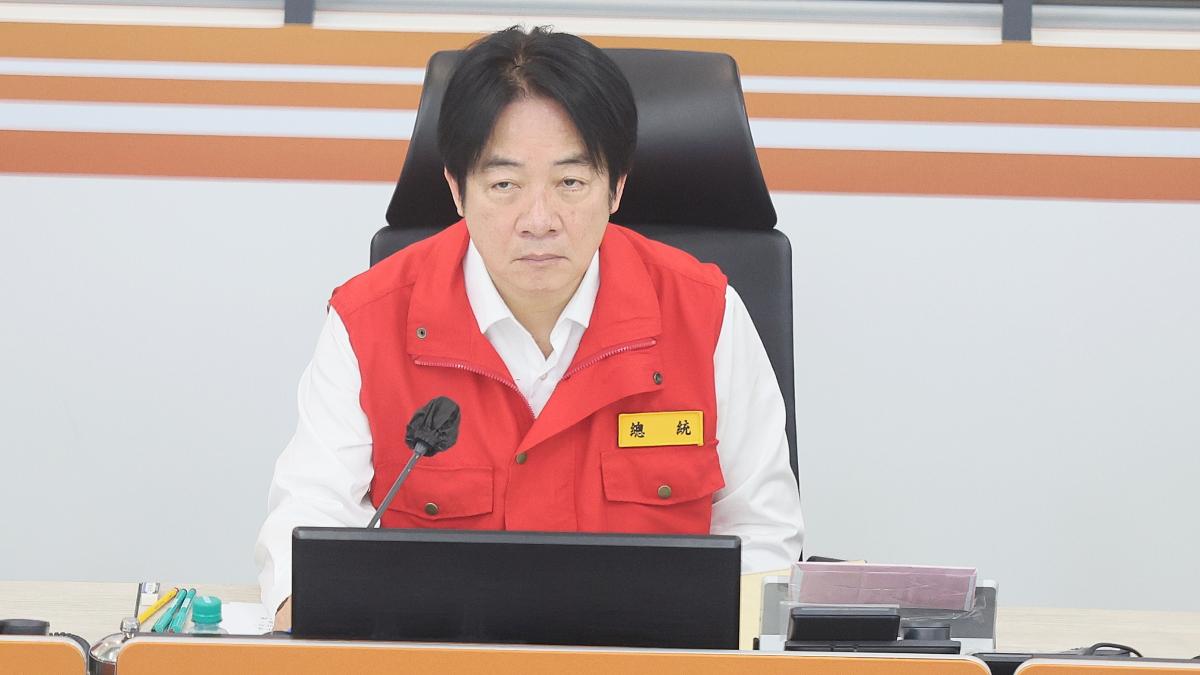
With Typhoon Bavi approaching, the Central Weather Administration (CWA) forecasts that the storm's wind circle will reach Taiwan's offshore waters tonight and move onto land between early this morning and tomorrow morning, significantly intensifying wind and rain. President Lai Ching-te conducted an on-site inspection of the Central Disaster Response Center this morning (10th) and held video conferences with representatives from New Taipei City, Taoyuan City, Hsinchu County, and Miaoli County to understand local preparedness. President Lai stated that central ministries have already prepared for this typhoon. After reviewing reports from the four counties, he praised their proactive preparations and urged other counties to follow suit. He emphasized that local governments should immediately notify the central government of any needs, and requested all central agencies to do their utmost to assist local governments in resolving issues.
The CWA's third working meeting and situation assessment for Typhoon Bavi was held this morning at the Central Disaster Response Center. CWA Director-General Lu Kuo-cheng explained that according to the latest satellite imagery, the typhoon has a radius of 380 kilometers—rarely seen in recent years—and is moving rapidly at 25 kilometers per hour, covering 600 kilometers in a day. The typhoon is currently located 700 kilometers east of Taiwan and will almost entirely cover the island tomorrow.
Lu stated that land warnings were issued at 5:30 a.m. today, with the storm's wind circle expected to reach offshore waters tonight and make landfall in Taiwan between early this morning and tomorrow morning. From that point, wind and rain across Taiwan will significantly intensify.
Regarding rainfall, Lu said total precipitation could reach 600 to 900 millimeters in the Taoyuan-Hsinchu-Miaoli region and northern areas including New Taipei and mountainous Yilan. Central and southern regions such as Taichung and Nantou could see 500 to 800 millimeters, while southern Taiwan will experience relatively less rainfall. He emphasized that this amount of rain is expected within a single day, indicating extremely high rainfall intensity.
Liu Shih-fang, Minister of the Interior and commander of the Central Disaster Response Center, stated that strong winds, especially in northern Taiwan, will persist from tonight through the daytime on the 11th, with gusts reaching over Level 12. She warned that many people mistakenly believe driving is safer, and urged the CWA to use cell broadcast messages to alert the public about strong gusts. She also requested the Ministry of Transportation to use various broadcasting systems to warn road users.
After listening to reports from central agencies and county representatives, President Lai expressed gratitude to Minister Liu Shih-fang and all staff at the disaster center for their early activation and preparation for Typhoon Bavi, the first to approach Taiwan this year. He noted that not only have all ministries prepared, but water and electricity under the Ministry of Economic Affairs and communications under the Ministry of Transportation are also ready. He then said, 'Second, I thank Minister Chou Jung-tsai,' immediately correcting himself upon realizing the error: 'Especially, I thank Premier Chou Jung-tsai' for establishing the disaster relief model early.
President Lai offered three key points: First, strengthen cooperation between central and local governments. He emphasized that all ministries are prepared and praised the four counties for their active preparations, urging others to follow. Given that total rainfall in northern mountainous areas could reach 600 to 900 millimeters, he stressed the need for vigilance. He urged local governments to notify the central government of any needs and asked central agencies to assist as much as possible.
Second, he urged all ministries and counties to ensure evacuation procedures for landslide-dammed lakes (natural dams) are properly executed. Third, he expressed gratitude to the military. Referring to the previous Mataian Creek landslide dam incident, he acknowledged that while civilian efforts—tens of thousands of 'shovel heroes'—played a major role, the military was also a crucial force. He called on the military to fully commit to this disaster response, working alongside central and local governments and the public to minimize damage.
FACT BOX
- Source: PR Times
- Category: News