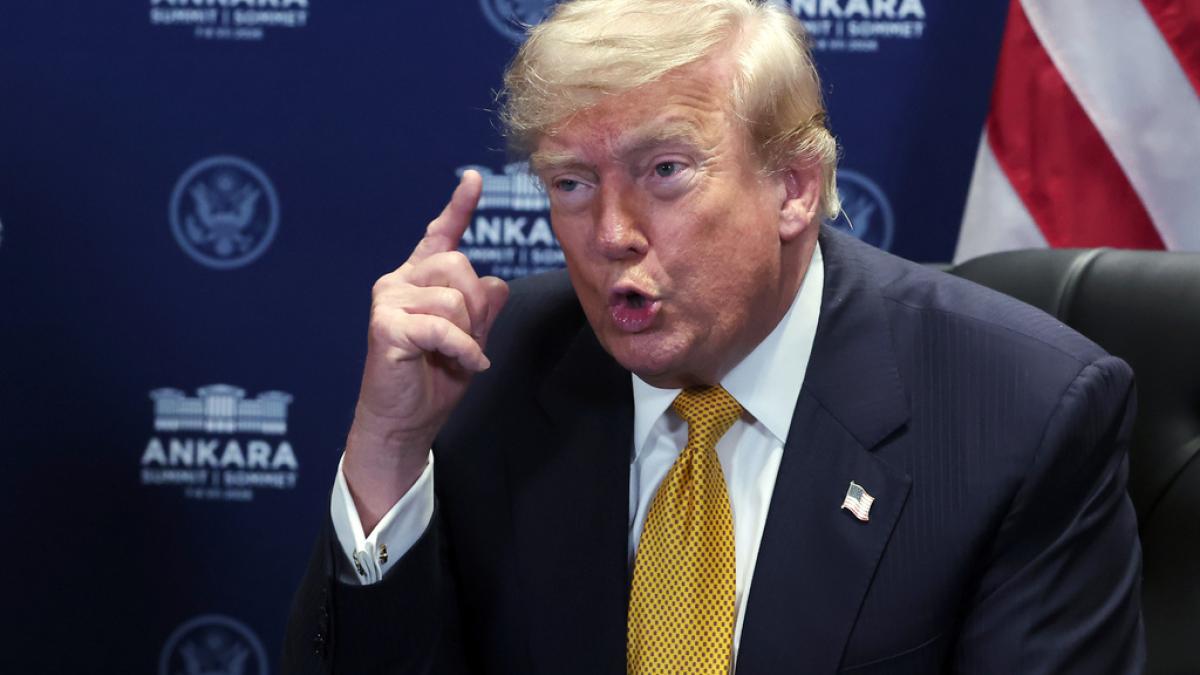
Taiwan has long been at the core of the global semiconductor supply chain, holding over 60% of the foundry market share. Approximately 90% of the world’s most advanced logic chips (advanced processes) are produced by TSMC, known as the 'national guardian mountain.' Former U.S. President Donald Trump has once again targeted Taiwan’s semiconductor industry, claiming he will reclaim 60% of global semiconductor manufacturing capacity before leaving office. In response, investor Ashun stated on Facebook today (10th) that 'Trump is just talking again,' and analyzed that reversing global market share within 2.5 years is virtually impossible.
When will U.S. chip production reach 60% capacity?
Ashun emphasized that based on real industry data, it is simply impossible for Trump to achieve 60% U.S. chip production by early 2029. In the semiconductor industry, 2.5 years is barely enough time to complete construction and trial production of an advanced process fab, let alone reverse global market share. He stressed that semiconductors are a capital-intensive, long-cycle industry—not like software, where you can simply copy and paste with a click.
Why does Trump keep calling Taiwan a 'thief'?
Ashun also calculated that for Trump to achieve 60% global capacity, the U.S. would need to replace the combined current shares of Taiwan (60–65%) and South Korea (15–20%) within 2.5 years. However, industry experts widely estimate that even with strong support from the CHIPS Act and various subsidies, a U.S. production capacity of 15–20% by 2030 would already be a significant success. He criticized Trump's repeated claims that 'Taiwan is a thief' as typical populist politics, designed to create a 'moral justification' that makes the American middle class feel 'justice has been served.'
Where does Taiwan’s 'Silicon Shield' come from? Can the U.S. overtake Taiwan in the short term?
Tech giants like Apple, NVIDIA, AMD, and Qualcomm heavily rely on Taiwan’s supply chain, giving Taiwan a strategic 'Silicon Shield' status. Although the U.S. is actively attracting semiconductor investments through the CHIPS Act and manufacturing reshoring policies, many experts and research institutions point out that the U.S. faces significant challenges in surpassing Taiwan’s advantages in advanced processes, complete supply chains, production efficiency, and talent clusters in the short term.
Did Taiwan take 100% of the chip business? What tools does Trump have for reshoring manufacturing?
Trump has repeatedly criticized Taiwan for dominating the semiconductor sector, even claiming Taiwan 'almost took 100% of the chip business.' He cites TSMC’s expanding investment in Arizona as evidence that companies are gradually shifting advanced processes and supply chains to the U.S., suggesting his manufacturing reshoring policy is already working. This time, he again singled out Taiwan, emphasizing that the U.S. is accelerating chip manufacturing reshoring through tariffs, investment incentives, and attracting companies to build factories in the U.S., aiming to make America a global semiconductor manufacturing hub once again.
FACT BOX
- Source: PR Times
- Category: News
- Organizations: TSMC / Apple / NVIDIA