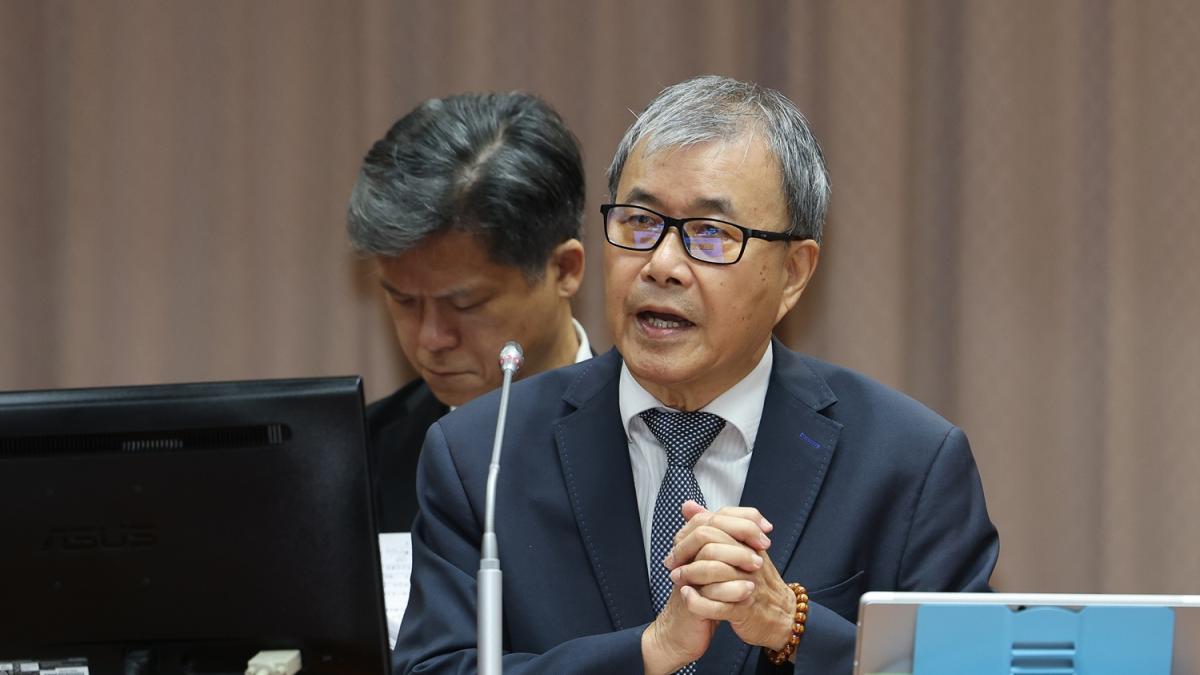
Recently, while the Legislative Yuan was still in session, Minister of Education Cheng Ying-yao took leave to conduct a 'local education inspection tour,' sparking controversy over his absence. Subsequently, Cheng used the Ministry of Education's official Facebook page to issue a high-profile clarification. Originally intended as a platform for policy communication, the official social media channel has now been used for personal justification, raising serious concerns about the misuse of public resources. How can the Ministry set a good example for students if it leads by violating ethical standards?
Scholars have criticized the situation, pointing out that Taiwan's education system faces numerous challenges—from early childhood to higher education—with problems constantly emerging. Recently, campus governance meetings have sparked public debate, yet instead of addressing these issues, the Ministry appears to be burying its head in the sand, distancing itself from Taipei by touring central and southern Taiwan, seemingly hoping that public attention will fade and the controversy will quietly disappear. Meanwhile, the recurring problem of teachers being unable to discipline students remains unresolved. Can the Ministry truly claim to bear no responsibility?
Facebook has become a stage for public relations performances—where has the Ministry's professional integrity gone? As a key national institution responsible for nurturing future generations and formulating education policy, the Ministry's official social media platforms should serve as essential channels for policy promotion, responding to teachers' and students' needs, and disseminating critical academic information. However, Minister Cheng's use of the platform for personal clarification turns it into a propaganda tool. While this may attract public attention, what does it have to do with the core mission of education? Using an official platform for a minister's personal defense—especially with suspected political campaigning—completely undermines administrative neutrality.
(Screenshot from Ministry of Education Facebook)
When public resources are repurposed as political propaganda tools for the ruling party, it not only reveals a misalignment of leadership professionalism but also raises questions about whether the underlying motive is merely to appease political superiors and gain political benefits. Online, many parents and citizens have sarcastically asked: 'Has the campus safety issue been resolved? Has the teacher shortage been addressed? What does eating pork have to do with enhancing educational competitiveness?' This absurd spectacle stands as the greatest irony of Taiwan's current educational crisis.
Repeated failures and neglect have left frontline educators exhausted. Summer vacation, traditionally a brief respite for teachers, is no longer truly restful. Many educators continue to attend training sessions, workshops, and credit courses. As the new semester approaches, they must immediately begin preparing lessons. Given the immense pressure teachers face, does the Ministry of Education truly understand their reality?
Summer is also when schools struggle to secure enough teachers for the upcoming semester. Recently, Taiwan's booming semiconductor industry has intensified the shortage of science and math teachers. With teacher salaries unable to compete with private-sector wages, schools rely solely on educators' dedication to survive. Now, with the Ministry engaging in questionable behavior and the Minister himself undermining administrative neutrality, teachers will only become more disillusioned and likely to leave, worsening the vicious cycle in schools.
(TSMC and other semiconductor firms have 'swept up' STEM graduates. Photo by Yan Lin-Yu)
Recently, education groups such as the National Education Industry General Union (NEIGU) have strongly criticized the Minister for serious dereliction of duty. In the face of nationwide challenges—including excessively high ratios of substitute teachers, loss of full-time teachers, and disputes over allowances and pension systems—the Ministry has failed to present effective solutions. Worse, Cheng has repeatedly been accused of deepening divisions between full-time and substitute teachers, and between retired and active educators, rather than addressing systemic issues. As a leader, failing to tackle structural problems and allowing distrust in educational professionalism to grow—is this not the very definition of dereliction of duty?
Moreover, in recent months, whether it's controversies surrounding campus gender equality cases or issues of educational resource allocation, the public has repeatedly witnessed the Ministry's passivity and tendency to shift blame. The Minister frequently expresses 'regret' and 'deep sorrow' but shows no concrete efforts toward reform or accountability.
Instead of returning to the core mission of education and helping frontline educators solve real problems, the Minister appears to be using Facebook merely to salvage his own reputation. During the legislative session, heads of government agencies are expected to attend committee meetings out of respect for the legislature. However, Cheng has repeatedly taken leave, earning criticism as the 'invisible minister.' While he initially rejected such criticism, he has since failed to take actions that would restore public trust.
Scholars argue that when the education sector needs leaders with courage and the ability to communicate with society under pressure, the Ministry has become completely dysfunctional. In every major incident, it has failed to respond effectively or gain public support, instead provoking skepticism and backlash. Ultimately, it waits for other news to overshadow education issues, then pretends nothing happened once public attention fades.
Society expects teachers to be role models and set examples for students—not just through isolated instances, but through consistent daily guidance that shapes students' character. But if the Ministry itself violates administrative neutrality, schools will inevitably follow suit, reflecting the nation's values. Is this truly what society wants?
FACT BOX
- Source: PR Times
- Category: News