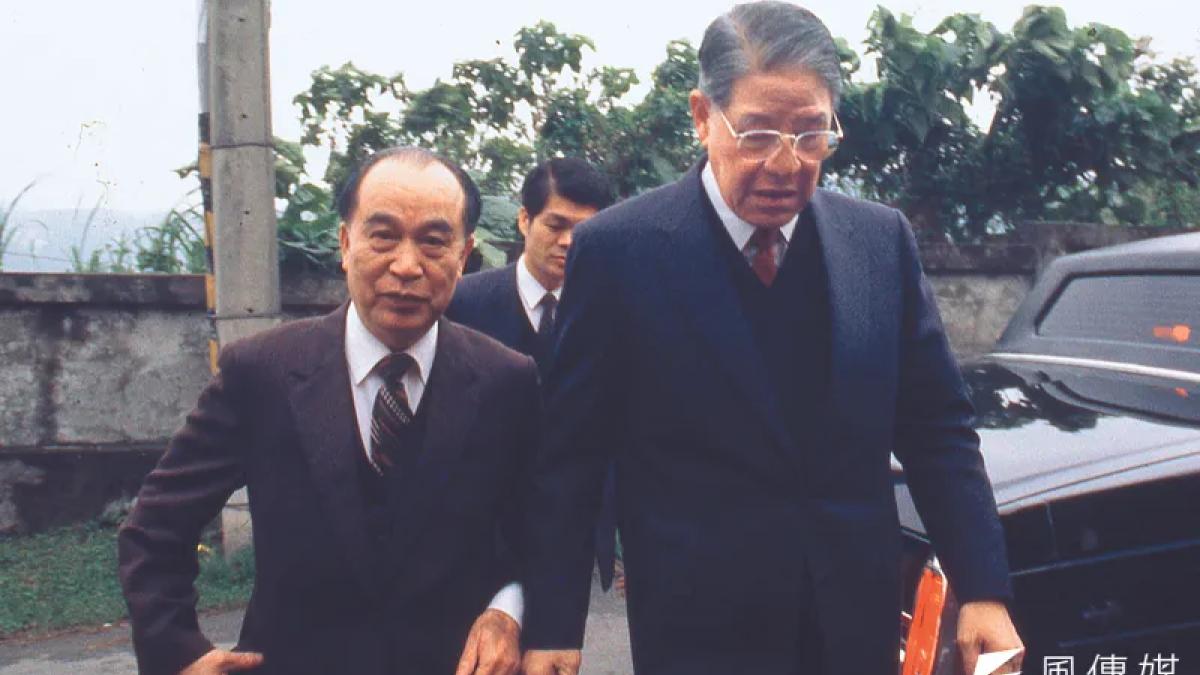
Why was Madame Chiang deeply concerned that the Kuomintang might undergo a qualitative transformation under Lee Teng-hui's leadership? Objectively speaking, Lee's party seniority was extremely shallow. He had no connection to the Kuomintang's profound historical past in China before 1949. Lee, who regarded himself as a political puppet, cautiously sought innovation and tried to establish his own political framework after taking office—something that undoubtedly unsettled certain party members.
Wang Tso-jung recalled that shortly after Lee assumed the presidency, he wrote an editorial titled "Be a Great President, Not a Powerful One" in the *China Times*, hoping to inspire his longtime friend. Unexpectedly, Lee later asked him, "If the president has no power, how can he get things done or become great?"
On February 22, Lee held his first press conference with domestic and foreign journalists. Breaking from the conservative tradition of the two previous Chiang presidents, who rarely held press conferences, Lee proactively engaged, speaking fluently and presenting fresh perspectives on cross-strait relations and foreign policy. He rejected "one country, two systems," urged Chinese Communist leaders to embrace democracy, and proposed a new framework for resolving cross-strait disputes—demanding that Beijing abandon the use of force against Taiwan as a prerequisite for reunification.
On foreign policy, Lee emphasized that the true achievement of the Republic of China in Taiwan over the past forty years was finding its own direction under extreme pressure. He called this "flexible diplomacy" and declared that, despite lacking formal diplomatic ties, Taiwan must actively expand substantive relations with countries worldwide.
On the highly anticipated issue of political reform, Lee's first major action as president—during his initial National Security Council meeting—was to advance the plan to revitalize central representative bodies. He instructed the Executive Yuan to promptly coordinate with relevant ministries to draft measures, and if necessary, use legislative procedures to ensure the full retirement of long-serving, unelected representatives, thereby enabling genuine constitutional democracy.
Western nations could not ignore the new positions Lee revealed after taking office. U.S. State Department analysis noted that Lee's statements signaled a quiet shift in the KMT's outdated discourse—no longer emphasizing the recovery of mainland China, but focusing instead on ensuring a prosperous and democratic life for Taiwan's people. Lee pledged that political reform would not stop and called for a grand reconciliation among Taiwan's diverse political forces. Washington officials praised Lee's strong confidence, noting he had upstaged Premier Yu Kuo-hwa (He upstaged Premier Yu). His words revealed a clear determination not to be a puppet controlled by mainland elites, nor an ethnic Taiwanese president hostile to mainlanders, but a president for all people.
Perceptive French officials stationed in Taiwan also sensed the island's transformation. They recalled autumn 1980, when the Chiang Kai-shek Memorial Hall was completed and Michel Deverge, then director of the French Cultural and Scientific Center in Taipei, attended the ceremony. Former President Yen Chia-kan delivered a speech in a strange accent that sounded like a local dialect. Deverge, fluent in Mandarin, asked a fellow guest what Yen was saying—only to be told the guest didn’t know either. To the French, mainlanders who arrived in Taiwan in 1949 spoke various regional Chinese accents, and even President Chiang had to rely on aides to translate his nearly unintelligible Ningbo dialect into standard Mandarin.
Eight years later, Jiangsu-Zhejiang dialects were increasingly rare on the island, and the influence of Hokkien speakers was growing. Lee’s Taiwanese-accented Mandarin at press conferences made it clear: after Chiang Ching-kuo’s death, “things were changing rapidly, and taboos were falling one by one” (les choses bougent et les tabous tombent un à un).
Lee sought fresh policies, but conservative forces refused to let him pass easily. At the KMT Central Standing Committee meeting on April 20, Shen Chang-huan launched the first attack. He expressed confusion over Lee’s public statements at the press conference—particularly the call for Beijing to abandon force and the concept of “flexible diplomacy”—and questioned whether the government had considered how the mainland might respond. Faced with this harsh challenge from his own secretary-general, Lee could not respond directly and instead instructed the Mainland Affairs Council to study the matter and submit a report.
Then, on May 5, Lee hosted a meeting at his residence with party elders Chen Li-fu, Hang Li-wu, and Hsiao Cheng. Despite his role as acting chairman, these elders ignored his authority and reiterated the old idea that the Central Standing Committee should continue rotating among its members.
Chen Li-fu not only opposed lifting martial law but began criticizing Chiang Ching-kuo’s late “half-hearted actions,” claiming the KMT’s decision to lift martial law was too hasty. He insisted the DPP was clearly guided and exploited by the Chinese Communist Party, calling the situation “very serious.” Lee patiently explained to the elders that democratization required tolerating opposition parties and establishing communication channels between the KMT and DPP to keep political activities within legal bounds.
The birth of Taiwan’s first native-born president did not immediately bring institutional transformation. Instead, it triggered a collective defensive reaction against such transformation.
Doubts about Lee came not only from conservative KMT factions but also from top Chinese Communist leaders. Beijing conducted an in-depth investigation into Lee’s background and, at a full meeting of the Central Advisory Commission in spring 1988, shared previously unknown details with retired cadres: “Lee Teng-hui indeed joined the [Communist] Party; he automatically withdrew after Tsai Hsiao-kang’s defection.” They assessed cross-strait relations with just six words: “Taiwan’s situation is becoming unstable.”
Shortly after the February 1988 presidential press conference, intelligence shared by Australia and Canada—members of the Five Eyes Alliance—revealed that Beijing’s Zhongnanhai leadership lacked confidence in Lee and had placed hopes for future cross-strait unification on Chiang Ching-kuo’s younger brother, Chiang Wei-kuo, then Secretary-General of the National Security Council.
Chinese Foreign Minister Wu Xueqian, meeting U.S. Secretary of State George Shultz in Washington, acknowledged that Lee was born in Taiwan and lacked experience living on the mainland, so Beijing remained cautious about his future political trajectory. Since Lee had publicly declared opposition to Taiwan independence upon taking office, China urged the U.S. to fully facilitate cross-strait cooperation and achieve peaceful reunification as soon as possible.
During spring and summer of that year, Wu further clarified in meetings with British officials that Beijing did not oppose Taiwan’s unofficial economic and trade exchanges with other countries. However, if Taipei tried to use such relations for political purposes, China was fully aware and urged other governments to remain vigilant against such “bad intentions.”
Beijing’s critical and skeptical stance toward Lee’s democratization and internationalization efforts puzzled Japanese Foreign Ministry officials: Wasn’t China itself on the path of reform and opening-up? Beijing’s criticism clearly contradicted its own policies.
In summer 1988, with unified support from three key figures—Li Huan (party), Yu Kuo-hwa (government), and Hao Pei-tsun (military)—Lee was smoothly elected formal KMT chairman at the 13th National Congress. Yet the election process sparked controversy. Young party delegates like Chao Shao-kang, Li Sheng-feng, and Lin Huo-wang proposed replacing the traditional standing ovation method with secret balloting to uphold democratic principles. The party center rejected the proposal, and the old standing method was used. In full view, Chao Shao-kang and seven others refused to stand, protesting the decision.
Ninety-year-old Soong Mei-ling insisted on attending in person and delivered a speech titled “Old Trunks, New Branches,” implying: “As old branches retire, new saplings grow. A great tree thrives not just from new leaves, but from its deep, old roots.” She reminded younger members not to erase the contributions of party elders and warned against “using the party for personal gain, seeking attention, creating novelty, and shaking the foundation of the state.”
Yet, through skillful party arrangements, Soong appeared on stage for only a few minutes, receiving salutes before being escorted out early by security. Li Huan read her speech on her behalf, and her one-hour address was condensed to just ten minutes. At the scene, elders like Chen Li-fu and Hsiao Cheng still attempted to nominate Soong as party chair or honorary chair. When Hsiao Cheng tried to speak, Legislative Yuan President Ni Wen-ya, fearing chaos, firmly blocked his ascent, causing another disturbance.
These incidents unsurprisingly became explosive topics in diplomatic reports from foreign missions in Taiwan. To Japanese Foreign Ministry officials, while KMT elders earnestly reminded the younger generation not to forget their roots, the younger generation was actively demanding democratic practices within the party through concrete actions. As authoritarianism faded and the KMT no longer had a Chiang family leader, scenes once unimaginable were now unfolding one by one.
The 13th KMT Congress marked the end of a brief period of harmony in the “post-Chiang Ching-kuo era,” with political struggles and divisions now surfacing. Yu Kuo-hwa, who unexpectedly succeeded Sun Yun-suan as Premier in spring 1984, had long been plagued by criticism of being too conservative and having a poor public image. In spring and summer 1988, the *Liberty Times* ran front-page headlines highlighting the low public approval of Yu’s cabinet—“too conservative, lacking innovation.” Subsequently, KMT-affiliated legislators, National Assembly representatives, and local councilors urged Lee to reorganize the cabinet.
FACT BOX
- Source: PR Times
- Category: News