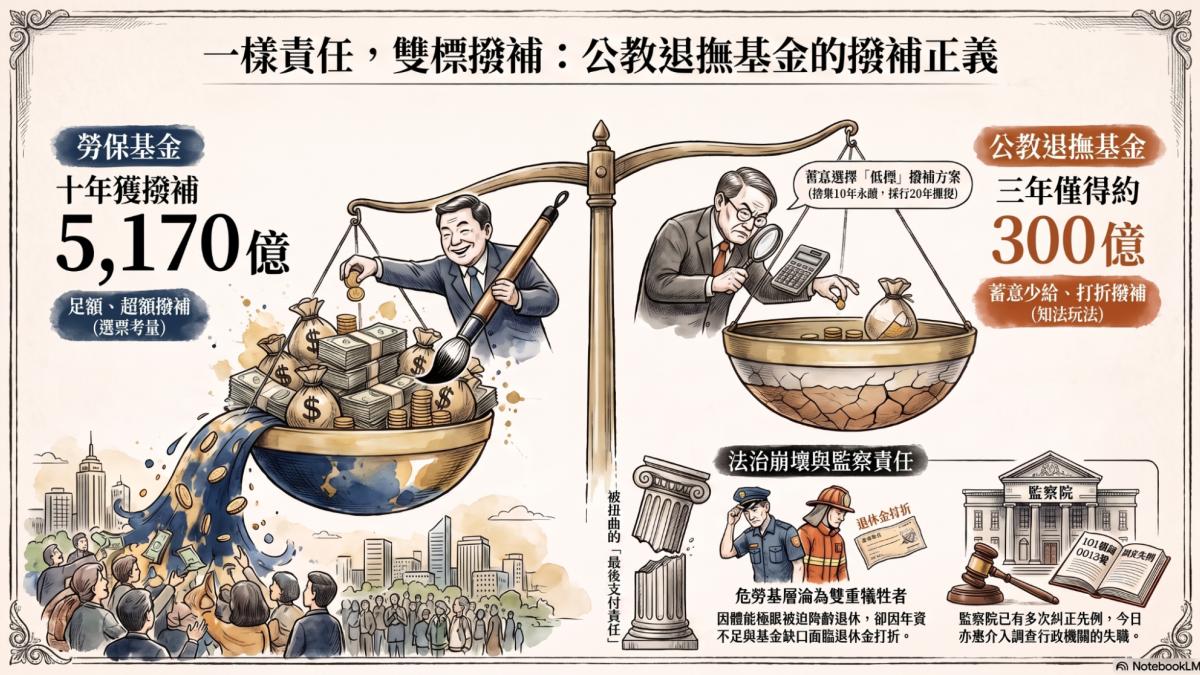
On May 20, 2016, the Tsai Ing-wen administration announced the launch of pension reform for military, public, and civil servants, claiming that 'not reforming would lead to bankruptcy.' However, the reform proceeded without completing the legal process, effectively recalculating years of service. By July 2023, the government introduced a 'new new system' for new civil servants, adopting an 'individual account system.' This led to a severe financial crisis for the old pension funds, as new entrants were disconnected from the existing funds. The Legislative Yuan specified in Article 93 of the 'Civil Servants Retirement, Resignation, and Compensation Act' and Article 98 of the 'Retirement, Resignation, and Compensation Regulations for Teachers in Public Schools' that the government should provide subsidies based on the financial actuarial results of the pension funds. However, the government has failed to fulfill this obligation. As of July 2024, despite the pension funds earning 3,132.32 billion NT dollars from the stock market, government subsidies remain at a low level. The Civil Servants Association's former chairman, Lee Lai-hsi, criticized the government for using the 'impending bankruptcy of the funds' as an excuse to push for reforms, while now enjoying stock market gains and continuing to reduce subsidies. The analysis also highlights the disparity between subsidies for labor insurance funds and civil servants' pension funds, with the former receiving 5,170 billion NT dollars over ten years, while the latter received only 300 billion NT dollars. The Control Yuan has a history of correcting the government's failure to fully subsidize pension funds, and the analysis calls for the Control Yuan to take action to ensure the government fulfills its legal obligations.
FACT BOX
- Source: PR Times
- Category: 政治