"TSMC's biggest competitor today is not Samsung, not Intel, but its future self," said former Executive Yuan Vice Premier Shih Jun-ji on the program 'After Hours International.' He pointed out that TSMC's global expansion has entered a new phase, and its most challenging competitor may no longer be Intel, Samsung, or Japan's Rapidus, but rather 'TSMC in the U.S.' versus 'TSMC in Taiwan.' When identical-process chips are produced simultaneously in Taiwan and the U.S., customers will consider not only cost, yield, and technology, but also geopolitical risk in pricing.
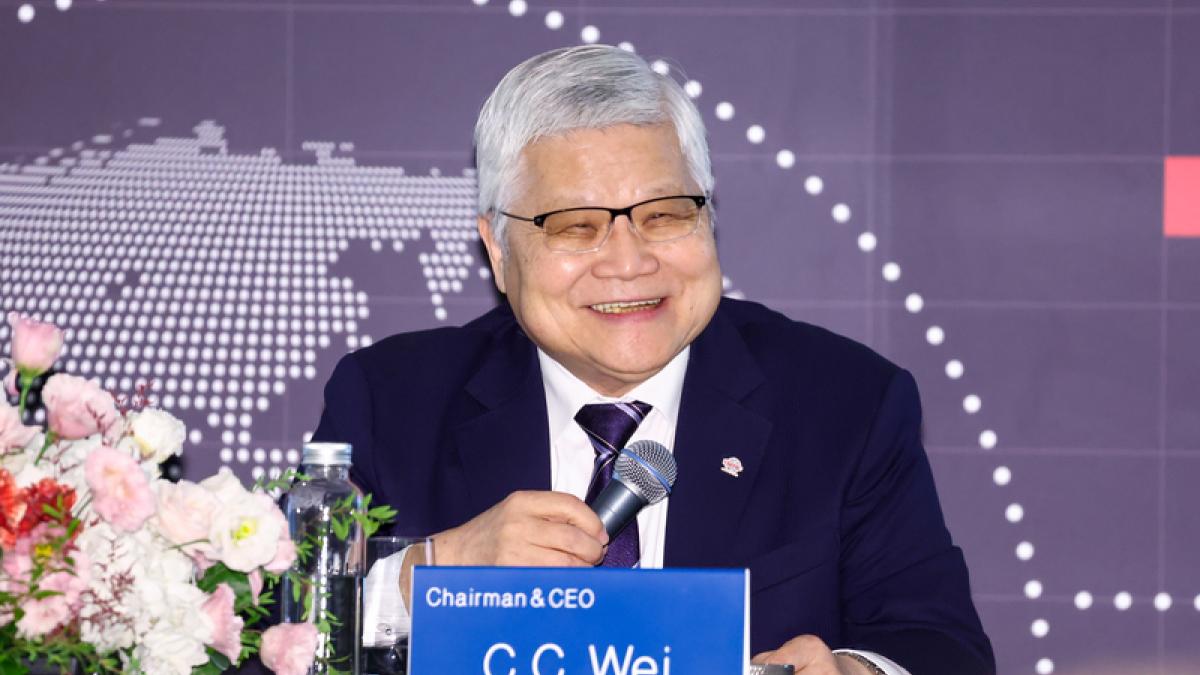
On July 16, TSMC Chairman Mark Liu announced an additional $100 billion (approximately NT$3.2 trillion) investment in Arizona, to build multiple 2-nanometer and more advanced process wafer fabs, while pledging continued investment in Taiwan. This marks the second expansion since TSMC's initial Arizona plant announcement in May 2020, bringing its total U.S. investment to $265 billion (about NT$8.5 trillion), a new record high.
Shih Jun-ji noted that TSMC is now facing an unprecedented structural dilemma: as its production scale in Arizona expands, the same TSMC chip will come in two versions—'Made in Taiwan' and 'Made in USA.' For customers, these two versions are nearly identical in technical specifications, but fundamentally different in risk profile.
Shih explained that when customers place orders with Taiwan-based factories, the lead time from order to chip delivery often exceeds one year. During this period, customers must bear a real uncertainty: if cross-strait tensions worsen, can TSMC deliver chips from Taiwan on schedule? In the past, when global production was concentrated in Taiwan, this was a systemic risk shared by all, with no comparative benchmark.
But with TSMC establishing a U.S. plant, the situation has fundamentally changed. For customers, U.S.-made TSMC chips are almost 'risk-free'—the U.S. won't face a Taiwan Strait-style geopolitical conflict, and supply certainty is nearly 100%. This creates a pricing gap between two products from the same company, akin to the difference between 'corporate bonds' and 'government bonds' in financial markets.
"It's as if Taiwan-made TSMC chips are corporate bonds, and U.S.-made TSMC chips are U.S. Treasury bonds," Shih said. "The market always demands a risk premium between risky corporate bonds and risk-free government bonds. This means Taiwan-made chips may have to be discounted, while U.S.-made chips can command higher prices."
This 'left-hand vs right-hand' dilemma is further complicated by Intel's full-scale revival. Shih noted that the U.S. government has converted its promised $9 billion in subsidies to Intel into direct equity, taking about a 10% stake and becoming its largest single shareholder. This move transforms Intel from a pure market competitor into a strategically backed 'U.S. national team' player.
Meanwhile, NVIDIA CEO Jensen Huang announced a $5 billion investment in Intel, and Apple is reportedly gradually shifting some chip orders back to U.S. domestic manufacturing. Under Intel's new CEO, Lip-Bu Tan, the company—once seen as technologically lagging—is now being propelled forward by unprecedented support from the U.S. government and major tech giants.
Japan's Rapidus, meanwhile, aims to challenge TSMC with price competition. Shih pointed out that Rapidus once claimed it could enter the advanced wafer market at over $20,000, compared to the market price of around $30,000. However, its follow-up capacity, second factory, and mass production capability remain uncertain—so much so that jokes about 'building the second plant on Mars' reflect widespread skepticism about its funding and scale.
Shih believes TSMC still leads in advanced processes, yield, mass production experience, and capacity scale, and its competitiveness should not be dismissed. The real concern is that chip pricing is no longer just about comparing technology and cost, but now includes geopolitical and national security factors. TSMC's greatest challenge may not be being overtaken technologically, but avoiding self-competition across global sites, where its Taiwan plants bear the 'war discount.'
FACT BOX
- Source: PR Times
- Category: News
- Organizations: Intel / Rapidus