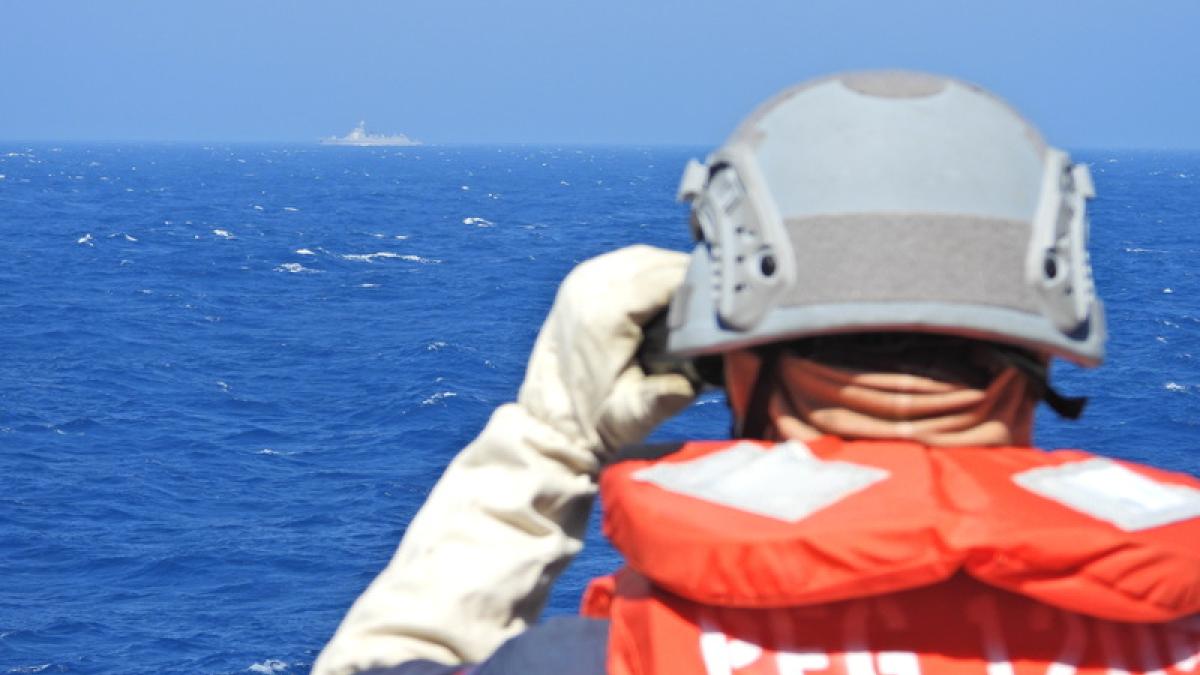
In recent years, China has continuously conducted harassment operations around Taiwan's surrounding waters. Facing an increasingly severe maritime environment, Taiwan's Ministry of National Defense (MND) and Coast Guard Administration (CGA) are advancing the establishment of a 'Military-Civil Common Operational Picture' (Common Operational Picture, COP). The goal is to integrate military and coast guard intelligence, surveillance, and reconnaissance (ISR) information, enabling real-time sharing of air and maritime domain dynamics.
However, to what extent are the MND and CGA sharing intelligence, and how is their communication mechanism structured? According to the latest documents submitted by the MND to the Legislative Yuan, in addition to situational awareness via the COP, the military also uses telephone notifications to alert the CGA and enable preemptive response preparations.
Defense Minister Ku Li-hsiung recently stated in the Legislative Yuan that in response to the常态化 patrol of Chinese vessels within Taiwan's waters, as well as China's ongoing military expansion and gray-zone coercion, the military has been able to respond in a measured, orderly, and controlled manner in coordination with the Coast Guard Administration, ensuring national security and regional stability.
Regarding real-time intelligence sharing: How is information communicated between the two agencies? Is radar imagery being jointly accessed? Can the Coast Guard view the military’s joint operational picture in real time? And can the military instantly access sensor data from CGA vessels?
According to the latest documents submitted by the MND to the Legislative Yuan, the military and CGA have established a bilateral intelligence-sharing mechanism through their surveillance and reconnaissance systems, jointly monitoring the movements of targets in Taiwan’s surrounding waters (including outer and offshore islands).
Furthermore, the MND stated that for Chinese vessels of special concern—such as Chinese coast guard ships, research vessels, and flag-of-convenience ships—or any abnormal activities potentially entering Taiwan’s surrounding waters, in addition to monitoring via the COP, the military also uses telephone calls to notify the CGA to prepare response measures in advance.
Regarding command authority when facing gray-zone harassment by Chinese government vessels: Does each vessel type have a different Rules of Engagement (ROE)?
According to documents submitted by the CGA to the Legislative Yuan, to effectively respond to the常态化 activities of Chinese government vessels and warships (including aircraft carrier strike groups) around Taiwan’s waters, the CGA follows the principles and relevant regulations outlined in the 'Comprehensive Maritime Mission Support Agreement' signed with the Navy. The CGA takes the lead in responding to Chinese government and civilian vessels, while the Navy handles Chinese warships (including carrier strike groups). When necessary, both sides provide mutual support and coordination upon request.
FACT BOX
- Source: PR Times
- Category: News