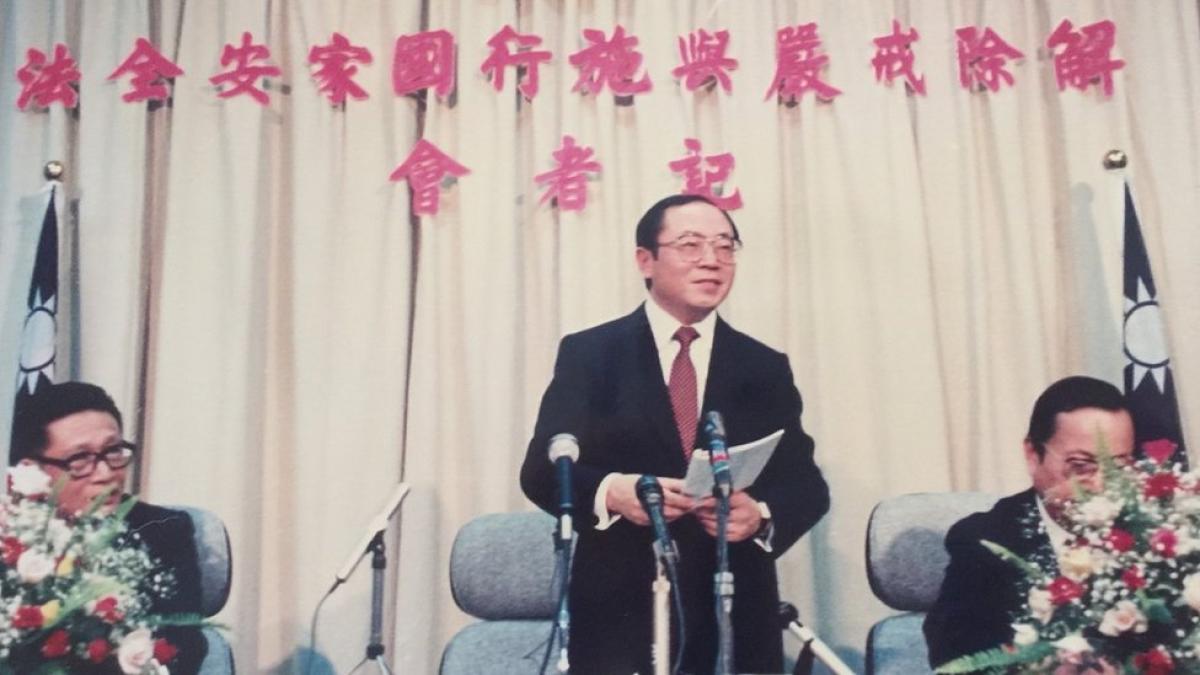
July 15 this year marks the 39th anniversary since martial law was lifted in Taiwan. Time has passed quickly—39 years have already gone by, surpassing the original duration of martial law by one year. Looking back 39 years, when the ruling Kuomintang (KMT) announced the lifting of martial law, I, a former political prisoner imprisoned on Green Island by the KMT, felt an immense sense of relief.
Lifting martial law meant the state would return to constitutional governance. From then on, freedom of speech and thought would be protected. Ordinary citizens would no longer be imprisoned simply for uttering words the authorities disliked. Especially for someone like me with a political criminal record, I no longer had to live in constant fear and anxiety.
Lifting martial law meant Taiwan would bid farewell to the KMT's white terror rule and enter a democratic society governed by law. From then on, no one would be subjected to torture for forced confessions, and no more mothers would 'cry through the long nights for their children imprisoned on this island' (as inscribed on the Pai Yang Weeping Monument on Green Island).
Lifting martial law meant freedom to form political parties. There would no longer be tragedies like Lei Chen, who was imprisoned for attempting to form a party. Idealistic individuals could now freely organize and realize their grand ambitions to transform society.
Lifting martial law gave people infinite imagination and boundless hope! From that moment, countless new social forces surged across Taiwan, challenging the undemocratic laws and systems of the martial law era. These forces included movements by the emerging local bourgeoisie, the working class, and farmers. Accompanying these movements, ideologies such as liberalism and socialism became active in Taiwan's intellectual circles. Ultimately, through the continuous impact of these new forces, the KMT's authoritarian regime was thoroughly dismantled, and Taiwan established an American-style two-party democratic political system. The people of Taiwan truly began living without fear, and the shadow of white terror seemed to have vanished.
However, as time has passed to the present day, the shadow of white terror appears to be returning. Two key characteristics of the KMT's past white terror seem to be quietly reappearing in today's Taiwan:
First, establishing 'anti-communism' as a fundamental national policy and enacting various laws to persecute and imprison anyone who opposes this policy.
Second, controlling the judiciary and using judicial and intelligence agencies to target opposition forces, fabricating charges against them.
These two characteristics are now quietly resurfacing in Taiwan. Cases such as Ko Wen-je, Tsai Cheng-yuan, Kao Chin Su-mei, the mainland spouse Ya Ya, Taitung County Magistrate Yau Ching-ling's pineapple guava case, online bullying by 'Blue Bird' and 'Black Bear,' and the enactment of the 'Five National Security Laws' and the Anti-Infiltration Act—all these signal that a new form of white terror is quietly descending upon Taiwan. People's inner peace is gone, and an unnamed fear is spreading across society. Some call it 'green terror.'
Why is this happening?
The essence of white terror lies in social class inequality. When the oppressed class rises up, the ruling class responds with repression—this is how white terror emerges. The French government's bloody suppression of the 'Paris Commune' in 1871, the KMT's brutal crackdowns across mainland China, and Taiwan's 38-year-long martial law—all are classic examples of white terror, driven fundamentally by the intensification of class conflict arising from class inequality.
Since Taiwan established a Western-style democratic political system, this democracy has been dominated by the KMT's bureaucratic bourgeoisie and the DPP's local bourgeoisie. These two bourgeois parties have largely ignored the needs of the lower classes in their policymaking, focusing instead on their own class interests. As a result, despite GDP growing year after year over the past three decades since democratization, wages for salaried workers have stagnated for 30 years. Generational low wages have left young people unable to afford homes or get married. The accumulated grievances of the lower classes have become the root cause of Taiwan's political and social instability since the 2014 'Sunflower Movement.'
In the decade since the 'Sunflower Movement,' this public discontent has shifted erratically between the two major parties, finally settling on the Taiwan People's Party in 2024. This has led to a three-party political standoff and a minority government led by the DPP.
This three-party standoff signifies the emergence of a new class conflict in Taiwan. The DPP's minority rule reflects the decline of Taiwan's local bourgeois power. Facing governance challenges, the weakening DPP has not engaged in self-reflection, addressed internal corruption, or sought to regain public support. Instead, it has adopted fascist-like policies, imposing white terror-style repression on opposition forces. This is the origin of the new white terror in Taiwan today.
This new white terror has further intensified cross-strait relations and deepened political polarization between ruling and opposition parties. This is the current predicament facing Taiwan.
*Author is a political prisoner from the 1970s
FACT BOX
- Source: PR Times
- Category: News