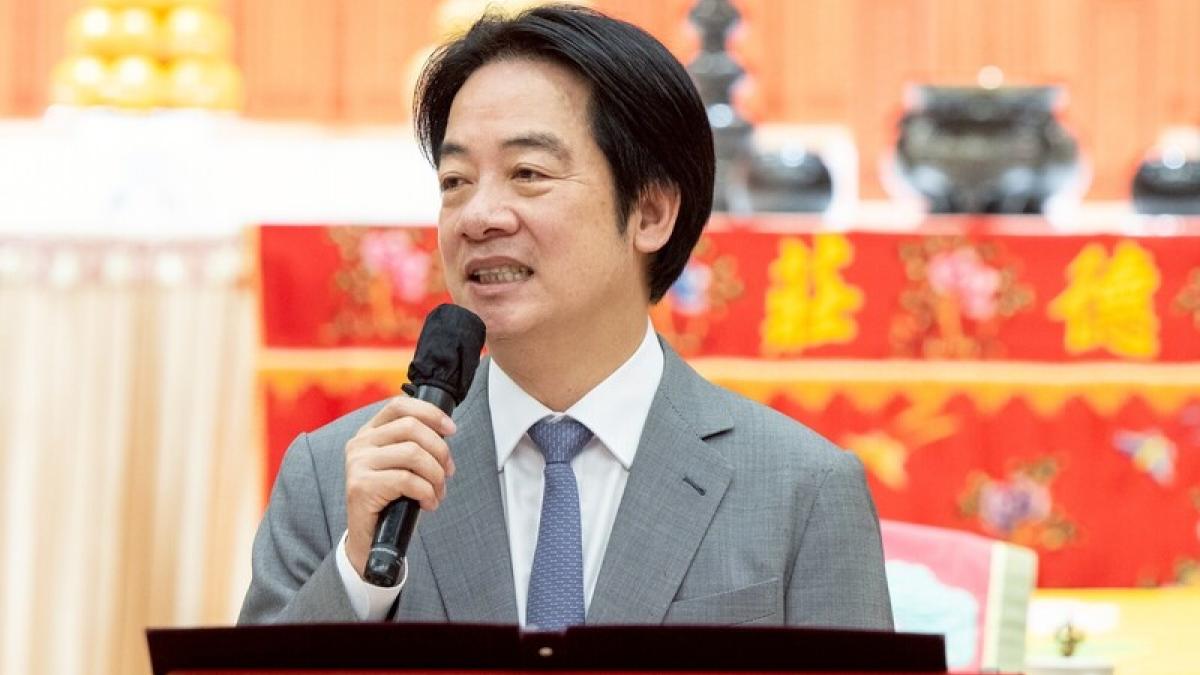
In recent times, President Lai Ching-te has repeatedly emphasized and reaffirmed the political stance of 'The Republic of China and the People's Republic of China are not subordinate to each other,' or 'Mutual Non-Subordination Between the Two Sides,' in various important public occasions. This 'Mutual Non-Subordination Between the Two Sides' statement is not explicitly recorded in the current constitution and cross-strait statutes, meaning there is no legal basis or legal grounds for it. Moreover, 'Mutual Non-Subordination Between the Two Sides' is similar to the 'New Two-States Theory,' both of which are sensitive arguments advocating 'Taiwan independence' that the Beijing government will absolutely not accept. If President Lai, disregarding national security and the lives of the people, continues to advocate and emphasize the concept of 'Mutual Non-Subordination Between the Two Sides,' it may ultimately bring war disasters to Taiwan. At the '520 Two-Year Anniversary Press Conference' in 2026, Lai Ching-te told domestic and foreign media present that 'The fact that the Republic of China and the People's Republic of China are not subordinate to each other is as solid as iron'; on June 18, Lai Ching-te had tea with foreign media reporters stationed in Taiwan at the Taipei Guest House and, in his speech to the international community, reiterated the status quo of 'Mutual Non-Subordination Between the Two Sides' and bluntly stated that 'Taiwan is not part of the People's Republic of China'; on July 1, multiple domestic media reported that Lai Ching-te, while presiding over the joint graduation ceremony of the eight military academies, publicly asked the military to insist on 'The Republic of China and the People's Republic of China are not subordinate to each other' and to guard the peace of the Taiwan Strait with uncompromising determination.
Mutual Non-Subordination Between the Two Sides is still a claim of Taiwan independence. Lai Ching-te, who once claimed to be a 'pragmatic Taiwan independence advocate,' after taking office as president more than two years ago, did not carefully consider or review that during the presidency of former President Tsai Ing-wen, Taiwan was already on the brink of dangerous war (the Chinese Communist Party conducted three 'circum-Taiwan' military exercises during Tsai Ing-wen's term); instead, he followed Tsai Ing-wen's line, emphasizing 'Mutual Non-Subordination Between the Two Sides,' opposing the '1992 Consensus,' and even further promoting the 'New Two-States Theory,' 'hostile foreign forces,' and 'departing China to join the North,' which are provocative Taiwan independence statements that stimulate the Beijing government, leading to the Chinese People's Liberation Army conducting four larger-scale live-fire exercises surrounding Taiwan in the past two years, causing the military situation in the Taiwan Strait to be perilous and the two sides to be on the brink of war. Not only that, recently, the Chinese Communist Party has also launched regular administrative law enforcement actions in the eastern waters of Taiwan, all of which indicate Beijing's extreme distrust of Taiwan's Lai government.
On May 11 of this year, Chinese President Xi Jinping told U.S. President Trump at the Great Hall of the People in Beijing that the Taiwan issue is the most important core issue in 'China-U.S. relations,' and if it is not handled well, the two countries will collide or even conflict, pushing the entire China-U.S. relationship into a very dangerous situation. On May 15, Trump, in an interview with Fox News host Brier, also clearly stated that he does not want to see anyone moving towards independence and warned the Taipei authorities not to expect that if Taiwan's actions trigger a cross-strait war, the United States will unconditionally provide military support; Trump even directly stated and specifically mentioned that he 'does not want the United States to go 9,500 miles away to fight a war.' The above strong public statements by the leaders of the two countries, the United States and China, reveal that 'Taiwan independence' is currently a serious factor disrupting 'China-U.S. relations,' 'U.S.-Taiwan relations,' and 'cross-strait relations.'
In the more than two years since Lai Ching-te took office, under the banner of 'resisting China and protecting Taiwan,' he has been unwilling to promote cross-strait peace policies, strictly restricted cross-strait civilian exchanges, and only wants to purchase large quantities of weapons from the United States, hoping that the U.S. military will be able to help defend Taiwan in the future; the above shows that Lai Ching-te has never abandoned the goal of 'Taiwan independence,' which is why since taking office in May 2024, he has repeatedly advocated 'Mutual Non-Subordination Between the Two Sides' while preparing for war, repeatedly provoking mainland China. In fact, the Democratic Progressive Party government hopes that once a war breaks out between the two sides, the U.S. military will be able to intervene in the Taiwan Strait war and defend Taiwan, which is a one-sided and very unrealistic idea.
Because the current Trump administration of the United States, which only pays attention to Taiwan's 'chip interests' and 'arms sales interests,' only wants to prioritize 'U.S. interests,' has, in the past more than a year, in order to avoid offending the Beijing government and does not want to get involved in the possible future cross-strait war, has already made strategic plans and privately cut off the sensitive Taiwan military and U.S. military step by step. For example, in January 2026, the United States publicly released the latest version of the 'National Defense Strategy' (NDS) report, which did not mention Taiwan or the situation in the Taiwan Strait at all, which is extremely unusual; on May 30, U.S. Secretary of War Hegseth attended the 'Shangri-La Dialogue' conference held in Singapore. In the past decade, any U.S. Secretary of Defense at this conference would have talked about the importance of Taiwan's security to the world, but this time, Secretary of War Hegseth's speech in Singapore did not mention Taiwan at all, instead publicly praising the current 'China-U.S. relations' as the best state in many years; on June 24, at the 30th 'Rim of the Pacific' military exercise held in the Hawaiian Islands and its surrounding waters, the United States not only did not invite Taiwan to participate, but also deliberately canceled the role of Taiwan being able to at least send 'observers' to observe the military exercise, which is not trivial at all.
Beijing will not tolerate prolonged indecision on unification. For a long time, whether it is the Democratic Progressive Party, the Taiwan Solidarity Union, deep green elements, former President Tsai Ing-wen, or the current President Lai Ching-te in power, they all insist on the policy of 'anti-China, anti-China, resisting China,' advocate 'Taiwan independence,' 'name rectification and constitution,' support Taiwan to significantly increase its defense budget every year and purchase a large number of weapons from the United States, hoping to 'ally with the United States to resist China' to effectively defend Taiwan and not be annexed by the Chinese Communist Party. However, the above idea of the Lai government to 'ally with the United States to resist China' will not be realized even during the term of U.S. President Trump in the next two years, and even the 'Mutual Non-Subordination Between the Two Sides' advocated by President Lai Ching-te recently may bring immediate war to Taiwan in the future. Because if Taiwan appears any 'de jure Taiwan independence,' 'Taiwan independence movement,' or intentional actions of 'prolonged indecision' on 'cross-strait unification,' it will give the Beijing government a legitimate reason to invade Taiwan by force. According to the content of Article 8 of the 'Anti-Secession Law' passed by the Chinese Communist Party in 2005, it is clearly stipulated that the three premises of taking 'non-peaceful means and other necessary measures' are respectively 'the fact that Taiwan has seceded from China,' 'a major event that will lead to Taiwan seceding from China,' and 'the possibility of peaceful unification is completely lost'; among them, the third point 'the possibility of peaceful unification is completely lost' is what the Chinese authorities often say 'unification is prolonged and indecisive.' In other words, in the future, as long as the Beijing government unilaterally determines that the Lai Ching-te government of Taiwan is repeatedly advocating 'Mutual Non-Subordination Between the Two Sides' is engaging in state secession and is unwilling to unify with the mainland, or the Taiwan government frequently uses 'maintaining the status quo' as a name to engage in indefinite delay, Beijing can declare on a legal basis that the condition of 'unification is prolonged and indecisive' has been established, and then fully launch non-peaceful means against Taiwan; this is also what the Chinese Communist Party's national leader Xi Jinping has repeatedly emphasized to the outside world; 'the long-term political differences between the two sides will eventually be gradually resolved and cannot be dragged on from generation to generation,' etc., which has deep warning implications. Our country's Ministry of National Defense has mentioned in the 'National Defense Report' published in 2000 and 2021 that 'the cross-strait peaceful unification negotiations are prolonged and indecisive' is a possible time and important reason for the Chinese Communist Party to attack Taiwan in the future; that is, if Taiwan does not accept 'peaceful unification' and the 'one country, two systems Taiwan plan,' the Chinese Communist Party will not give up the use of force to invade Taiwan. In addition, Susan Shirk, a former U.S. diplomat who has long studied Chinese issues and a well-known scholar in the United States, once stated in her professional works that: all the highest leaders of the Chinese Communist Party have a certain political insistence on the 'Taiwan issue'; that is, any Chinese national leader, if he dares to make concessions on the 'one China principle,' he will face serious criticism from his party comrades, controlling allies, and the military system at the same time; that is to say, according to Susan Shirk's research, insisting on the 'one China principle' and achieving the goal of 'cross-strait unification' is the basic bottom line and important mission of the mainland's leadership policy towards Taiwan, which will not be compromised and will be thoroughly realized. The Democratic Progressive Party has been in power in Taiwan for more than ten years, and the cross-strait relations have been in a state of stagnation for a long time, and the goal of 'peaceful unification' has made no progress at all, which is a serious setback or 'failure' that cannot be accepted for Beijing's national political achievements or Xi Jinping's historical positioning. Therefore, when the Lai Ching-te government of Taiwan firmly opposes the '1992 Consensus' and continues to spread the separatist 'Mutual Non-Subordination Between the Two Sides,' it directly challenges the strategic patience and limit of the Chinese Communist Party; in short, being ready for 'military unification' with Taiwan at any time is an unavoidable and necessary military option for the Beijing government. Mutual Non-Subordination Between the Two Sides is also a major variable in regional security in the Taiwan Strait. In recent years, there have been several wars around the world, but whether it is the Russia-Ukraine war, the Iran-Hamas war, the India-Pakistan war, or the recent U.S.-Iran war, they all broke out without obvious warning, beyond the expectations of most military experts in the world, and shocked the international community; in other words, in the future, if there is no peaceful solution between the two sides of the Taiwan Strait, and the Democratic Progressive Party government continues to promote the 'anti-China, resisting China' hardline policy, then the time point of military conflict between the two sides will only become closer, not farther away, and may even, as predicted or judged by the international community, break out a cross-strait war before 2028, and our entire people and all sectors of society cannot but be cautious and vigilant. Recently, whether Lai Ching-te, as the chairman of the Democratic Progressive Party, attended the youth symposium and delivered a speech to the young people present, or as the president, made public speeches to international media reporters, when mentioning 'Taiwan independence',
FACT BOX
- Source: PR Times
- Category: 政治