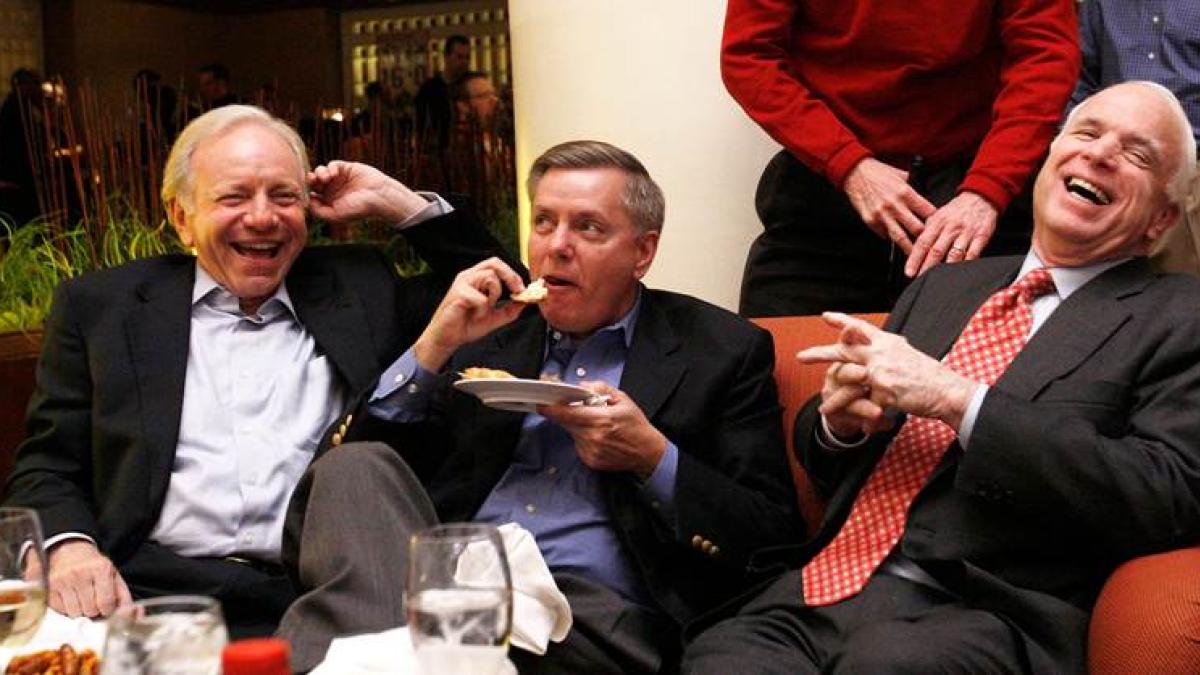
Washington's Capitol Hill is never short of alliances, but desperately lacks friendship. Every handshake has a price, every photo-op has a district, and every 'my dear friend' is backed by consultants and cameras. Yet John S. McCain III, Joe Lieberman, and Lindsey Graham maintained a bond across party lines, faiths, and regions in this city where loyalty is converted into political currency. They were known as the 'Three Amigos'—or, in Taiwanese street humor, the 'French Fry Brothers': golden on the outside, spicy in speech, foreign policy salty and sharp, yet unforgettable in aftertaste.
McCain passed away in 2018, Lieberman in 2024, and Graham suddenly in July 2026. Graham had just returned from Kyiv, still advocating for sanctions on Russia and air defense aid for Ukraine. Medical reports confirmed aortic dissection as the cause, with no evidence of foreign assassination. With the last of the 'Three Amigos' gone, a legendary era spanning 9/11, the Iraq War, and the Trump years has come to a close.
But legends are not only about people. With their departure, so ends America’s waning confidence in leading the world through war, partisan strife, and populist waves.
McCain, Graham, Lieberman (AP)
Petraeus Gave the Friendship a Name
McCain and Lieberman first met in the Senate in the late 1980s; Graham joined in 2003. After 9/11, the trio became a regular delegation to Iraq and Afghanistan, staunch supporters of Bush’s troop surge strategy.
During one warzone visit, General David Petraeus, then a four-star U.S. Army general, saw the three together again and jokingly called them the 'Three Amigos.' Lieberman recalled Petraeus saying, 'Here come the Three Amigos again—welcome!' He later posed for a photo with the senators, inscribing it 'To the three amigos.' A military joke from the battlefield became the historical name for a bipartisan friendship on Capitol Hill.
In truth, Petraeus only named the bond. What nurtured it was shared flights, risks, and time. Lieberman said you truly get to know colleagues not through votes, but through long debates on planes. Speeches can be polished, votes calculated, but few can keep pretending to be someone else under the risk of death.
Soul, Conscience, and Fire
McCain, born into a military family and a Vietnam War POW, was the moral core. He believed honor mattered more than victory, and that American power without moral ideals was mere imperialism. Lieberman, once a Democratic vice-presidential candidate and later an independent senator, was like a silent anchor in a storm.
Among the three, Graham was the fire—quick, sharp, witty, and deeply aware of how power works. He could fiercely attack opponents on camera, then negotiate with them in private, or revive a dying bill. If McCain was the soul, Lieberman the conscience, Graham was the fire. Despite differing parties and beliefs, they became close friends. Lieberman called it 'very American'—not everyone must be the same; differences need not be betrayal.
An Unofficial Foreign Ministry
The 'Three Amigos' were more than travel companions—they were an unofficial, unbranded foreign ministry that penetrated the White House, Pentagon, and allied capitals. McCain provided moral authority, Lieberman cross-party legitimacy, and Graham access to power. They traveled as lawmakers, negotiated as friends, and used congressional power to fund their beliefs. Their footprints spanned Iraq, Afghanistan, Georgia, Ukraine, Israel, and the Middle East—nearly mapping post-Cold War American interventionism.
Yet when private trust rapidly becomes public power, it can bypass bureaucratic inertia but also necessary caution. They saw the cowardice of isolationism but not always the arrogance of interventionism. They understood the sin of inaction, yet sometimes underestimated the sin of entering others’ histories with good intentions.
Taiwan: The Frontline of Vigilance
Taiwan was not a mere stopover but a litmus test of their internationalist beliefs.
McCain long advocated that the U.S. provide defensive weapons under the Taiwan Relations Act, refusing to sacrifice Taiwan’s security for Beijing’s cooperation. In 2015, he urged the Obama administration not to delay arms sales; in 2016, he led a delegation to Taiwan as Senate Armed Services Committee chairman.
Lieberman fought for Taiwan’s international identity and economic space. He supported Taiwan’s UN participation as early as 1992, joined the Senate Taiwan Caucus, and advocated for a U.S.-Taiwan free trade agreement.
Graham pursued security institutionalization. After Russia’s full-scale invasion of Ukraine in 2022, he led a bipartisan delegation to Taiwan. That same year, he co-sponsored the Taiwan Policy Act with Democratic Senator Robert Menendez, aiming to expand security aid, military cooperation, and sanctions tools. Though the bill didn’t pass in original form, it gained 17–5 support in the Senate Foreign Relations Committee.
Each had a focus: McCain on arms sales and deterrence, Lieberman on international dignity and economic normalization, Graham on elevating Taiwan’s security as a structural pillar of Indo-Pacific strategy. Their real impact wasn’t a single visit or weapons deal, but transforming 'support for Taiwan' from an executive option into a bipartisan congressional habit.
But friends are not insurance companies. Viewing the U.S. as a permanent policy is a weak nation’s dangerous romance. Converting U.S. support into defense reform, social resilience, and political consensus is Taiwan’s true coming of age.
The Light and Shadow of Internationalism
Their shared belief could be called 'armed internationalism': American security cannot be defended at borders; allies’ fates are tied to national interests; dictators who face no cost mistake restraint for weakness; diplomacy, alliances, sanctions, and military force when necessary are tools to maintain order.
This belief drove U.S. intervention in Bosnia, strengthened NATO’s eastern flank, and made them early warners of Russian threats. Taiwan received their long-term support because they saw the Taiwan Strait not as a local conflict, but as the frontline of whether democratic order can withstand authoritarian expansion.
Yet the same ideology led America into the long nights of Iraq and Afghanistan. They believed evil cannot vanish by prayer alone—perhaps not wrong. But they sometimes wrongly believed American missiles could build democracy for others. Baghdad didn’t become free with Saddam’s fall; Kabul didn’t escape the Taliban after two decades of war.
This is the deepest historical paradox in their legacy: they saw the cost of retreat but underestimated the cost of overconfidence; they embodied the courage of internationalism, yet bore its arrogance. Mature history doesn’t rush to create saints or hastily judge; it illuminates both courage and blind spots, and records the unintended ruins created by good intentions.
Graham, McCain, Lieberman (Getty Images)
After the Legend
Yet their political paths diverged in later years. McCain publicly broke with Trump; Lieberman, after leaving the Senate, tried to preserve space for centrist dialogue; Graham shifted from Trump’s sharpest critic to a reliable ally. McCain chose dignity outside power; Graham chose to stay beside power, bearing its stains. The former was like a monument, the latter like a bridge—monuments stay clean, but bridges must endure mud, weight, and the trampling of traffic.
Yet their personal friendship never broke. They proved friendship isn’t endless agreement, but the refusal to deny the other’s goodwill and character even when you disagree.
McCain’s deepest lesson to his two friends may not have been how to win wars, but how to accept defeat. On the night of his 2008 presidential loss, he acknowledged Obama would become America’s president—and his president. He didn’t rewrite personal failure as a national conspiracy, because he believed democracy must go on. Grace isn’t pretending not to hurt, but refusing to make your wound someone else’s disaster in the moment of greatest pain.
Duke Jing of Qi climbed Niushan Mountain, gazed at the land, and wept, lamenting he could not hold it forever. Yanzi laughed: 'If Duke Tai and Duke Huan could hold it forever, how could it have come to you today?' The deepest illusion of power is mistaking the temporary for the permanent. The greatest grace in life is knowing every seat is borrowed, and every round of applause has its end.
FACT BOX
- Source: PR Times
- Category: News