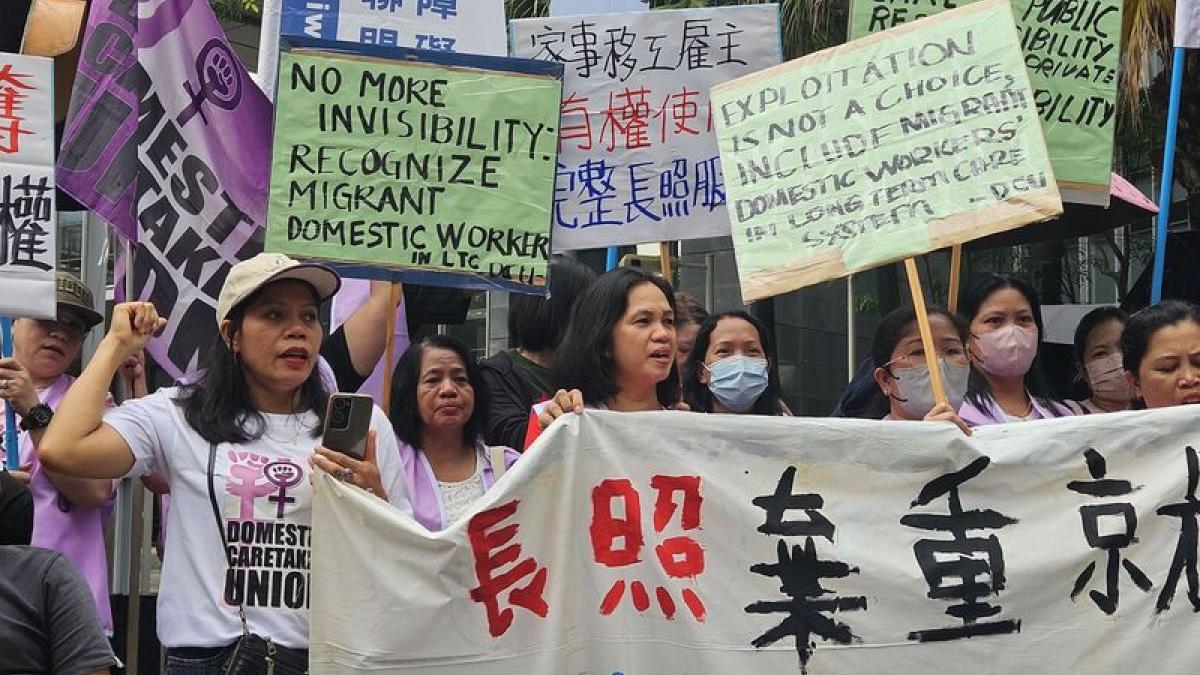
In recent years, Taiwan has frequently debated a troubling phenomenon: is the quality of foreign caregivers declining? Some blame the labor quality of specific source countries, others criticize lax screening by agencies, while some argue these are merely isolated cases. However, if we remain trapped in moral accusations or individual disputes, we will never see the full picture.
This is not a commentary based on abstract theory, but rather the empirical observation accumulated by the author over 35 years in the migrant worker recruitment business, including personally establishing a training center in Indonesia over two decades ago, serving more than 6,000 Taiwanese families and handling countless migrant worker cases.
What we encounter daily are not just foreign workers, but countless employer families struggling under caregiving pressure, healthcare systems, and insurance companies. When the sample size is large enough and the time span long enough, what emerges is not 'individual cases,' but a structural shift in proportions.
The author believes that the core reason for the current quality crisis in Taiwan's foreign caregiver market lies in policy changes that have unknowingly distorted market incentives, thereby altering market behavior. This is a classic case of a 'well-intentioned policy leading to unintended consequences'—a systemic tragedy.
1. The Self-Regulating Mechanism of the Past 'Three-Year Revolving Door'
Looking back over two decades ago, Taiwan was the most desired destination for Asian migrant workers. At that time, Taiwan offered higher wages and better benefits. To compete for this market, training centers in source countries invested heavily to send their best-qualified workers to Taiwan.
Back then, after being recruited from rural areas into training centers, workers had to undergo intensive training for at least three to six months. Every aspect—from basic Chinese, self-introductions, living habits, caregiving skills, work attitude, to health status—was repeatedly evaluated.
The underlying logic was simple: 'The cost of front-end screening failure must be borne by the source country agencies.'
Under the rule that workers 'must leave Taiwan for at least one day upon completing three years' (commonly known as the 'revolving door clause'), if a worker was repatriated due to inadequate skills, poor adaptation, or failing medical exams, or if the employer chose not to renew after three years, the overseas training center would lose all its prior investment in training and cross-border administrative costs. To minimize their business risk, 'strict screening and precise selection' became the most rational business choice for agencies.
2. The Fatal Regulatory Shift: Amendment to Article 52 of the Employment Services Act, Severing Commercial Incentives
However, this long-standing market equilibrium was completely shattered nine years ago.
At the time, human rights groups led the discourse, arguing that the requirement for migrant workers to leave Taiwan for one day every three years forced them to pay 'toll fees' to overseas agencies upon each return. Under strong moral pressure, the Taiwanese government passed the amendment to Article 52 of the Employment Services Act, eliminating the mandatory departure requirement and allowing workers to renew contracts directly in Taiwan.
This seemingly immediate and well-intentioned reform has, ten years later, fully revealed its massive side effects, directly triggering a vicious cycle of 'bad money driving out good':
1. The Good Can't Come In
For overseas agencies, when workers no longer need to return home and can be indefinitely renewed in Taiwan, the opportunity for 're-evaluation and re-deployment' every three years disappears. Under profit-maximization logic, the rational choice for overseas agencies is to prioritize sending their best, most obedient, and highest-quality workers to markets like Singapore, Hong Kong, and Japan, which still require returning home for re-deployment, while 'dumping' lower-tier or even inexperienced newcomers into Taiwan.
2. The Bad Can't Leave
The past 'three-year mandatory departure' acted as a natural market filter, allowing underperforming, disobedient, or health-compromised workers to be smoothly eliminated upon contract expiration. After the amendment abolished the departure requirement, this filtering mechanism vanished. Workers who have mastered Taiwan's legal loopholes now exploit labor laws favoring workers to remain in Taiwan, leaving employers in the difficult position of 'easy to hire, hard to dismiss.'
3. Mid-Level Policy Adds Fuel to the Fire: From 'Skilled Caregivers' to 'Clever Absconders'
To make matters worse, Taiwan later introduced the 'Mid-Level Foreign Technical Talent' policy, allowing migrant workers who have completed six years of work to stay indefinitely.
Migrant workers are living human beings, not machines. After six, nine, or even more years in Taiwan, they have become highly 'socialized.' They are no longer the naive, obedient laborers they were upon arrival, but individuals who fully understand Taiwan's legal loopholes, have mastered underground channels, and recognize the government's weak enforcement.
When these 'well-informed' veteran workers realize that illegal work in the underground market can earn them several times more, and that being caught typically only results in repatriation, their likelihood of taking risks and collectively absconding skyrockets. This is the structural reason behind the recent record-breaking rise in absconded migrant workers in Taiwan, surpassing 89,000—the very workers we kept with good intentions have become waves of 'black-market deserters' who know the legal loopholes inside out.
4. The Transformation of Labor Contracts: Employers Bearing 'Unlimited Liability'
With the front-end screening incentives severed and the back-end elimination mechanisms失效, Taiwanese employers are forced to pay the real price in their living rooms and hospital wards. This is not mere speculation, but a reflection of real shifts in frontline case patterns.
In the past, sudden incidents involving migrant workers in Taiwan were mostly work-related accidents, so accident insurance was sufficient. However, in recent years, among the cases we handle, the proportion of workers requiring massive medical treatment or even dying in Taiwan due to 'major illnesses' has increased alarmingly compared to the past.
This has forced many agencies in recent years to advise employers to go beyond basic accident insurance and plan for more comprehensive medical and life coverage for migrant workers.
Conclusion: Rebuilding a Balanced Migrant Worker System with Rationality and Evidence
Protecting migrant workers' rights is an undeniable responsibility of a civilized society. However, truly progressive policies should not pursue a single value of 'human rights protection' while ignoring the reality that markets will inevitably adjust their behavior according to institutional incentives.
When front-end quality management responsibility is diluted, mid-level elimination mechanisms are crippled, and back-end medical, caregiving, insurance, and management costs continue to rise, the heavy burden ultimately falls not on policymakers in offices or human rights advocates, but on countless exhausted long-term care families and the entire social welfare system.
The author deeply understands that this 35-year, 6,000-family practical observation represents the most authentic cry from the front lines. Yet we also recognize that whether this observation has an absolute causal relationship with the overall market still requires further empirical research by the government, academia, and third-party institutions—using official data (such as annual rates of failed entry medical exams, absconding rates within three years, cross-border medical incident ratios) and cross-national comparisons with countries like Singapore and Japan.
This is not the fault of any individual worker, agency, or employer. What we need is the courage to re-examine the system.
Only by establishing a system that balances 'migrant worker rights, employer protection, talent quality, and market incentives' can we ensure that well-intentioned policies truly yield beneficial outcomes, allowing Taiwan to maintain a safe and healthy social care safety net amid the flood of a super-aged society.
*The author is the Honorary Chairman of the National Federation of Employment Service Business Associations of the Republic of China.
FACT BOX
- Source: PR Times
- Category: Survey