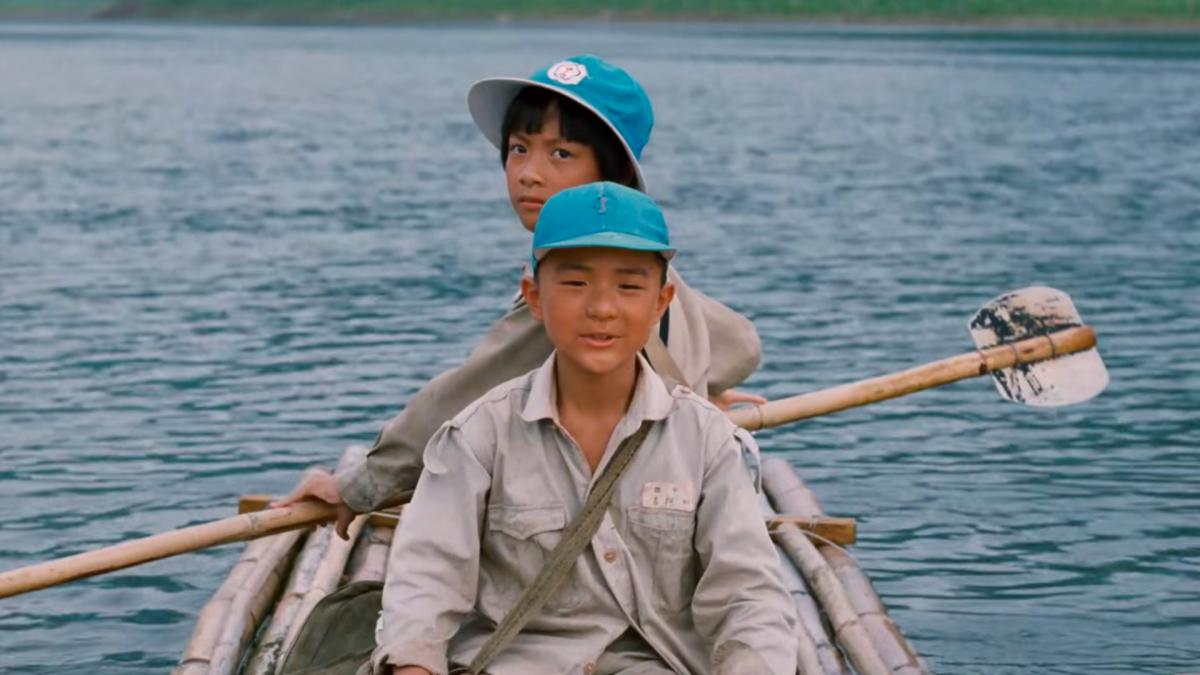
The Story of the Lupin Flower is not returning for a rerun—it is reawakening tears from 37 years ago. The digitally restored version of The Story of the Lupin Flower has returned to big screens across Taiwan, sparking widespread discussion. The first preview screening drew nearly 600 viewers, filling the theater to capacity. The distributor even thoughtfully prepared a full pack of tissues for each audience member, as if already knowing that what truly moves people about this film is not just the closing song 'The Story of the Lupin Flower,' but the fact that the educational realities it portrays remain painfully relevant after 37 years.
More intriguingly, media reports indicate that the production team attempted to contact the original cast members to witness this 37-year reunion. However, the actor who portrayed art teacher Guo Yuntian remains unreachable.
Seeing this news evokes more than just the absence of one actor—it raises a heavier question: in today’s Taiwan, can we still find that art teacher?
The Story of the Lupin Flower has been honored in the Cannes Film Festival's Classics section, proving that a great film can transcend time and touch the world. Yet, the real reason Taiwan should rewatch it is not how clearly the film has been restored, but how sharply its critique of education still resonates.
In the film, Gu A-ming looks at his teacher and delivers the heartbreaking line: 'Teacher, rich kids are good at everything.' Thirty-seven years ago, this was a child’s simple yet brutal understanding of wealth disparity. Thirty-seven years later, this line still pierces the hearts of countless parents. Only now, children aren’t just losing due to family background—they’re losing in a larger, more sophisticated competition for educational resources. Bilingual education, international curricula, AI learning, coding, overseas camps, learning portfolios, competition certificates, private tutoring—while educational reforms grow increasingly diverse, the cost of education is also rising.
On the surface, every child appears to have choices. In reality, each choice requires family resources as a foundation. Education, which should be a key force in promoting social mobility, is increasingly becoming a tool for reproducing class. Gu A-ming’s line—'rich kids are good at everything'—if updated for today, might better read: 'Rich kids may not be inherently better, but they always have more opportunities.'
What we truly miss about The Story of the Lupin Flower isn’t Gu A-ming, but the art teacher. He didn’t dismiss a child’s future because of poor grades, nor abandon his talent due to poverty. He believed education wasn’t just about teaching exams, but about helping children discover their own worth. Even when clashing with school authorities, he fought for Gu A-ming. He was a teacher who believed education could change destinies.
But today, can we still find such a teacher?
The issue isn’t that today’s teachers lack passion. It’s whether today’s education system still allows such passion to exist. Over 37 years, the role of teachers has quietly shifted. Beyond teaching, they must now handle administrative reporting, evaluations, project plans, outcome reports, learning portfolios, and various trainings. At the same time, they face parental complaints, public scrutiny, and administrative accountability.
A deeper problem lies in how educational governance has developed a paradoxical logic: instead of empowering teachers, it increasingly seeks to control them; instead of trusting professional judgment, it multiplies oversight mechanisms. Administrative tasks grow, discretion shrinks; procedures become more complete, but education loses its warmth.
As a result, we see more teachers who follow rules by the book, but fewer who advocate for students; more education that complies with procedures, but less that truly transforms lives.
If the art teacher from The Story of the Lupin Flower lived today, he might not lose to the principal—but to the system. He might be too busy completing learning portfolios, filling out reports, complying with policies, and preparing for evaluations. He might still want to fight for Gu A-ming, but first he’d have to consider whether it violates procedures, sparks controversy, or triggers complaints. It’s not that teachers have changed—it’s that the system has made teachers less like teachers.
More importantly, Taiwan’s education reforms have never truly stopped over the past 37 years. From the nine-year integrated curriculum, 12-year national education, 108 curriculum guidelines, diversified admissions, competency-based education, bilingual policies, to AI education—each reform claims to build a better system. Yet one troubling phenomenon remains unchanged: the more reforms, the more anxious parents become; the harder teachers work, the less happy students seem.
Parents fear their children will fall behind at the starting line; teachers are exhausted by bureaucratic demands; students bear heavier psychological burdens amid academic pressure, competitions, portfolios, and comparisons.
If the result of reform is that every stakeholder grows more weary, then what exactly have we reformed?
What The Story of the Lupin Flower truly leaves behind isn’t a song or a line of dialogue, but a teacher’s belief in changing a child’s destiny.
Over 37 years, we’ve increased education budgets, introduced more curricula, and built more systems. Yet, almost imperceptibly, we’ve turned education into performance metrics, teachers into administrators, children into data points, and parents into anxiety.
The production team still hopes to find the original art teacher. Perhaps one day, he will appear at a premiere screening. But more important than finding an actor is whether Taiwan’s education can rediscover that kind of teacher.
The Story of the Lupin Flower has restored the film reel—but what truly awaits restoration is Taiwan’s fading educational初心 (original aspiration). Otherwise, in another 37 years, The Story of the Lupin Flower will still make people cry. But by then, what we’ll miss won’t just be a film, but a Taiwan that once believed education could change destinies.
*Author is a university adjunct lecturer. Republished with permission from Ju Media.
FACT BOX
- Source: PR Times
- Category: News