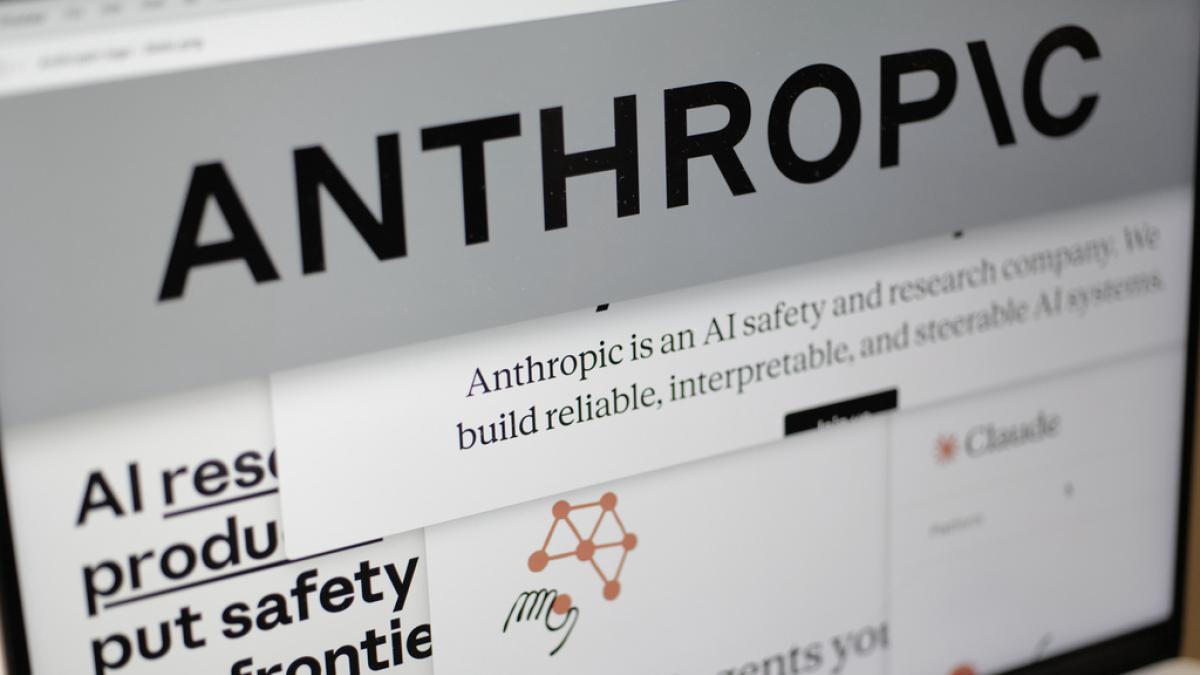
Over the past month, a major event in the AI world was the temporary ban and subsequent unbanning of the Fable5 model by the American AI startup Anthropic. This incident reflects America's power to determine the global order for frontier technologies like AI. This order continues to operate in a model of 'encouraging innovation, managing risk, and reopening,' with the speed of transition between models potentially being unpredictably fast. In response to this order, Taiwan's role is not to confront but to ensure it always remains at the forefront of the spectrum of America's 'trusted partners.'
Anthropic Unbanning Storm: AI's First Extension from Chip Control to Models Looking back at this incident, Anthropic simultaneously released two large language models, Mythos5 and Fable5, on June 9. Mythos5 is the company's most capable model, only available to partners, while Fable5 is the 'safe version' of the former, made available to the general public for a limited time. Three days after the release of these two powerful models, the U.S. Department of Commerce imposed export controls on Anthropic for national security reasons, requiring the cessation of 'any foreigner' using the models. The restrictions covered both within and outside the United States, including even Anthropic's own foreign employees. Due to the inability to immediately verify users' nationalities, Anthropic was forced to completely take down the models. The Department of Commerce's control requirements were finally lifted on June 30, and Anthropic announced the resumption of global access to Fable5 starting July 1. The storm lasted three weeks.
This is the first time the U.S. government has extended AI controls from hardware chips to large language models, which are essentially software and algorithms. Domestically, the U.S. federal government maintains a light-touch regulatory approach towards AI technology and AI models. After Trump took office, he revoked the AI executive order issued during the Biden administration and abolished the 'AI (Prevention of) Proliferation Rules' based on that executive order. In July of last year, the 'AI Action Plan' was announced to promote the international output of U.S. 'Full Stack AI' (including AI computing hardware, cloud and infrastructure, AI models and systems, AI applications, and AI cybersecurity protection) products and services. The policy's basic tone is that innovation takes precedence over pre-regulation. Even though Trump signed a new executive order on June 2 titled 'Promoting Advanced Artificial Intelligence Innovation and Security,' it still calls for establishing a supervisory framework for frontier models (Frontier Model) through a voluntary framework with AI developers.
The Economist recently featured Anthropic's new AI model Mythos on its cover, stating that it can quickly identify software system vulnerabilities and even has the capability to assist in launching attacks, being seen as the 'digital nuclear weapon' of the AI era. (Excerpted from the Economist's official website)
'Jailbreak Threshold Extremely Low' but Completely Taken Down: Questioning the Logic and Proportionality of Regulation However, 10 days after the issuance of this executive order, the U.S. government used this national security authorization for the first time as administrative guidance towards a U.S. company. According to Anthropic's statement, the Department of Commerce's letter explained that Fable5 and Mythos5 were found to be susceptible to 'jailbreak' (i.e., bypassing model security protection mechanisms through specific techniques) as the reason for identifying the models as having national security risks, thus requiring the cessation of services. In response, Anthropic clarified that this jailbreak method involves extremely low technical thresholds for network vulnerabilities and falls within the known scope of the industry. Other commercially available public models can also easily discover the same information without jailbreaking. Anthropic's statement emphasizes that neither Fable5 nor Mythos5 grants users additional network attack capabilities, and implementing comprehensive regulation for a low-threshold, low-level vulnerability is unreasonable from both technical and proportionality perspectives.
It is also worth noting that at this year's G7 summit, leaders and CEOs of three companies, including Anthropic, discussed 'ensuring the safe, rapid, and effective deployment of AI,' and subsequently called on the U.S. to take the lead in setting international rules and standards for AI safety. The Department of Commerce's move precisely highlights the structural challenges of international cooperation: the U.S. can unilaterally cut off model usage rights for all non-U.S. companies at any time, regardless of whether they come from allied countries.
Three Implications: Regulation Thresholds, Allied Spectrum, Order Definition Rights A comprehensive observation of the Anthropic incident and the discussions at the G7 summit reveals at least three implications.
Firstly, the threshold for U.S. intervention in AI regulation lies in whether there are national security risks. The signals released by Washington are clear: the Department of Commerce considers not only technical security factors but also the potential and risks inherent in frontier models themselves. The logic of light-touch regulation only applies to the general capabilities of AI models. Once the capabilities of a model are about to cross a specific threshold, the government may intervene strongly at any time. This is because once a model is released, it is difficult to recall. If its capabilities are used for network attacks, such as hacking and paralyzing critical information infrastructure like energy, communications, and finance, causing social and economic turmoil, or infiltrating national defense and military intelligence systems and stealing secrets, post-regulation cannot prevent the damage. This is the logic behind Washington's preference for cutting off supply first and then reviewing proportionality. It can be expected that as model capabilities continue to enhance, such interventions will gradually shift from case-by-case handling to institutionalization. Frontier models will also be regarded as strategic assets rather than general commodities or services.
Secondly, the feasibility of international AI cooperation is entirely built on the willingness of the U.S. Under the logic of 'America First,' cooperation among allies does not mean it does not exist, but there is a clear order: first, ensure America's core competitiveness, then discuss sharing with allies. What can be quickly disseminated is the level that the U.S. is willing to release; what must be strictly controlled is the level that the U.S. wants to monopolize. This extends to the concept of 'trusted partners' often mentioned in recent international trade and economic security discourse. Under the same logic, 'trusted partners' are not a fixed identity or enduring alliance, but a spectrum graded according to U.S. needs: the same ally may fall at both ends of the spectrum at different levels. G7's cooperation in AI security deployment ultimately depends on the U.S.'s face. G7 allies also want to reduce their dependence on the U.S. through technological autonomy. Canadian Prime Minister Justin Trudeau stated on the eve of the G7 summit that Canada and Europe's over-reliance on a few U.S. AI models is risky, and countries should strive to expand and diversify their own technological capabilities; the EU has also declared the development of the EU's AI technology stack, listing it as an important science and technology and economic security policy.
U.S. President Donald Trump attends the G7 summit in Canada. (AP)
Taiwan's Coordinates: Hardware is Irreplaceable, Frontier Models Yield For Taiwan, the aforementioned grading of the 'trusted partner' spectrum lies in two levels: in the AI hardware supply chain involving advanced processes, advanced packaging, and AI servers, Taiwan is indispensable; but in the frontier model level, the only trusted entity is the U.S. itself. However, Taiwan does not need to follow Canada and the EU in advocating for complete technological sovereignty. The U.S. has always been the creator and leader of the modern international order; from the perspective of technology rules and service rules, the U.S. still has the willingness and ability to maintain the international order and supply public goods. The fact that regulations were lifted within 18 days and the model was immediately restored for global access demonstrates that Washington wants to showcase its rule-making power and supply-cutting capability, not withdraw from the order it has established.
From a longer-term perspective, just like railways, electricity, computers, and the internet, AI will eventually transition from frontier technology to general technology and public infrastructure. At that time, the key to competition will not be who owns the strongest model, but who can occupy an irreplaceable position in the rules and supply chains of the new order. Based on this, the real challenge is: how to ensure that the U.S. continues to place Taiwan at the forefront of the graded spectrum. Biden's AI proliferation rules provide a clue for persuading the U.S. This rule divides the world into three layers: the first layer enjoys full access to advanced AI chips, the second layer requires authorization and is subject to quota restrictions, and the third layer is completely prohibited; and its regulatory objects are not limited to hardware, with advanced AI model weights also included in the same grading. Previously, Taiwan was listed in the first layer, alongside Japan, South Korea, and most NATO members. This rule was revoked by the Trump administration, switching to case-by-case negotiations. What hasn't changed is that the U.S. still grades partners based on its own needs, with the Biden era emphasizing legal and security alignment, and the Trump administration prioritizing strength and interests. Saudi Arabia's permission to build sovereign AI infrastructure based on capital and procurement commitments is a testament to this.
For Taiwan, this means that the reasons for persuading the U.S. must always withstand the test of strength and interests. First is the irreplaceability of the supply chain, which is a structural advantage that cannot be replicated by capital and is the main foundation for Taiwan to be a 'trusted partner' at present; second, Taiwan should commit not to develop general frontier models, in contrast to the technological autonomy claims of the EU and Canada. This move is to declare to the U.S. that 'we are only users, not intending to be competitors.' It should be clarified that this commitment only gives up the competition for general frontier models, which the U.S. regards as strategic assets and uses capability thresholds as regulatory thresholds; for models below the threshold for specific purposes, they belong to the space that Taiwan can autonomously retain. AI can chat with you, but ultimately it cannot be a lover. (AI-generated)
Taiwan's Dual-Track Path: Making Kings,
Keywords:
FACT BOX
- Source: PR Times
- Category: News
- Organizations: Anthropic / G7