The AI boom has turned Samsung Electronics and SK Hynix into key global beneficiaries of memory and high-bandwidth memory (HBM), generating massive profits that are not only retained by shareholders and management but also shared with employees. In an exclusive interview with "After Work International Line," former Vice Premier Shih Jun-ji pointed out that South Korea’s semiconductor firms (Samsung, Hynix) have used labor negotiations to distribute part of corporate profits to employees, with average bonuses reaching NT$12 million. This contrasts sharply with Taiwan, where workers’ share of economic growth has steadily declined over the past 30 years. Where has this wealth gone?
"After Work International Line" host Lu Yi-chen noted that in South Korea, listing SK Hynix as one’s employer on a dating profile significantly boosts matchmaking rankings. Shih Jun-ji explained that both Samsung and SK Hynix have agreed through labor negotiations to share profits with employees. In Samsung’s case, the company committed to allocating 10.5% of profits to employees and ensuring the system lasts for 10 years. In the first year, the average employee could receive around $400,000 USD—approximately NT$12 million—far exceeding the annual income of an average salaried worker.
Shih emphasized that this system was not voluntarily granted by the company but was won through strikes by Samsung employees. He noted that South Korean labor unions are stronger than Japan’s and among the most institutionalized in Asia, with regular spring and autumn labor struggles. In contrast, the share of economic gains rightfully belonging to Taiwan’s workers has steadily decreased over the past 30 years.
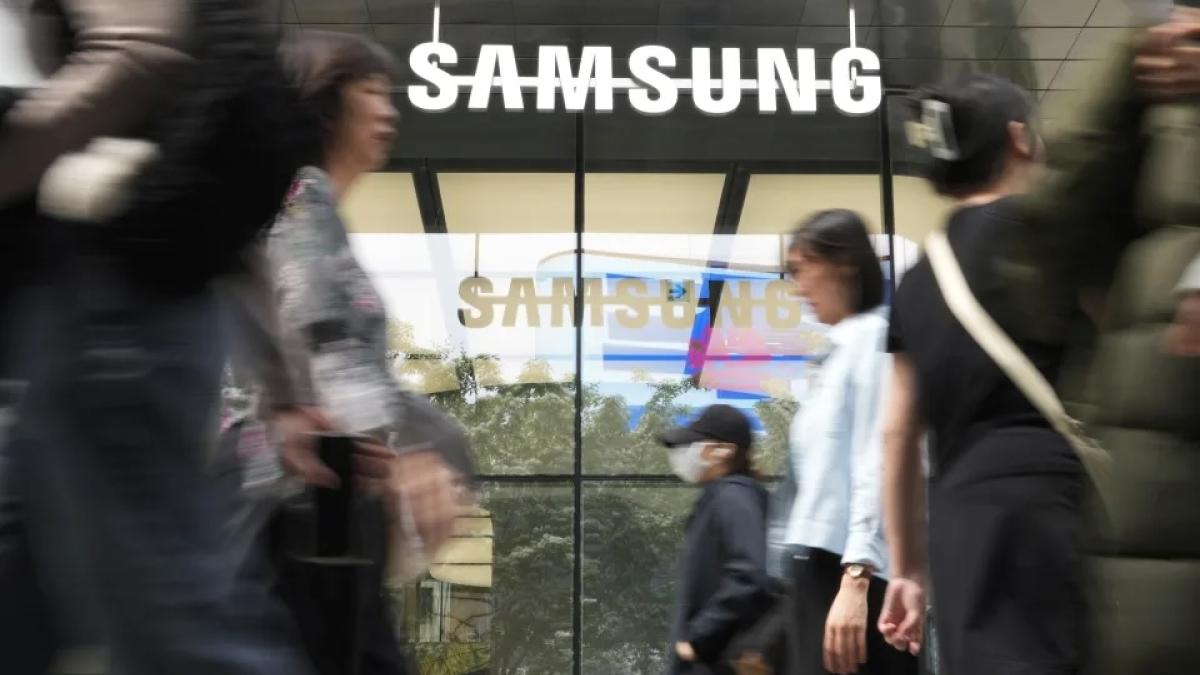
A large number of Samsung Electronics employees in South Korea, dissatisfied with the company’s bonus system, decided to launch a massive strike through their union. (AP)
Taiwan’s GDP is soaring, but workers feel no benefit
Shih presented data on Taiwan’s income distribution during the program. The share of wages in GDP was around 52% 30 years ago but has now dropped to 44%—a loss of about 8%. Taiwan’s current GDP is NT$28 trillion, so 1% equals NT$280 billion, meaning 8% equates to a staggering NT$2.24 trillion in wealth that has disappeared from workers’ hands in the distribution structure. If this amount were evenly distributed among Taiwan’s 23 million people, each person would be missing NT$10,000 per month in real income compared to what they should have received 30 years ago.
Where has this missing trillions gone? Shih analyzed that it primarily flowed in two directions: First, due to Taiwan’s shift toward highly capital-intensive industries, much wealth has gone toward depreciation of machinery and equipment. Second, it has flowed into “profits for owners and shareholders.” The share of profits going to shareholders and capital owners has increased by about 5% over the past 30 years. While workers in the U.S. and South Korea still receive 50% to 55% of GDP, Taiwan’s workers receive less than 45%.
This phenomenon has drawn international media attention. South Korean media have described Taiwan’s income distribution dilemma as “wealthy Taiwan, poor Taiwanese.” The Hankyoreh’s series “A Gap Society Driven by Semiconductors” points out a unique phenomenon behind the impressive data: “beggars with superpowers.” While tech giants profit immensely from the AI wave, many young Taiwanese remain trapped by high housing prices, low wages, and heavy living costs, creating a disconnect between economic growth and public perception.
Former Vice Premier Shih Jun-ji (pictured) appeared on Feng Media’s “After Work International Line” hosted by Lu Yi-chen on the 15th. (Photo by Ko Cheng-hui)
Stock-based bonuses: South Korea’s engineer class mobility engine, absent in Taiwan
Shih specifically highlighted South Korea’s employee stock ownership system, calling it a mechanism Taiwan’s businesses should learn from but rarely discuss seriously. SK Hynix’s employee stock ownership program allows a broad group of employees, including mid-level engineers, to hold company shares at discounted prices. When the stock price rises significantly, they can accumulate real wealth and feel rewarded for their contributions.
In contrast, Taiwan’s tech industry employee bonus system has significantly shrunk since the 2008 reform. In 2008, Taiwan implemented the “employee bonus expensing” system, fundamentally changing the previous practice of treating bonuses as “profit distribution” by mandating them to be classified as “operating expenses.” Shih believes that while this change made accounting practices more rigorous, it gradually deprived Taiwan’s tech workers of the financial incentive to “grow together with the company.”
Shih’s analysis suggests that the AI revolution is not just a technological competition but also a competition of distribution systems. If companies let only shareholders enjoy AI dividends while workers bear overtime, labor shortages, and high housing prices, talent loyalty may decline, potentially leading to labor conflicts. While South Korea’s NT$12 million bonuses may be hard to replicate directly, it forces Taiwan’s business leaders to ask: For every dollar earned from AI, how much do the actual chip-makers—beyond shareholders—get to share?
South Korea, Taiwan, and Japan’s AI-related firms have achieved global success, igniting a frenzy in the market. (AP)
More in-depth reports from Feng Media: · Will the U.S. defend Taiwan’s security? A senior Japanese media figure: If war breaks out across the strait, Trump’s ‘red line’ will be this · How can the U.S. and China cross the Thucydides Trap? Harvard professor Allison’s exclusive audio leak: These two words will be the key · Exclusive: What if Taiwan falls? A U.S. naval scholar reveals the truth: Is it worth sacrificing the 7th Fleet to defend Taiwan?
FACT BOX
- Source: PR Times
- Category: News