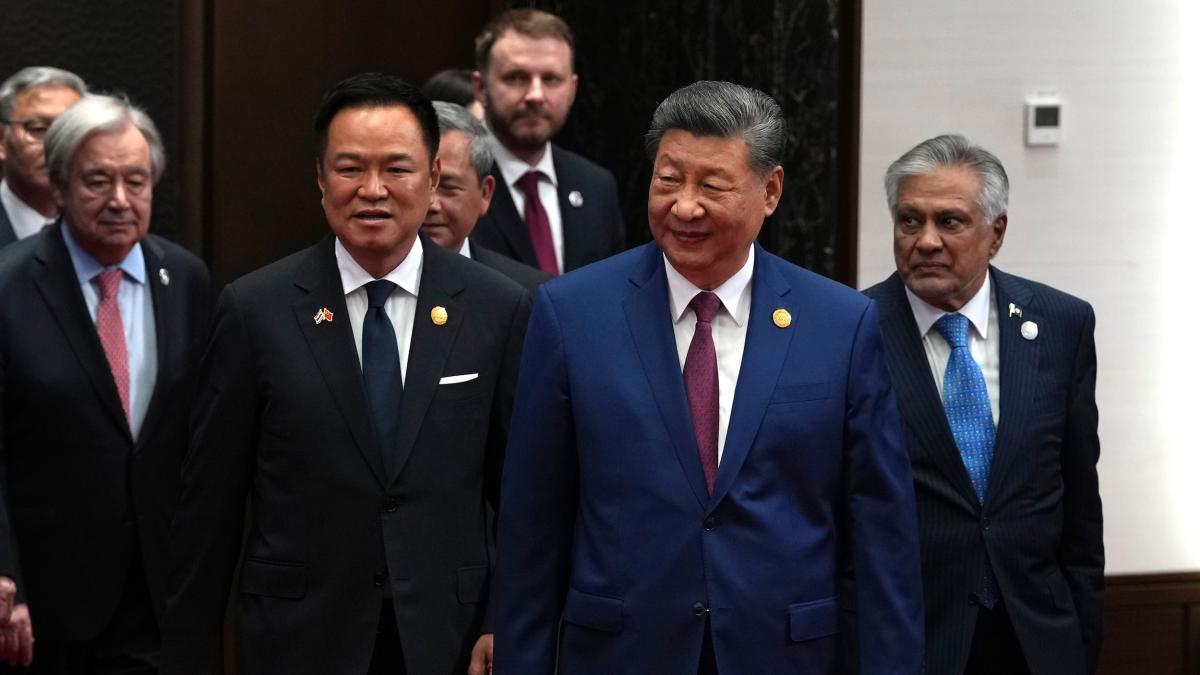
Starting today (July 17) through the 20th, Shanghai is hosting the 8th World Artificial Intelligence Conference (WAIC) and the High-Level Conference on Global AI Governance. This year marks the first time Chinese leader Xi Jinping has personally attended the event, delivering a keynote speech at the opening ceremony.
According to Xinhua News Agency, Xi Jinping stated that AI development should "always remain controllable," opposed the overextension of national security concepts, and expressed China's willingness and pivotal role in global AI openness and sharing.
"The development of artificial intelligence should not be a solo performance by any single country, but rather a symphony of global cooperation," Xi said. "We must seize this rare historic opportunity and encourage open-source, open collaboration, and shared progress."
On July 17, 2026, Chinese President Xi Jinping attended the 2026 World Artificial Intelligence Conference and the High-Level Conference on Global AI Governance. (AP)
Hosted by China's Ministry of Foreign Affairs and organized by local Shanghai authorities, the World AI Conference serves as a key platform for China to showcase its technological prowess, signaling a clear shift in its AI strategy—from viewing AI as merely an industrial development tool to positioning it as a cornerstone of global shared governance.
Multiple analysts interviewed by BBC Chinese say that "open source" has become a central keyword in China's AI strategic narrative.
Against the backdrop of intensifying U.S.-China tech rivalry and tightening Western export controls on semiconductor chips to China, some analysts believe China is using the narrative of open-source AI as a "public good" to challenge what it sees as a "Western-dominated closed technology ecosystem," aiming to portray itself as a leading force in building a more inclusive global AI order.
Chinese state media have also elevated "open-source sharing" as a core doctrine. People's Daily Online published a commentary today emphasizing that China's open-source AI approach is a remedy for the growing global digital divide in AI:
"China has always adhered to not imposing technological blockades or creating exclusive barriers. We proactively open windows for dialogue and are willing to share our technology and experience with countries worldwide, ensuring AI truly serves the common development of humanity."
China's 'Open' or 'Open-Source' Model: How Effective?
However, how effective is China's AI 'open' or 'open-source' model, and what strategic thinking lies behind it?
Dr. Kyle Chan, a researcher at the John L. Thornton China Center of the Brookings Institution, told BBC Chinese that China's current open-source AI model differs fundamentally from the 'closed model' adopted by top U.S. AI labs.
He noted that the combination of low cost, high performance, and controllability makes China's open-source model more attractive than ever before.
Vivian Toh, a semiconductor commentator and editor-in-chief of Singapore-based tech news site 'TechTechChina,' told BBC that the significance of China's path lies in leveraging 'cost' as a lever to disrupt global markets. The core competitiveness of China's open-source models is their extreme cost-effectiveness.
However, she told reporters that China's unique AI path is not about dismantling Western ecosystems or overthrowing the existing order, but rather about carving out a new track defined by 'low cost, high collaboration.'
"On this track, open-source versus closed-source is not a 'must-choose-one' dichotomy. The U.S. has Anthropic; China has its own closed models too."
"It's just that currently, China's open-source models—such as DeepSeek and Tencent's Hunyuan—have achieved greater cost-effectiveness and industry acceptance," she added.
Dr. Chan emphasized that under pressure for revenue growth, Chinese AI companies may shift toward hybrid strategies combining closed and open models.
He also warned that if cybersecurity and other risks intensify, Beijing might reconsider its support for open-source models.
"In other words, while China has achieved a symbolic victory today, it cannot be guaranteed that China will indefinitely adhere to the open-source model," Chan said.
Challenges Remain
Xi Jinping described AI as "a shared intellectual achievement and valuable asset of all humanity," calling for genuine multilateralism, the effective role of the United Nations, and the early formation of a globally agreed-upon governance framework.
Some analysts believe this narrative directly targets the dominant Western AI development model.
Top Western labs like OpenAI, Google, and Anthropic mostly adopt closed or limited-open strategies, keeping core model parameters and training data highly confidential. The U.S. government, through export controls, attempts to restrict advanced AI capabilities—such as high-end AI chips—to "friendly countries."
China's open-source strategy is not without controversy.
While Chinese authorities repeatedly emphasize building "secure and controllable" AI infrastructure to avoid dependence on foreign technologies, many critics question whether Chinese companies' open-source initiatives are "truly open."
Others worry that technology ultimately serves national strategy, with sensitive information excluded from databases accessible to global users.
A 2026 study by Stanford University and Princeton University found that large language models (LLMs) developed in China are heavily influenced by Chinese government regulations—such as the "Interim Measures for the Management of Generative AI Services"—and exhibit severe political censorship.
The report stated that, compared to Western models, Chinese models show extremely high refusal rates, shortened responses, and tendencies toward inaccuracy when asked about sensitive topics like Xinjiang, Hong Kong, and Taiwan.
It also found that even when questions are posed in English rather than Chinese, the built-in censorship mechanisms in Chinese models remain active. The study concluded that performance differences are not merely due to language differences in training data but are directly shaped by the regulatory environment.
The study further noted that LLM censorship differs from simple website blocking. Open-source-labeled AI models often provide "plausible-sounding" excuses or apologies when refusing to answer, making it extremely difficult for average users to detect information suppression.
Vivian Toh told BBC that the challenges facing Chinese AI are evident.
She pointed out that the self-reliance rate of core foundations in China's AI ecosystem—such as AI frameworks—still needs improvement, and translating influence into sustainable business models remains a challenge.
Additionally, competition over data, standards, and governance is a major hurdle: with a market of over a billion users, China must establish "dual user authorization" security standards to prevent high-risk data leaks and avoid models consuming entire industries.
Regardless, this AI technology showcase by China to the outside world is not just about technical superiority, but also about who will define the future global digital order.
Comprehensive analysis suggests that Xi Jinping's first personal attendance at this conference is not only a display of China's AI strength but also an indirect response to the U.S. and its allies. In other words, in the face of U.S. tech sanctions, China is attempting to transform challenges into proactive competitive advantages, rather than maintaining a defensive posture as it has often claimed.
FACT BOX
- Source: PR Times
- Category: Event
- Organizations: OpenAI / Google / Anthropic
- Products / services: Hunyuan / DeepSeek