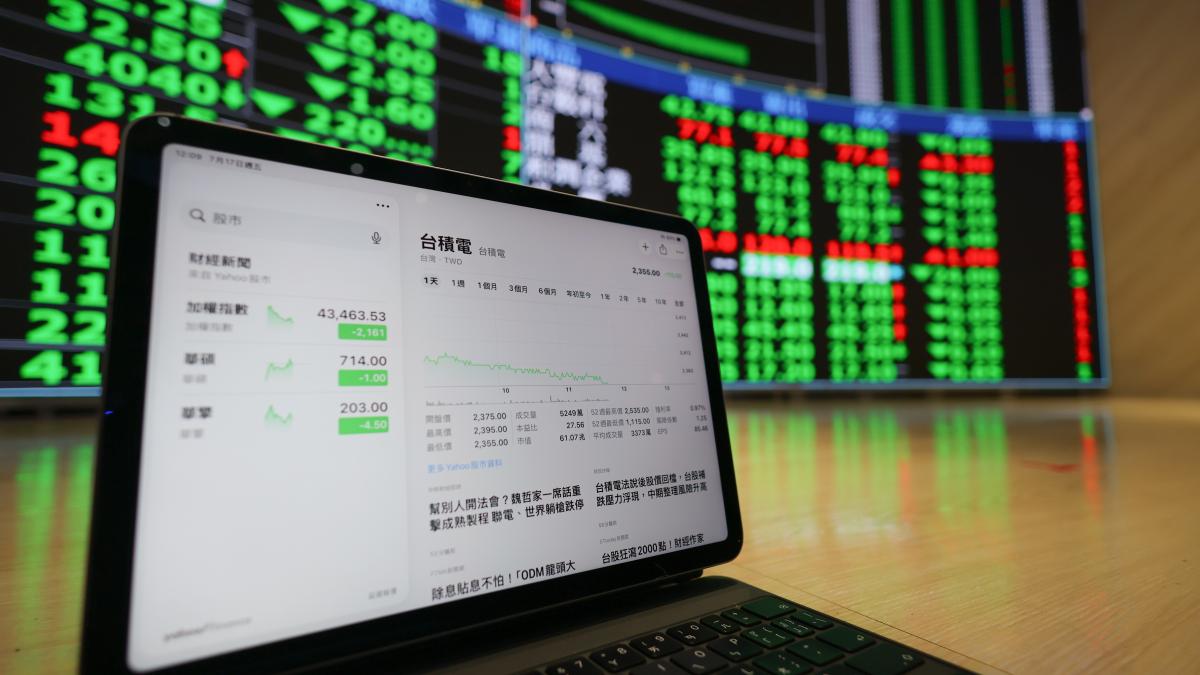
Foreign investors currently still hold approximately NT$74 trillion in Taiwan stock assets, making them the largest main force in the Taiwan stock market. However, in the short term, they are withdrawing some capital and reducing risk exposure, as the market digests the overheating of the AI rally and global risks. The share cleansing caused by foreign investors continuing to deleverage and adjust short positions led to an epic crash in Taiwan stocks on the 17th. The weighted index plunged 2,953.71 points at closing, down 6.47%, ending at 42,671.27, causing market panic to rapidly escalate.
Regarding this, Ruan Mu-Hua appeared on the program 'How Bo-Jie Sees It' and stated, 'Foreign investors come to Taiwan to make money, not to act as philanthropists.' Ruan pointed out that foreign investors are skilled at maneuvering in the market, and pension funds, sovereign wealth funds, and other foreign institutions conduct 'rebalancing' at the end of each quarter, selling stocks that have risen significantly. The proceeds are then partially taken as profit (Take Profit), with the remainder reinvested into stocks whose weightings have relatively decreased, ultimately restoring portfolio balance.
'When they carry out such actions, the stocks that have risen too much get sold off,' said Ruan Mu-Hua. He noted that Delta Electronics (2308) and TPC (2383) are clear examples. 'These stocks are excellent, so why are they being sold? Precisely because foreign investors are taking profits,' he emphasized. Ruan stressed that investors should always pay attention to institutional rebalancing operations at the end of each quarter.
Finally, Ruan Mu-Hua shared three key investment steps: 'Determine whether the market is in a bull or bear phase,' 'Identify star industries with explosive growth potential over the next 3–5 years,' and 'Select leading companies with high transparency.' Ruan stated that the bull market driven by artificial intelligence (AI) has broken the traditional concept of economic cycles. 'Because the capital expenditure and technological momentum of AI are too strong, it has already broken the cycle.'
Ruan urged investors to first confirm the current conditions and situation, and then identify the most advantageous industries. 'For example, within Taiwan's stock market, should you invest in food, chemicals, textiles, servers, or semiconductors?' These industries all interact with the macro environment. After confirming the industry, one must then identify the best company in that field. Ruan explained this as a 'top-down' investment strategy—analyzing industries from the macro environment, then evaluating individual companies within those industries.
More exclusive insights from Storm Media: · Will Taiwan stocks fall another 1,000 points on Monday? Experts give one key number—the 'life-or-death line': These types of stocks are very dangerous · Is Taiwan stocks falling back to 42,000 points a good thing? Ruan Mu-Hua predicts the 'correction buying opportunity' in Q3: Irrational emotions need to take a break · Was TSMC responsible for the Taiwan stock crash? Ruan Mu-Hua analyzes the subtext of the earnings call: This company is highly ethical
FACT BOX
- Source: PR Times
- Category: News