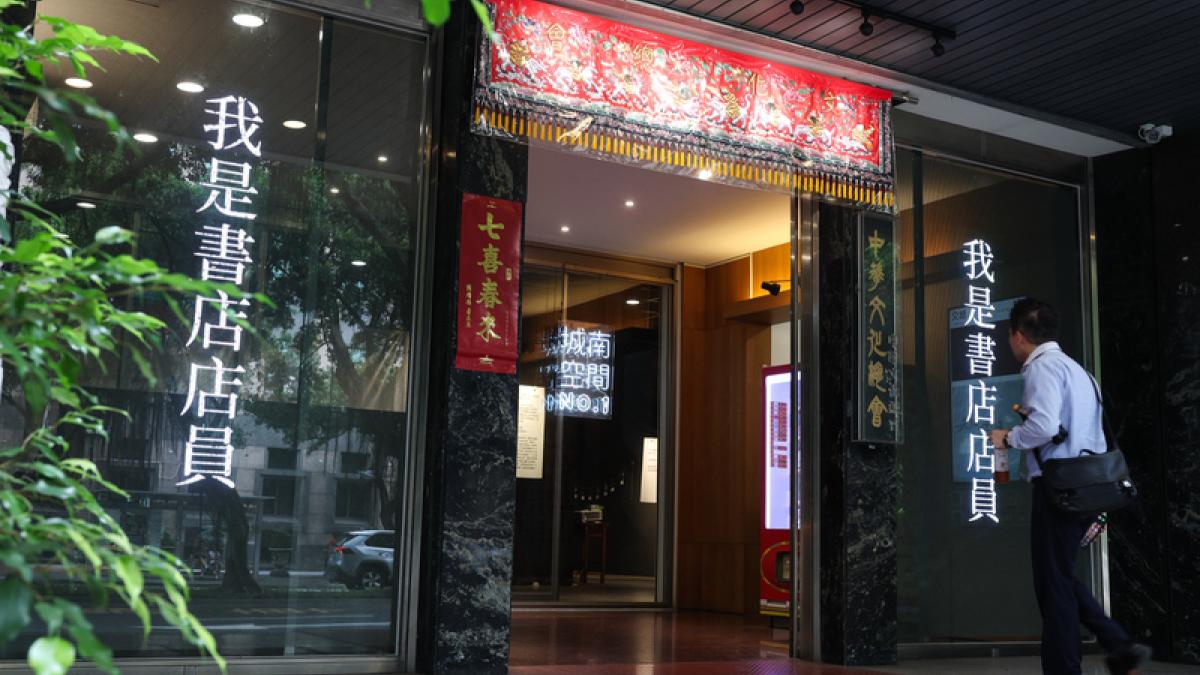
"I am a bookstore clerk" went viral overnight, with even the Ministry of Culture and the Cultural Affairs Council adopting the slogan, and the band Fire EX.'s concert reaching a climax with the chant. In recent years, Taiwanese identities have shifted rapidly—Ukrainians, diehard Taiwan independence advocates, Yoko Akira—and now, bookstore clerks. What remains unchanged is that these identities are political postures, secret passwords to distinguish 'us' from 'them,' embraced within echo chambers to confirm no 'impurities' have infiltrated. 'Just reading a few books?' Much like the 2019 Hong Kong anti-extradition bill protests, 'I am a bookstore clerk' has become 'Support Hong Kong' 2.0. The incident began on July 15, when a female clerk from an independent Hong Kong bookstore was arrested by Hong Kong's National Security Department. In front of media cameras, she wore a black T-shirt printed with 'I am a bookstore clerk.' Instantly, 'freedom to read' and 'reading is not a crime' echoed across online discourse. Even President Lai Qing-de, who had remained silent during the 'toxic oil' scandal, seized the moment to voice support. Yet, since 2019, those in Taiwan who claim to 'support Hong Kong'—especially Hong Kongers living in Taiwan—know best the cold and warmth of such gestures.
The phrase 'freedom to read' may seem unproblematic, but in reality, it is a decontextualized political slogan and a mobilization tool. Like the once-popular film *Detention*, in which a student laments: 'I was just reading a few books—why did it come to this?' This line moved audiences to tears, inciting righteous anger against the state's brutality for punishing someone 'merely' for reading. However, *Detention* is based on the early 1950s White Terror 'Keelung High School Case.' The real story involved teachers and students reading not Tagore's poetry, Turgenev's *Fathers and Sons*, or Kurihara Seison's *The Symbol of Anguish*, but 'bandit zone' Yan'an radio broadcasts and progressive 'red books'—Marxist-Leninist works, writings by leftist Chinese authors like Lu Xun and Ba Jin—and singing not 'Rainy Night Flower' but 'The March of the Volunteers.' These facts are documented in Lan Bo-chou's *Song of the Horse-drawn Carriage*, based on firsthand testimonies.
The teachers and students arrested by the KMT government were, in a sense, dying for their beliefs—sacrificing themselves for their socialist ideals and identification with the 'red motherland.' Yet in the film, these truths are replaced with hollow rhetoric of 'freedom,' leading audiences to naively believe that innocent youths indulging in romantic literature were crushed by the 'evil KMT.' Few realize this occurred during the height of the Chinese Civil War, when Taiwanese high school students could not escape the era's currents, torn between the 'white homeland' and the 'red homeland.'
A female clerk from Hong Kong's independent bookstore 'Liu Xia Bookstore' being handcuffed by national security police. (Screenshot from RFA)
Are books not inherently carriers of立场?
Why has the heroic history of CCP martyrs been flattened and decontextualized into 'freedom' and 'just reading a book'? The goal is clearly to hijack history and dishonestly graft it onto contemporary 'anti-Communist' and 'anti-China' ideologies. If the Keelung High School Case occurred today, people would likely scream 'Communist bandits must die' and rush to apply the harshest penalties under the 'National Security Act' or 'Anti-Infiltration Act.'
The Hong Kong independent bookstore incident, while different in nature, also opposes the 'red homeland,' believing in American supremacy and the inevitable downfall of the CCP, quietly transforming slogans like 'Liberate Hong Kong, the times are changing' into books lining bookstore shelves. Yet the method is the same: depoliticizing books and reading, using independent bookstores to elevate moral high ground, and cloaking anti-Communist, anti-China ideologies in neutral, innocent, and pure packaging.
But books have always been vehicles of立场 and ideology—even the most apolitical poetry reflects the author's values. 'Freedom to read' is, in truth, grazing freely within a carefully constructed pasture, eating only the grass pre-selected by the rancher. Independent bookstores are no exception—the books on their shelves reflect the owner's intended worldview. The so-called 'freedom of publication' and 'freedom to read' championed by Taiwan and the Western 'democratic camp' rely on capital and market tastes to build the pasture's fences, replacing political censorship with economic gatekeeping. Grass that violates 'political correctness' is eliminated at the source.
A world where only red flowers cannot bloom?
Taiwan is considered the freest place in the Chinese-speaking world for publishing, yet it perfectly replicates the logic of pasture and grass. Years ago, several prominent scholars led an effort to write a popular book challenging prevailing myths and presenting the real mainland China. Contributors were top-tier, and I was honored to write one chapter. All submitted on time, and the editor compiled the manuscript—but for years, no publisher would take it, despite the editor's prestige, forcing apologies to the authors. The reason? Simply visit any bookstore's mainland China section and observe the prevailing titles.
Similar cases are not isolated. Recently, scholars attempted to compile a reader criticizing the U.S. and opposing war. After contacting multiple publishers, some declined due to political concerns, others bluntly stating they wouldn't publish books that would make readers 'uncomfortable.' In other words, the countless 'freely published' books we see in stores have already been filtered by publishers and editors through 'self-censorship,' eliminating anything that violates political correctness. Any that slip through, like the 2020 mainland anti-pandemic picture book *Waiting for Dad to Come Home*, face public denunciation, lawmaker press conferences, widespread media backlash, and official bans. Is reading truly free? Are books truly innocent?
The Hong Kong bookstore clerk was released on bail two days after her arrest. But on that night two days prior, when she walked into the spotlight wearing her 'I am a bookstore clerk' shirt, it was clear she was never just a clerk—she was a missionary and gatekeeper of a specific political ideology. When everyone chants 'I am a bookstore clerk,' it proves one thing: in our world, only red flowers cannot bloom.
*The author is a veteran media professional and CEO of Yuanxiangren Cultural Studio.
FACT BOX
- Source: PR Times
- Category: News