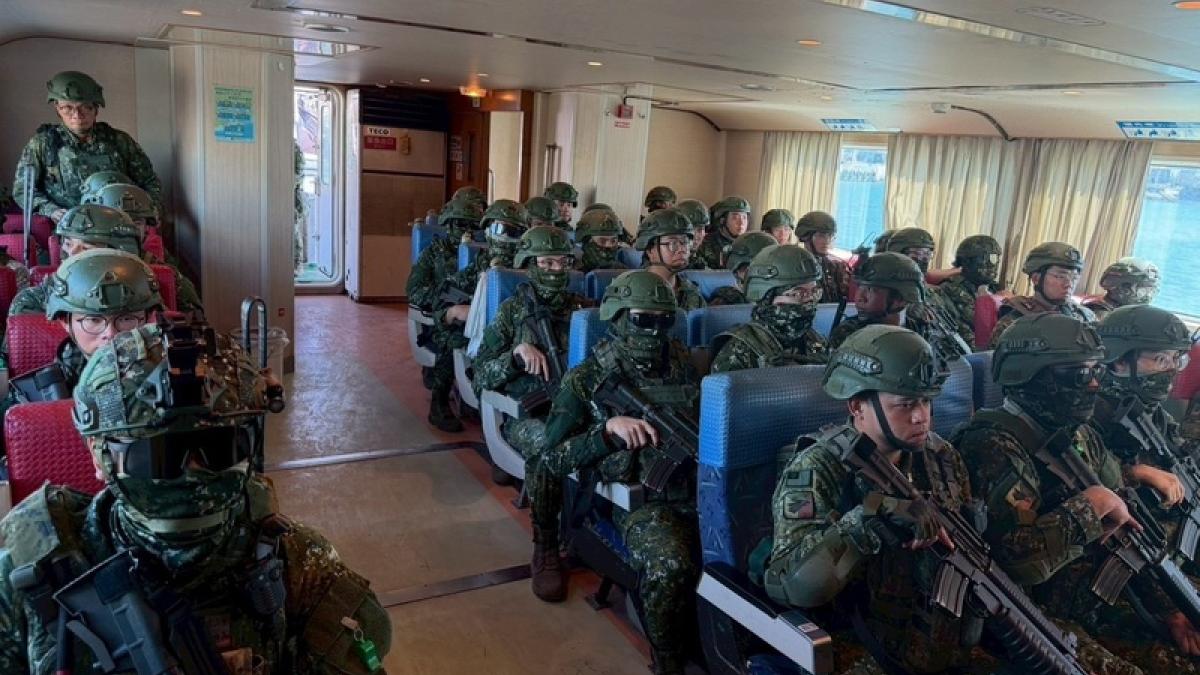
A few days ago, while browsing the internet, a quick commentary titled 'Determination to fight for Taiwan independence on July 1?' from the Japanese-Chinese Times News appeared. Senior media commentator Zhang Jun-kai questioned a 'recent' public opinion survey by the Institute of Sociology at Academia Sinica. The survey claims that as high as 82% of Taiwanese respondents are 'willing to fight for their country,' surpassing South Korea's 70% and Japan's 29%. Researchers suggest this high 'resistance will' stems from a strong perception of sovereignty threats from mainland China.
However, Zhang Jun-kai presented counter-evidence: a similar 2026 survey by the magazine "Vision" showed 63.9% of respondents did not want themselves or their families to go to war. A 2023 survey also indicated that 69.0% of people aged 20 to 29 were unwilling to send themselves or their families to the battlefield.
At the end of June and beginning of July, I vaguely recall seeing reports about the release of this survey. At the time, I was busy with other matters and didn’t pay much attention. My intuition told me this might be another survey conducted by a pro-government institution. After reading Zhang’s commentary, I became even more suspicious: Since when has Academia Sinica begun conducting surveys that echo the government’s stance? Has the director changed? Or is someone impersonating Academia Sinica and fabricating research results?
In the afternoon, after finishing other tasks, I immediately checked Academia Sinica’s official website. Strangely, I couldn’t find the survey report on the websites of the Institute of Political Science, Institute of Sociology, or the Research Center for Social Sciences. I also checked the 'News and Events' section of Academia Sinica’s official site but found no relevant information. I called the Institute of Sociology, and they replied they were unaware of the news reports and had no knowledge of such a special lecture event.
With no other choice, I turned to Google. Thanks to AI assistance, Google instantly found a complete report from the Central Broadcasting Station on July 2: The source was a special lecture titled 'Demographic Characteristics and Resistance Will: Evidence from the World Values Survey in Taiwan, Japan, and South Korea,' held by the Institute of Sociology at Academia Sinica on June 26. The lecture was hosted by Paul Peng, Associate Research Fellow at Academia Sinica’s Institute of Sociology and convener of the 'Thematic Research Group on Comparative Asian Social Transformation,' with data based on research findings presented by Associate Research Fellow Pan Hsin-hsin.
Pan Hsin-hsin explained that the study was based on the 'World Values Survey (WVS)' questionnaire conducted between 2018 and 2022 in Taiwan, Japan, and South Korea. Respondents were asked, 'If a war breaks out now, would you be willing to fight for your country?' The results showed that 82% of Taiwanese respondents were willing, the highest among the three, followed by South Korea at 70% and Japan at 29%.
Upon verification, both Paul Peng, the lecture host, and Pan Hsin-hsin, the researcher, are indeed members of Academia Sinica’s Institute of Sociology. At this point, I breathed a sigh of relief: Academia Sinica’s reputation had not been stolen.
However, can a cross-national survey conducted between 2018 and 2022 be considered 'recent'? Can data from four years ago accurately reflect today’s public opinion in Taiwan in 2024? When exactly was the survey conducted—2018, 2019, 2020, 2021, or 2022? 2019 saw the Hong Kong anti-extradition protests, and 2020–2022 were marked by pandemic lockdowns. During this period, the DPP and the Tsai administration, in collusion with the U.S., promoted the narrative that the coronavirus originated in Wuhan, fostering a strong anti-China sentiment among the Taiwanese public. Even if the survey results from that time were 'accurate,' can they explain Taiwan’s 'resistance will' in 2026?
Pan Hsin-hsin noted that since 1981, the WVS has conducted eight international surveys across nearly 100 countries. Are there comparable data from previous surveys? For example, during the period of intense cross-strait exchanges from 2008 to 2016, did 82% of Taiwanese also express willingness to fight for national defense?
This Academia Sinica survey shows the highest percentage of willingness to fight for the country among similar studies. The 82% figure is astonishingly high—so high that even the governments of Iran, Israel, and Ukraine would envy it!
As Zhang Jun-kai questioned, similar surveys by "Vision" magazine show not such high willingness. On the contrary, over 60% of respondents said they do not want themselves or their families to go to war! The results from "Vision" align with human nature and match our everyday impressions.
According to the Central Broadcasting Station report, Pan Hsin-hsin claimed that age, gender, and marital or parenting status seem to have little impact on willingness to fight, but 'party identification' is the key factor influencing Taiwan’s resistance will. The data presented by Pan show nearly 90% of DPP supporters are willing to fight, compared to 30% of KMT supporters and 50% of TPP supporters.
Although we cannot access the full questionnaire—such as whether it was conducted via phone or face-to-face interviews, the number of successfully completed surveys, refusal rates, or sampling errors—nor the full research report, we remain deeply skeptical of the data on party identification’s influence on willingness to fight.
Assume the survey had 1,200 valid responses. Based on past election turnout and party vote shares, 30% of voters typically do not vote. Among the 70% who do vote, the DPP averages 40%, the KMT 40%, the TPP 10%, and 10% have no clear party affiliation. Whether non-respondents on party identification are counted as non-voters, or assuming all 1,200 respondents answered both 'willingness to fight' and 'party preference,' the figures—90% of DPP supporters, 30% of KMT supporters, and 50% of TPP supporters—simply cannot add up to 82% overall willingness to fight! (See footnote)
Allow me to raise further doubts about the conclusion that '82% of people are willing to fight for their country.'
The survey question: 'If a war breaks out now, would you be willing to fight for your country?' sounds like it’s asking about the respondent’s 'willingness'—a question tied to civic duty and morality. Under long-term political socialization by the state, this is akin to asking, 'Do you love your country?' Naturally, most people would answer, 'Yes, I’m willing!' 'I love my country!'
Willingness to fight is one thing; actual action is another. If fighting for one’s country comes with conditions, choices, or if respondents are asked to shift from subjective participants to objective observers, the answers would surely differ!
For example: 'If a war breaks out now, and you’re studying or working abroad on a master’s or PhD, would you return to Taiwan to fight?' 'If the government exempts only children from combat, and you are an only child, would you still insist on fighting?' 'Do you think your friends (government officials, the wealthy) will fight, flee abroad, transfer assets, surrender, or refuse conscription?' 'Do you think your parents would encourage you to fight?' 'If you could pay money to avoid conscription, what amount would be reasonable? What could your family afford?'
Or, before asking about willingness to fight, what if respondents were first asked, 'What do you think the probability of winning the war is?' The answers would undoubtedly be very different.
From our lived experiences, gender, age, marital status, parenting, socioeconomic status, provincial origin, and military service experience are undoubtedly key factors influencing people’s willingness and determination to go to war.
Post-war baby boomers who served in the military overwhelmingly do not want to see war break out across the strait. Even if not anti-war, they are war-weary. Especially many second-generation Mainlanders, whose parents endured displacement and poverty, served in the military during harsh times, witnessed bizarre military phenomena, and later visited, worked, or traveled in mainland China, are particularly unwilling to return to a war era.
From this perspective, it’s not that KMT supporters are less willing to fight, but rather that many KMT supporters are second-generation Mainlanders who, even without direct war experience, carry deep family memories of conflict.
Similarly, regarding war and peace, from our lived experiences, we can reasonably infer the following phenomena:
- Elderly parents, unwilling and unable to bear the pain of 'white hair burying black hair,' naturally have a higher anti-war tendency. - Parents with children of conscription age especially dread war, fearing their children may never return. - Mothers, though strong by nature, do not want their families or communities to suffer. As mothers, they cannot bear to see their children go to war, risking their lives. This vulnerability is human nature.
- Highly educated individuals who care about global affairs and possess empathy and imagination can envision the brutality of war and prefer to enjoy life, thus showing higher reluctance to go to war.
- Young people, especially those raised in prosperous and stable societies, generally do not want to go to war. Yet Pan’s research claims 88% of young Taiwanese are willing to fight—far removed from common sense.
Wealthy families and high-income business operators have the most delicate relationship with the ruling authorities. They least desire war but most need government favor. On the issue of willingness to sacrifice for the nation, they typically express supportive attitudes publicly.
FACT BOX
- Source: PR Times
- Category: Survey