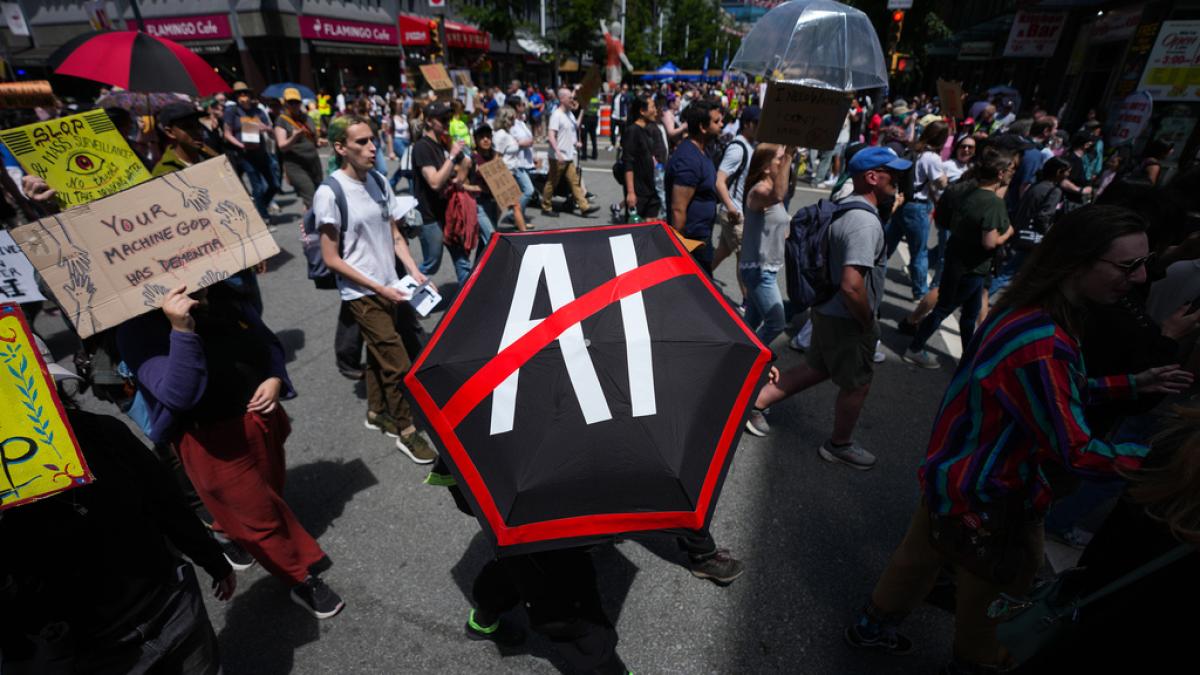
A wave of artificial intelligence (AI) has triggered an arms race among global tech giants, but this technological frenzy is facing unprecedented resistance across American society. On the 18th, protesters opposed to unchecked data center expansion launched 142 demonstrations across 42 U.S. states—the first nationwide, cross-state protest against data centers—highlighting growing fury over AI infrastructure monopolizing local resources.
Tea Party Veteran at the Helm
This nationwide protest, named 'Humans First,' was orchestrated by Amy Kremer, the iconic leader of the 2009 right-wing populist 'Tea Party' movement in the United States and current chair of 'Humans First.' Kremer openly compares today’s backlash against data centers to the original Tea Party movement. She told Reuters that while grassroots anger in the past targeted government overreach and excessive taxation, today’s outrage is directed at tech giants and politicians who, through 'backroom deals,' are forcing data centers into communities without local consent.
"They just wake up one day and find a massive facility being built in their neighborhood—one they never wanted," Kremer said. "This anger transcends party lines."
Kremer predicts that the data center issue will become a decisive topic in the upcoming November midterm elections and even the 2028 presidential race. While she has sharply criticized Republican leadership for giving Big Tech a 'free pass,' she emphasizes that 'Humans First' does not advocate for a blanket construction ban like the one pursued by Democratic-led New York State. Instead, the movement calls for returning decision-making power to local residents.
Seventy Percent of Americans Oppose
According to a joint poll by Reuters and Ipsos released in June, only one-third of Americans support the current pace of data center construction. More alarmingly, just 14% of respondents said they would support building a data center in their own community to serve tech giants like Meta, Alphabet, Microsoft, Amazon, and Elon Musk’s xAI.
Newsweek, citing Gallup’s May poll data, reports that a staggering 70% of Americans oppose building AI-dedicated data centers in their local communities, with 48% expressing 'strong opposition.' Common concerns include excessive water consumption, skyrocketing electricity bills, noise pollution, and the loss of farmland and wildlife habitats.
The protests reflect a rare bipartisan consensus on resource anxiety. In Texas, a conservative stronghold, 18 protests erupted on the 18th—more than any other state. Swing-state Georgia saw 11 protests, and Democratic-leaning California had 8. Whether red states (Republican) or blue states (Democratic), the low-frequency hum of massive cooling systems and the staggering water and power demands have forged an exceptionally rare 'cross-partisan consensus' in the U.S.
In Fredericksburg, Virginia, a young protester held a sign reading, 'We live on water, not data.' In the desert of California’s Imperial County, 54-year-old Ivan DelSol, a left-leaning resident, led protests under scorching heat exceeding 38°C. A proposed data center project in the area is expected to draw up to 260 million gallons (about 984 million liters) of precious freshwater annually from the Colorado River. DelSol angrily stated, 'Using so much freshwater for AI is a dystopian absurdity!'
Meanwhile, in Tyler, Texas, 31-year-old Eva Cardona, a self-described 'political nomad' and first-time activist, said she was driven to take real action after growing tired of online warnings about AI’s unchecked growth. 'I wanted to do something more tangible than posting on Facebook,' she said.
Trump’s Base Shows Cracks
Faced with surging public anger, the tech industry has mobilized urgently. Josh Levi, chair of the industry lobbying group Data Center Coalition, issued a statement attempting to quell tensions, asserting that the industry is actively engaging with policymakers and local residents to ensure data centers 'strengthen rather than weaken local development' and minimize negative impacts on households and businesses.
This grassroots backlash comes at a sensitive time as the U.S. and China compete for AI dominance. The Trump administration has long advocated accelerating infrastructure development, viewing it as key to maintaining a competitive edge over China in AI. However, TechRadar points out that this expansion policy is creating serious rifts with Trump’s grassroots supporters—conservative voters who support expanding fossil fuel production but adamantly oppose handing over those energy and resources to tech giants that seize land and drive up residential electricity prices.
This public anger has already translated into tangible economic resistance. Newsweek reports that grassroots movements across the U.S. have successfully delayed or canceled expansion projects totaling $130 billion. Data Center Watch notes that recently, projects worth $64 billion have been put on hold due to local opposition. Notably, several Republican officials jointly sent a letter to FBI Director Kash Patel, questioning whether 'foreign influence from China' is manipulating environmental leftists to obstruct U.S. tech development. However, this Tea Party-led coordinated protest seems difficult to dismiss as mere 'Chinese interference.'
FACT BOX
- Source: PR Times
- Category: News
- Organizations: Meta / Alphabet / Microsoft