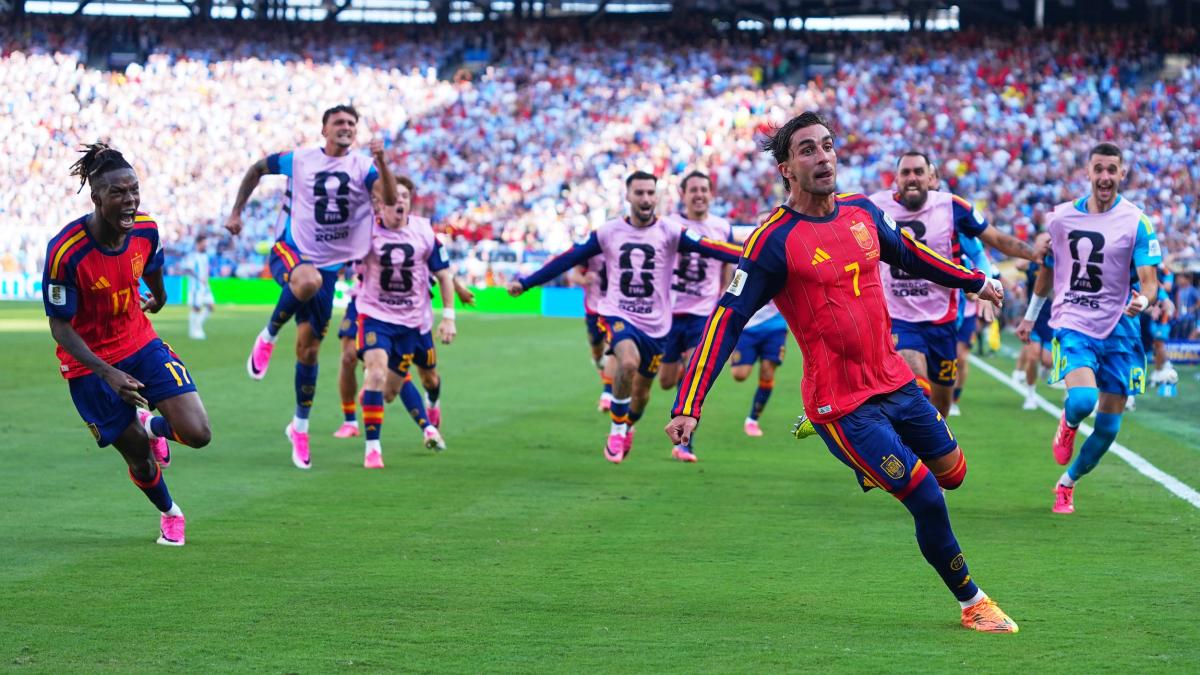
The 2026 FIFA World Cup final between Argentina and Spain kicked off on July 19 at MetLife Stadium in New Jersey, USA. This clash between two of the world's top-ranked teams turned into a grueling battle shaped by injuries and red cards. Argentina's attack was completely shut down, while European champions Spain secured their second World Cup title with a 1-0 victory in extra time, thanks to a goal by substitute forward Ferran Torres.
The match ended 0-0 after 90 minutes of regulation. However, in stoppage time of the second half, Argentina's midfield linchpin Enzo Fernández received his second yellow card, resulting in a red card and ejection. This left Argentina with 10 men for the entirety of extra time, placing them at a severe disadvantage. Argentina's offensive struggles were historic: they failed to register a single shot—on or off target—for the first 115 minutes of the match.
Earlier, in the 44th minute of the first half, Manchester United center-back Lisandro Martínez suffered a thigh injury and was forced off in visible pain, covering his face with his jersey. He was replaced by 38-year-old veteran Nicolás Otamendi. Martínez had been a defensive rock throughout the tournament, leading his team with 34 clearances and contributing 63 defensive interceptions (second on the team). His departure severely weakened Argentina's backline.
In the 70th minute of the second half, Argentina's other starting center-back, Cristian Romero, also went down injured just before the second hydration break and was substituted by Facundo Medina. With both starting central defenders forced off, Argentina's defense was left in disarray. Spain, now with a numerical advantage, finally broke the deadlock early in the second half of extra time. Torres capitalized on a rebound in the box, slotting the ball home with his left foot.
Spain held onto their 1-0 lead until the final whistle, claiming their second World Cup title after their 2010 triumph in South Africa. Spain's young star Lamine Yamal had two of the best chances of the match but failed to convert. However, in extra time, he received the ball on the right flank and passed to Pedro Porro—one of the most active players on the pitch. Porro delivered a cross toward the far post that was nearly out of play, but substitute Nico Williams, who had entered in the 75th minute, headed it back into the center, where Torres calmly finished with his left foot. This was Spain's 20th shot of the game and the only one to beat Argentina's goalkeeper Emiliano Martínez, fulfilling Spain's long-awaited dream of World Cup glory since 2010.
The final also set multiple age-related World Cup records. Spain's head coach Luis de la Fuente, at 65, became the oldest manager to win the World Cup. Argentina's captain Lionel Messi, at 39, became the second player in history to appear in three World Cup finals and set the record for the oldest outfield player to play in a World Cup final. Unfortunately, Messi's final World Cup performance ended with zero goals and zero assists, concluding his legendary international career without another title.
FACT BOX
- Source: PR Times
- Category: Event