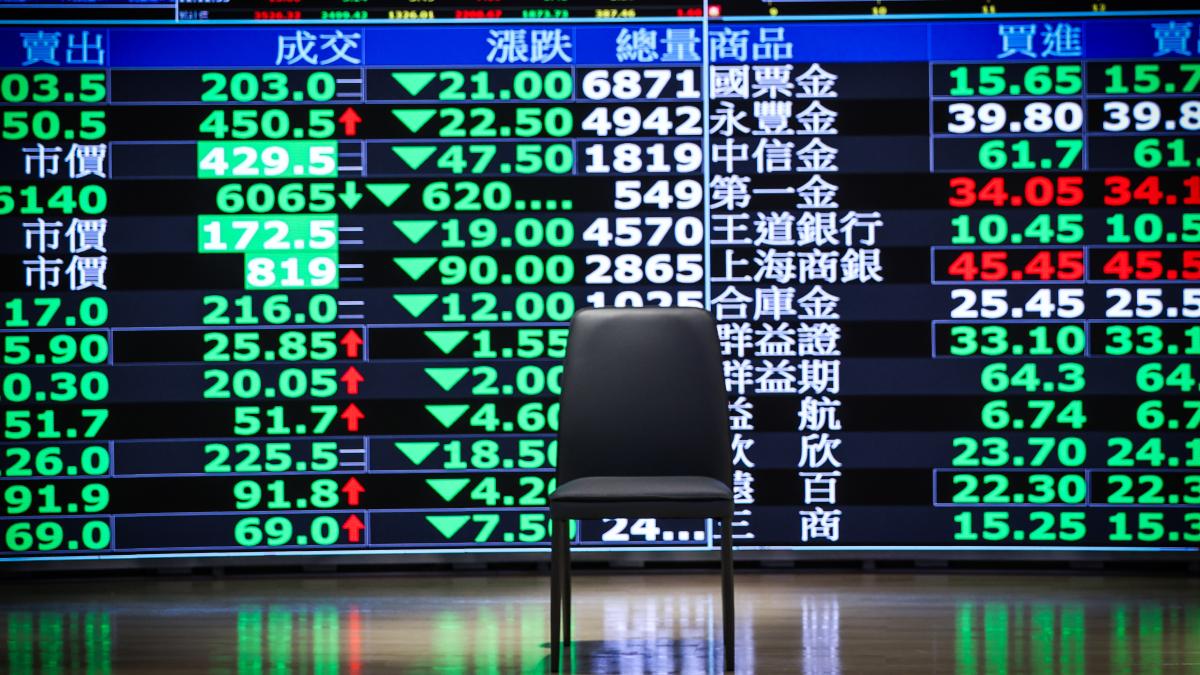
Major U.S. stock indices closed in the red, and the Philadelphia Semiconductor Index has entered a technical bear market. TSMC's earnings call failed to reverse bearish sentiment, hitting global tech stocks with multiple negative factors simultaneously. On the 17th, Taiwan's stock market saw a wave of panic selling, with the weighted index plunging nearly 3,000 points—the largest single-day closing drop in Taiwan's stock market history—sparking investor fears of a bear market.
In response, Huang Shixiu, founder of Nuclear Myth Busters, posted on Facebook questioning what truly defines a bear market. He proposed three dimensions for evaluation and challenged whether the current market meets any of these conditions.
Huang explained that while many financial commentators and investment influencers constantly predict market movements, almost none of them actually trade with their own capital. He criticized those who lack the ability to profit from the market yet thrive by 'harvesting韭菜 (cutting grass)'—a metaphor for exploiting retail investors.
Huang's three definitions of a bear market are as follows:
First, the mechanistic aspect: when falling stock prices fundamentally damage the economy, leading to credit contraction, financing difficulties, and corporate bankruptcies.
Second, the psychological aspect: when market sentiment shifts from extreme optimism ('I won't lose money') to extreme pessimism ('I can't make profits'), prompting investors to sell at any cost.
Third, the positioning aspect: when margin calls or psychological limits trigger a stampede, causing speculative capital to exit and stocks to shift from speculators to long-term investors.
Huang asked, 'Right now, which of these conditions does the current market actually meet? You must at least discuss these factors before you can even talk about a bear market.'
After the 17th's crash, some immediately predicted another sharp drop on Monday. When after-hours trading rose by 1,000 points, others rushed to forecast a rebound. Huang questioned, 'Why the rush? Whichever prediction you make, you're just fabricating stories without understanding.'
He bluntly stated, 'Most financial pundits and investment influencers aren't actually trading. They spend all day predicting the market but dare not put real money on the line. Without the ability to profit from the market, they survive comfortably by harvesting韭菜. The tragedy isn't the fraud itself—they know they're committing fraud. The real tragedy is that in this day and age, people still believe such fraud.'
Huang concluded, 'I don't have many stories to tell. I just say: deleverage, manage volatility, control risk, and manage exposure. Save one person at a time—that's how you accumulate good karma.'
More exclusive insights from Feng Media:
- Taiwan stock market to drop another 1,000 points on Monday? Expert gives one 'make-or-break number': these stocks are dangerous - Market-cap ETFs like 0050 and 006208 hit hard by Taiwan's plunge—Ruan Mu-Hua names one ETF that's 'highly resilient': maximum drawdown in single digits - $74 trillion foreign capital exiting Taiwan? Two tech stocks heavily dumped—Ruan Mu-Hua reveals 3 insights: the force is too strong
FACT BOX
- Source: PR Times
- Category: News