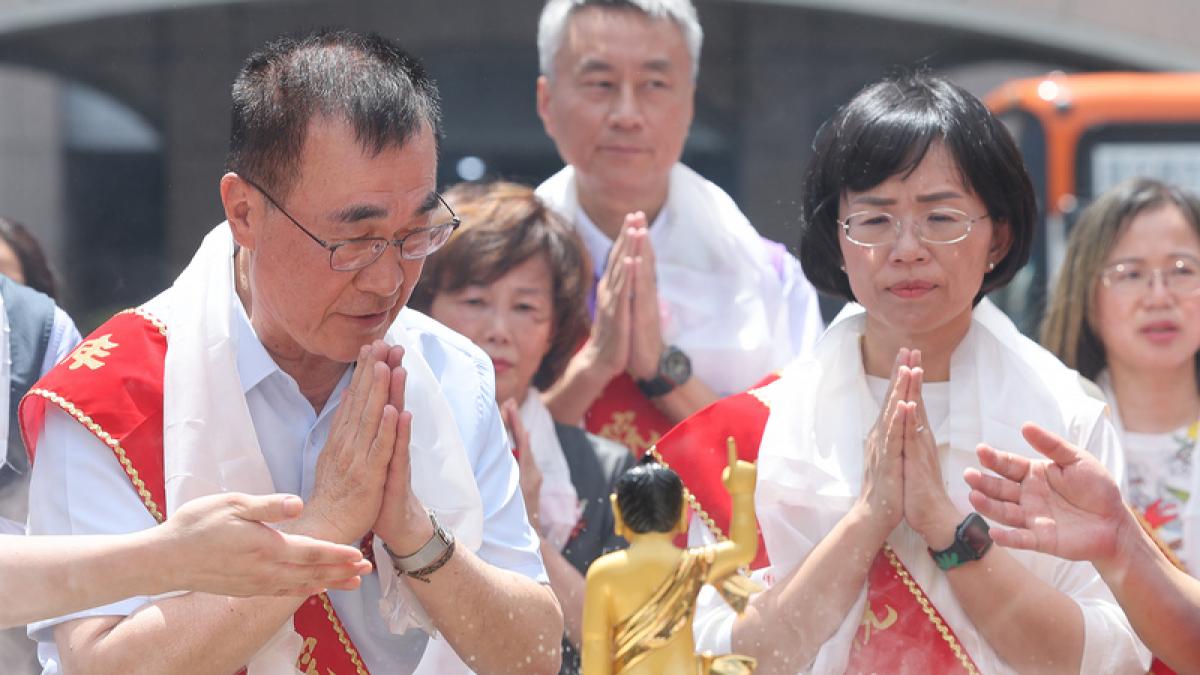
The year-end New Taipei City mayoral election has become fiercely competitive. According to the latest poll, Kuomintang (KMT) mayoral candidate Lee Sichuan leads with 50.85% support, ahead of Democratic Progressive Party (DPP) candidate Su Chiao-hui at 44.06%. In response, renowned Japanese scholar on Taiwan politics, Ogahara Yoshiyuki, posted an analysis on Facebook, stating that New Taipei City is likely to be the decisive battleground in the upcoming nine-in-one elections. He argues that if the DPP continues to emphasize 'resisting China and protecting Taiwan' or labeling opposition parties as 'pro-China,' it may consolidate its core supporters but is almost certain to lose in New Taipei.
Could Lai Qingde's approval rating sway the election? According to a recent poll by Juren Tianxia News Network, Lee Sichuan has gained support from centrist voters and Taiwan People's Party (TPP) supporters. Among 23.52% of centrist voters, Lee leads Su 54.81% to 33.21%, a 21.60 percentage point advantage. Among those who identify with the TPP, 81.97% support Lee. Additionally, 78.36% of voters who supported Ko Wen-je, the founding chairman of the TPP, in 2024 now back Lee.
Ogahara notes that President Lai Qingde's approval rating in New Taipei stands at 43.42%, while disapproval is at 56.58%, a 13-point gap. This suggests that Lai should avoid being too visible in the New Taipei campaign. With the DPP having governed long-term, public resentment exists, and last year's failed mass recall effort further damaged the party's image.
Who benefits from turning the race into a party showdown? Ogahara analyzes that if the DPP continues framing the election around 'resisting China' or 'pro-China' accusations, it will likely lose in New Taipei despite solidifying its base. He suggests the DPP should downplay party identity and focus on livelihood issues. For Su Chiao-hui's camp, shifting the narrative to a candidate-versus-candidate contest rather than a party battle will be key to victory.
This mayoral race features a seasoned male political veteran versus a mid-career female candidate, both solidifying their bases while showcasing distinct strengths. While Lee held a significant lead last year, the gap has narrowed this year, consistent with the latest Juren Tianxia poll. With four months until voting, the race is now seen as evenly matched. The battle for voters in their 20s will be particularly crucial. Over the next four months, the campaign's outcome will depend on which side demonstrates greater strategic acumen.
The survey was conducted by Juren Tianxia News Network,委托 to Pearson Data. Funding came from Juren Tianxia. The survey targeted New Taipei residents aged 20 and above, conducted online from July 6 to 11, 2026, with 1,766 valid responses. At a 95% confidence level, the margin of error is ±2.30%.
The sampling method used online active distribution via a Data Management Platform (DMP), with stratified random sampling by gender, age, and residence. User profiles were enhanced with behavioral tags to ensure uniqueness. Accuracy of gender, age, and location was verified through database cross-checking and questionnaire design. Duplicate responses, shared links, and non-random samples were excluded. Sample representativeness and weighting used ratio estimation, calibrated against Ministry of the Interior's May 2026 demographic data and Pearson's DMP adjustments to align sample characteristics with the population structure.
FACT BOX
- Source: PR Times
- Category: Survey