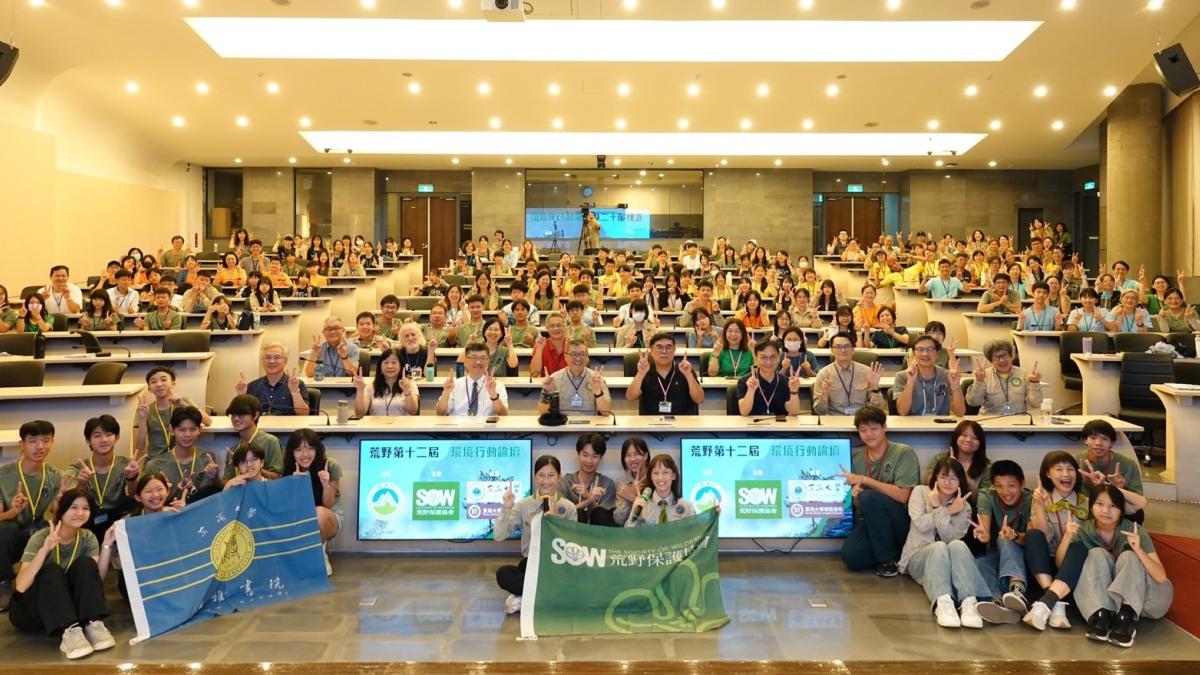
The '2026 National Environmental Action Forum' recently took place at Tunghai University, attracting over 350 young students, environmental action teams, and civil organizations from across Taiwan. Participants presented innovative action plans addressing climate change, ecological conservation, and the circular economy.
Environmental Minister Peng Chi-ming stated that the government will establish a public-private collaboration mechanism to incorporate outstanding forum proposals into environmental governance policies, enabling youth creativity and civic initiatives to influence public policy.
Co-organized by the Environmental Protection Administration, Wild at Heart Association, Tunghai University's General Education Center, and the College of Liberal Arts, the '12th National Environmental Action Forum 2026' was held on the 18th and 19th at Tunghai University. Wild at Heart Association Chairman Lee Chi-ting noted that after regional preliminaries in northern, central, and southern Taiwan, top teams gathered at Tunghai for the national finals. Through presentations and cross-domain exchanges across youth, adolescent, adult, and English-language categories, the forum stimulated intergenerational innovation on environmental issues.
Lee emphasized that this year marks the 12th edition of the forum and expressed gratitude to Tunghai University for eight consecutive years of support since 2019, serving as a key partner in helping young generations transform environmental ideals into action.
In his opening remarks, Minister Peng praised the Wild at Heart Association for its long-term environmental advocacy and, more importantly, its consistent on-the-ground efforts to protect Taiwan’s land. He highlighted that while Taiwan faces challenges such as climate change, urban heat islands, river management, and the circular economy, advocacy alone is insufficient—what is needed are actionable, implementable solutions. He pledged to build a government-civil society cooperation platform to ensure outstanding proposals become vital references in policy development. He stressed that environmental action must be sustained and practically implemented, not one-off events, to build a better sustainable future for Taiwan.
Tunghai University Vice President Yang Ting-ya pointed out that environmental issues such as Canadian wildfires, extreme weather, and food crises transcend national borders. Citing Sam Kass’s book 'The Last Supper,' he emphasized that responding to the climate crisis requires coordinated efforts across policy, social action, technology, and culture—with culture being the most critical. Aligning with the forum’s spirit of 'sharing, action, change,' he stated, 'sharing drives action, action accumulates change, and change ultimately becomes culture.' Only when sustainability becomes part of daily life can Taiwan truly respond to climate challenges.
Dean Wang Chung-ming of the College of Liberal Arts invoked Mencius’s concept of 'the heart that cannot bear the suffering of others,' noting that environmental protection begins with compassion for land, life, and society. When such compassion is supported by policy and public participation, it transforms into a powerful force for social change. He praised the collaboration between the Environmental Protection Administration and the Wild at Heart Association as a deep integration of civil action and public policy, aligning with the College’s values of humanistic care, civic engagement, and social practice. He expressed hope that youth will carry forward their environmental passion from this forum to become agents of societal transformation.
FACT BOX
- Source: PR Times
- Category: Event