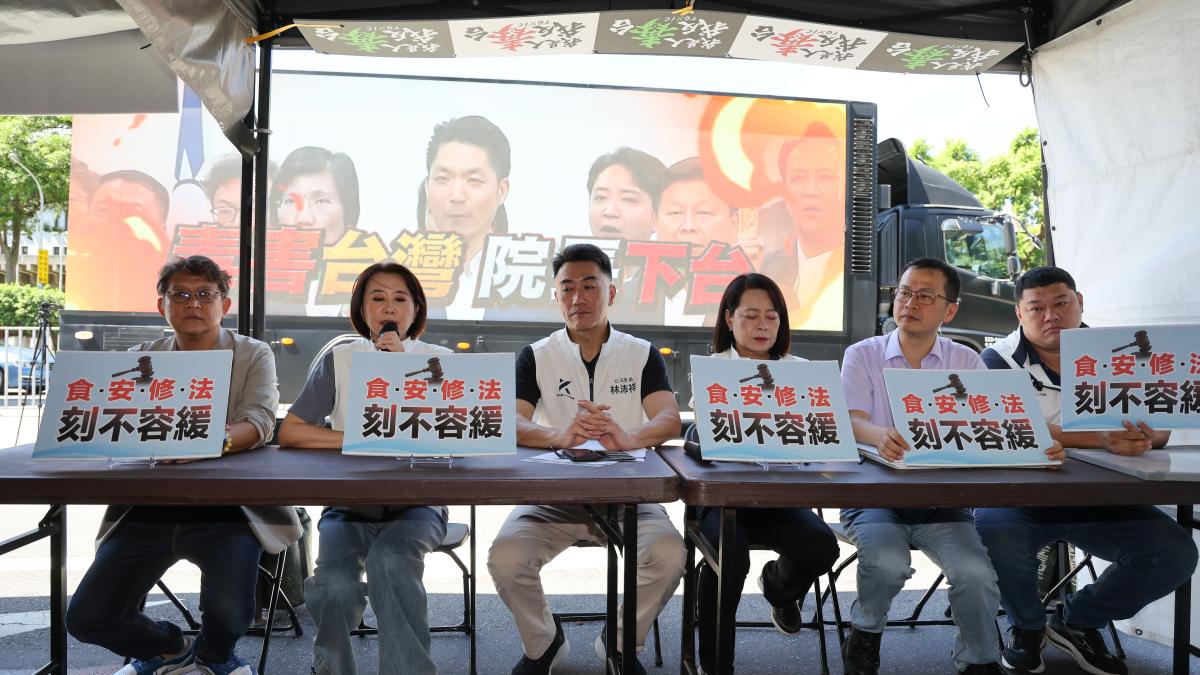
The toxic oil incident continues to escalate. The central and local governments are blaming each other, political parties are mobilizing supporters to take to the streets, and media coverage is dominated by political attacks over 'who should resign,' 'who is covering up,' and 'who is forcing people to eat toxic oil.' A public crisis that should have been about food safety governance has quickly become a stage for political confrontation. However, more important than asking who gained or lost politically is the deeper question: Why does Taiwan's public crisis repeatedly turn into a governance crisis?
From the pandemic, egg shortages, blackouts, imported eggs, to today's toxic oil incident, the issues differ, but the script is strikingly similar: crisis erupts, media amplifies, political polarization intensifies, street protests emerge, blame-shifting follows, and eventually the issue fades from headlines—yet the institutions that need reform remain largely unchanged. Crises recur not only because risks persist, but because the system fails to truly learn from them, thus losing the ability to transform crises into institutional progress.
Food safety is inherently a public governance task that relies heavily on science and institutions—not a competition of political stances. Take benzo(a)pyrene (BaP), the carcinogen in question: it is indeed internationally recognized as a carcinogen, so government actions such as legal inspections, tracking product flows, ordering recalls, and disclosing information are necessary. However, detecting a carcinogen does not automatically equate to a public health emergency. Real risk must be assessed based on contamination levels, exposure duration, intake amounts, and exposure scenarios across different population groups.
In other words, food safety is never a binary judgment of 'safe' or 'dangerous,' but a governance system built on scientific evidence, risk assessment, and risk management. When political language overrides scientific judgment, it does not enhance food safety; instead, it distorts information, amplifies public panic, and undermines trust in professional institutions.
Yet science is only part of crisis governance. The greater challenge lies in whether institutions function effectively. Taiwan's current Food Safety and Hygiene Management Act adopts a system where the central government coordinates and local governments execute—a structure designed for division of labor and cooperation, not for shifting responsibility. The central government is responsible for cross-county information integration, risk assessment, product traceability, and setting uniform standards. Local governments, meanwhile, carry out frontline tasks such as inspections, sampling, sealing, recall orders, and penalties.
While the central government must improve the speed of information disclosure and the quality of risk communication, local authorities cannot simply wait for central directives. Mature governance means not concentrating responsibility at one level, but ensuring every node in the system can function immediately when a crisis hits.
Unfortunately, in an age of rapid information flow, emotions spread far faster than institutional corrections. A political slogan spreads more easily than a risk assessment report; a street protest captures headlines more readily than an inter-agency review. Democracy needs oversight, but it needs governance even more. The purpose of oversight should be to improve institutions, not to replace them. When public crises are addressed only through political mobilization, democratic operation risks devolving from institutional competition into emotional competition, and public policy may slide from professional governance into 'volume-based governance.'
What is truly eroding is not just government credibility, but public trust in democracy’s ability to solve problems. The greatest challenge for 21st-century democracy is no longer winning elections, but governing increasingly complex public affairs. Food safety, energy transition, pandemic control, artificial intelligence, biotechnology, and extreme climate events all involve high levels of expertise and uncertainty—issues that cannot be resolved by slogans or protests alone.
As public problems grow more complex, democracy needs not just more political participation, but mature institutional cooperation, credible expert judgment, and the capacity for risk communication that builds social consensus. Expertise is not the opposite of democracy; it is a foundational pillar for effective democratic governance. A mature democracy does not let politics override expertise, but ensures politics protects expertise; it does not let emotions replace institutions, but ensures institutions respond to public anxieties.
When the toxic oil incident eventually fades, what should remain is not just political memory, but institutional memory. We must use this crisis to re-examine food traceability, risk assessment, inter-agency coordination, information disclosure, and central-local division of labor—making our governance capabilities more mature than before the crisis. The true value of a mature democracy lies not in the absence of crises, but in the ability to grow stronger with each crisis.
If every public crisis leaves behind only intensified political polarization while institutions remain stagnant, what is truly lost is not just food safety or government trust, but democracy’s capacity to govern complex public issues. And a democracy that has lost its governance capacity, even if it still holds elections, will struggle to genuinely respond to people’s anxieties.
*The author is the founder of the Taiwan Sustainable Governance Forum and an associate professor at Chinese Culture University.
FACT BOX
- Source: PR Times
- Category: News