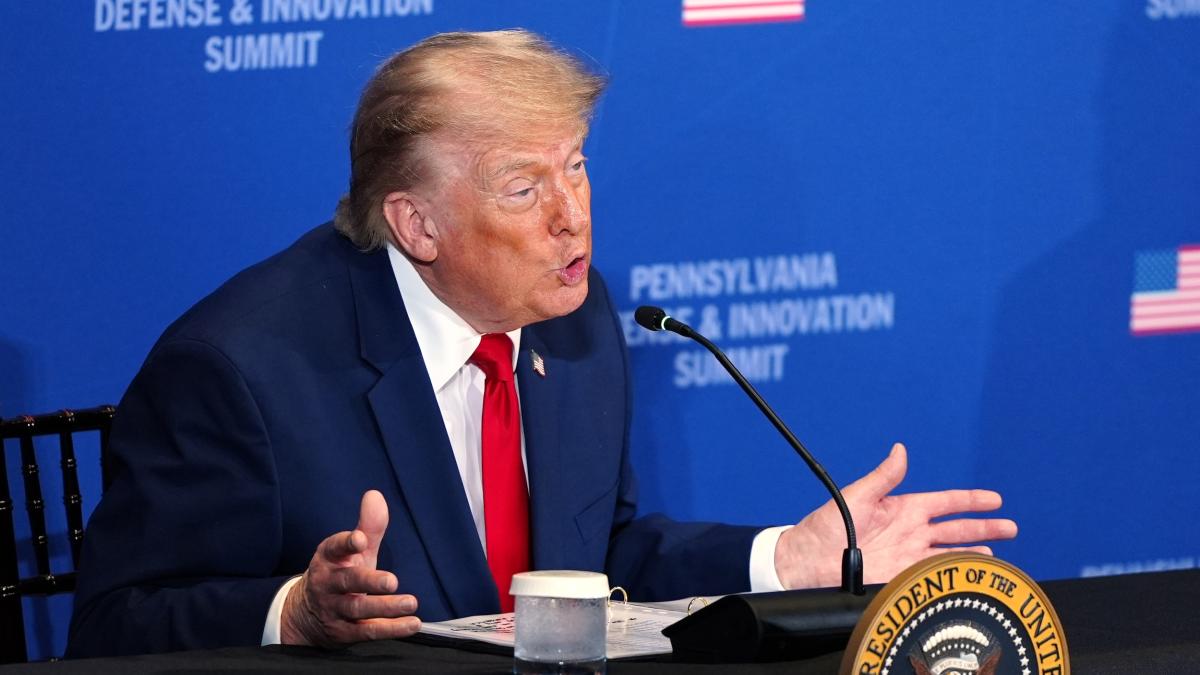
Although U.S. President Trump was a political outsider, how did he manage to win the presidential elections in both 2016 and 2024, becoming the leader of the world's most powerful nation? Nobuo Kuroda, Chief Economist at Japan's Nomura Research Institute, analyzes that for over 40 years, neither the Democratic Party nor the traditional Republican Party adequately addressed a critical issue: under the waves of free trade and globalization, the United States has long suffered from trade deficits, causing sustained outflows of domestic wealth and severely eroding job opportunities—particularly in manufacturing, agriculture, and mining. These industries are predominantly blue-collar and concentrated in inland or rural regions of the U.S. As job opportunities shrank due to free trade, public discontent grew increasingly intense. In contrast, sectors such as finance, services, and academia, which are largely based in urban areas on the East and West Coasts, were less affected by trade imbalances.
When Trump announced his candidacy for the 2016 presidential election in 2015, the U.S. political and media establishment largely dismissed him as irrelevant. Yet, support from millions of blue-collar workers surged, ultimately overturning mainstream political thinking and propelling Trump into the White House. The root of Trump's power lies in the deep-seated public grievances accumulated from decades of U.S. trade deficits.
On February 2, Kuroda delivered a keynote speech at the CaiXun Influence Forum titled 'The Global Economy at a Crossroads and the End of the U.S.-Led Global Order.' He explained that despite Trump being a political novice whose statements are often inconsistent and chaotic, he won two presidential elections because both major parties failed for 40 years to address the persistent U.S. trade deficits and an overvalued dollar—factors that led to the continuous loss of blue-collar jobs and the accumulation of grassroots resentment.
Kuroda illustrated this with a chart showing that both the U.S. and the U.K. began running trade deficits around 1980. The U.S. deficit expanded rapidly during the Clinton administration in the 1990s. Although it temporarily narrowed during the 2008–2009 financial crisis, it has continued to grow since. Kuroda emphasized that every additional dollar of U.S. trade deficit means one less dollar of domestic economic activity—money flowing out of the U.S. to other countries. Trade deficits reduce the size of the U.S. economy (GDP) and slow economic growth.
Under normal circumstances, governments strive to minimize trade deficits, as larger deficits typically lead to national impoverishment. Yet, both U.S. parties have long ignored this issue. Kuroda compiled data from multiple international institutions and think tanks, estimating that from 1980 to 2024, the cumulative U.S. trade deficit amounts to approximately $46 trillion (over NT$1,400 trillion), equivalent to 157% of the U.S. GDP.
'$46 trillion is an enormous sum—equivalent to all Americans losing $46 trillion in income over this period. And this loss wasn't evenly distributed. Only workers in manufacturing, agriculture, and mining were significantly affected, while those in finance, services, or academia were largely unscathed,' Kuroda stated. In other words, rural and non-metropolitan areas of the U.S. became the hardest hit—residents lost jobs and income—while urban Americans remained relatively unharmed.
He analyzed that neither party effectively addressed this impact. Republicans, traditionally supporting free trade, believed market forces would self-correct and thus avoided intervention. Democrats, while rhetorically supporting blue-collar workers, took little concrete action, including failing to address the overvalued dollar. For ordinary Americans who lost $46 trillion in income, voting for either party made no difference—neither would help them. This neglect created the conditions for Trump's rise.
When Trump recognized the widespread public anger among millions of Americans, he began openly advocating protectionism to support businesses and workers. Suddenly, millions of blue-collar workers rallied behind him. In 2015, when Trump first declared his intention to run in the 2016 election, he was widely ridiculed as a crazy man who knew nothing about politics, diplomacy, or national security. But as he championed protectionism, massive public support emerged—shocking both parties.
Republicans were stunned: their long-standing support for free trade made Trump's protectionist stance heretical, yet it attracted wave after wave of new supporters. Democrats were equally shocked to see their traditional blue-collar base shifting to support Trump. This shift was so dramatic that Hillary Clinton, the Democratic presidential candidate and former Secretary of State who originally supported the Trans-Pacific Partnership (TPP), reversed her position at the last minute and declared support for protectionism. But it was too late—Trump won.
Kuroda believes that the U.S. political establishment, whether Democratic or traditional Republican, largely failed to recognize the deep social damage caused by decades of free trade. This neglect allowed a political outsider like Trump to rise to power—an impact that continues to shape U.S. and global affairs today.
Now, one and a half years into Trump's second term, a major challenge looms: the November 2024 midterm elections. All 435 seats in the House of Representatives and one-third of the Senate seats (35) will be up for re-election. While Republicans currently hold majorities in both chambers, their margins are slim. In the 100-seat Senate, Republicans hold 53 seats, Democrats 45, and two independents who typically align with Democrats—giving Republicans a six-seat advantage. In the House, Republicans hold 218 seats to Democrats' 212—a mere six-seat majority.
Looking at U.S. history since World War II, the ruling party has lost its congressional majority in over 90% of midterm elections. Moreover, when a sitting president's approval rating falls below 50%, the ruling party almost certainly loses seats. Polls from The Washington Post, AP, and The Economist consistently show Trump's approval hovering around 37%, significantly down from 47–50% at the start of his term.
This suggests that although Trump successfully harnessed public discontent to gain power, maintaining Republican dominance in Congress and securing favorable conditions for his continued governance remains a formidable challenge in the coming months.
FACT BOX
- Source: PR Times
- Category: Survey