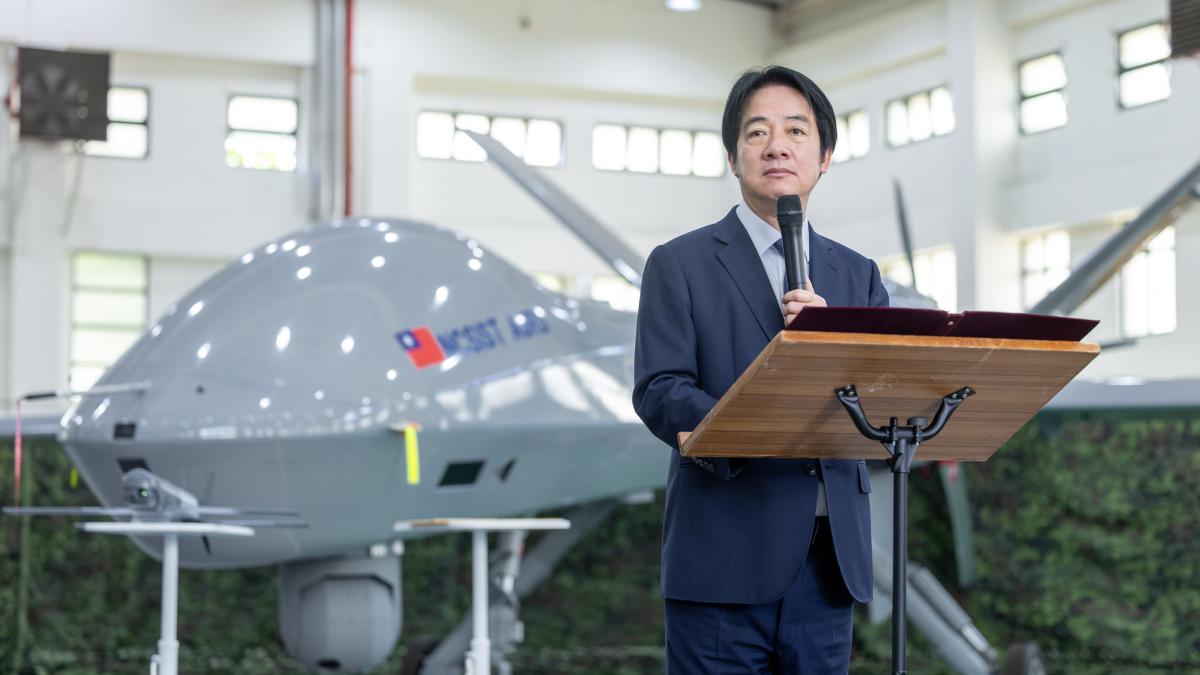
The Executive Yuan recently proposed a special drone bill with a total budget of NT$210 billion. However, opposition parties in the Legislative Yuan have submitted their own versions, advocating for the budget to be incorporated into the annual budget and placing the Ministry of Economic Affairs (MOEA) as the overseeing authority. In response, President Lai Ching-te made a rare public outburst during his inspection of the Aerospace Institute at the National Chung-Shan Institute of Science and Technology (NCSIST) on July 17. President Lai stated that the opposition parties are refusing to support the Ministry of National Defense's (MND) required funding and proper oversight structure, expressing deep frustration. He emphasized that he hopes the Legislative Yuan will support the nation so that every officer, from the defense minister down to individual soldiers, can focus on their duties without being held hostage by legislative delays.
Lai pointed out that China's political and military pressure on Taiwan, along with infiltration and cross-border suppression, has intensified in recent years. To demonstrate Taiwan's commitment to safeguarding national security, maintaining stability in the Taiwan Strait, and contributing to peace in the Indo-Pacific, Taiwan must respond to international calls for collective defense and shared responsibility. To this end, the MND previously submitted an eight-year special defense budget totaling NT$1.25 trillion for legislative review. However, the Legislative Yuan ultimately approved only NT$780 billion—insufficient even to cover arms purchases from the United States—while cutting NT$470 billion from programs including international cooperation, commissioned projects, independent R&D, and defense industry development. Most critically, the entire drone-related budget was completely deleted.
Lai stressed that, based on the Russia-Ukraine war, the Israel-Hamas conflict, and ongoing U.S.-Iran tensions, drones have become the most crucial weapon on modern battlefields and represent the essence of asymmetric warfare. Therefore, the Executive Yuan has not given up. Lai expressed gratitude to Defense Minister Kao Li-hsiung and his team for resubmitting a special drone bill totaling NT$210 billion. The remaining NT$200–300 billion will be allocated through supplementary budgets and next year’s annual budget to make up for the NT$470 billion cut.
Regarding the opposition's proposal to place drone development under the MOEA instead of the MND, Lai expressed strong dissatisfaction. Citing Defense Minister Kao’s testimony in the legislature, he emphasized that “money for rice and money for oil cannot be mixed.” This budget is specifically for military drones required by the MND. In contrast, the opposition’s proposed drone industry development bill under the MOEA would only allow funds to be used for commercial and civilian applications, failing to meet the military’s force-building needs. Lai stressed that the MND and MOEA have distinct mandates: the MND focuses on national defense, while the MOEA supports industrial development and supply chain construction to assist in drone production. The Executive Yuan has already allocated a six-year, NT$44.2 billion program to the MOEA for industrial chain development, making additional funding proposals from the opposition unnecessary.
Lai criticized the opposition for denying the MND both the necessary funding and oversight authority, while simultaneously proposing to redirect funds to the MOEA—a clear case of conflating different institutional responsibilities. After viewing NCSIST’s R&D achievements, Lai expressed admiration, stating that Taiwan’s drone technology is already on par with international standards. National security agencies—including the National Security Council, MND, Ocean Affairs Council, and Ministry of the Interior—along with relevant Executive Yuan agencies, have established a comprehensive drone warfare framework through international exchanges. NCSIST, the Industrial Technology Research Institute (ITRI), the Institute for Information Industry (III), academic research institutions, and the Overseas Alliance of Excellence in Drones are all in place. “Everything is ready except the east wind,” Lai said, urging the Legislative Yuan to support the government’s drone offense-defense system. With such support, he expressed full confidence in safeguarding national security.
Finally, Lai called on the opposition parties, acknowledging that political competition is inevitable but stressing that national interests and the safety of people’s lives and property must not become pawns in political games. He expressed deep sorrow seeing Defense Minister Kao and MND officials repeatedly visiting legislative committees and individual lawmakers’ offices to explain the budget. These unnecessary efforts could be eliminated, freeing up time and energy for military leaders and personnel to focus on training and combat readiness.
Lai urged the public to support the government’s determination to protect national security. National defense development requires stable, long-term funding, and special budgets have been routinely used in the past. It is inappropriate to abruptly switch to annual budgeting now. Once the special budget is passed, the necessary systems can be rapidly established.
FACT BOX
- Source: PR Times
- Category: News