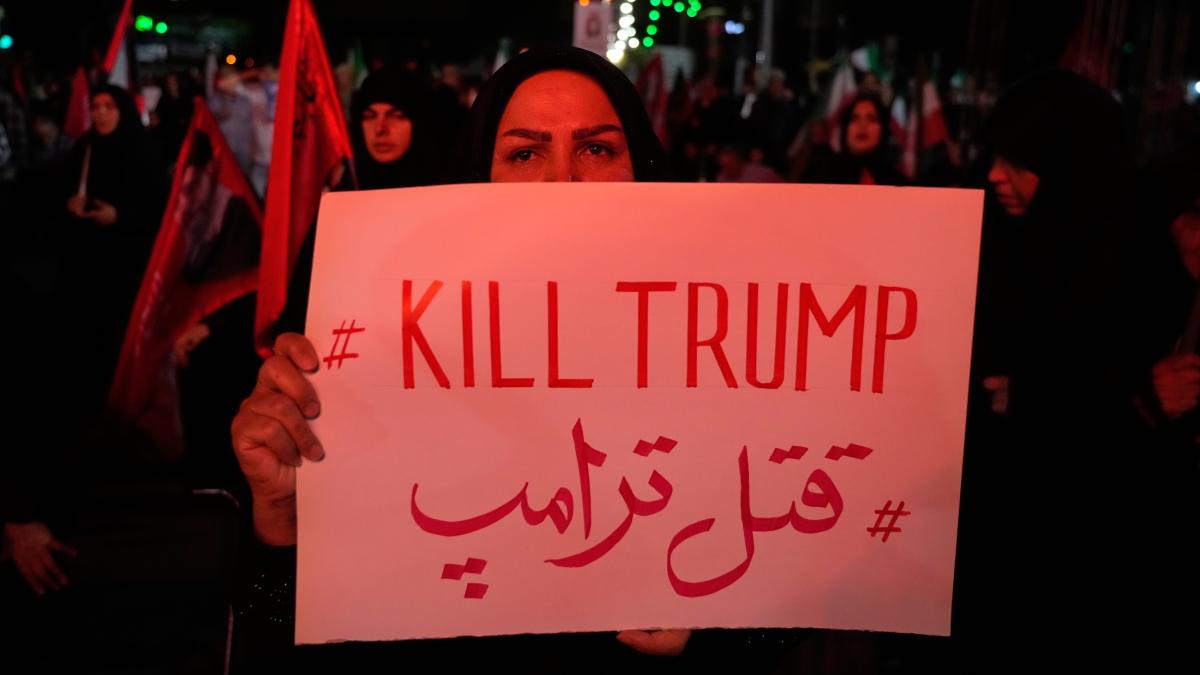
The U.S.-Iran conflict has taken a catastrophic turn, as the United States launched a new round of airstrikes on Iran, while American military casualties continue to rise. Iran's Islamic Revolutionary Guard Corps (IRGC) announced that two oil tankers attempting to pass through the southern 'unsafe' waterway were bombed and halted. On July 20, Asian markets reacted immediately, sending international oil prices soaring past $90 per barrel for the first time since June 11.
According to the Financial Times, Brent crude futures—the global benchmark—jumped 2.5% in early Asian trading on July 20, reaching $90.30 per barrel. Oil prices have risen over 23% this month alone, marking the largest single-month gain since the conflict began on February 28.
On July 19, 2026, a statue commemorating the late Supreme Leader Khamenei stood in Tehran's Islamic Revolution Square (AP).
The Associated Press reports that the surge in oil prices stems from the rapid escalation of retaliatory strikes between the U.S. and Iran. The U.S. confirmed additional military casualties over the weekend, with at least three American soldiers killed in airstrikes since July 17, and the remains of a fourth possibly discovered in Jordan. The U.S. claims its offensive aims to secure safe energy transit through the Strait of Hormuz, targeting Iranian military installations, coastal surveillance posts, and communication networks. However, Bloomberg reports that attacks have expanded over the past week to include bridges, utilities, and port facilities, making a return to last month’s fragile ceasefire agreement highly unlikely.
On July 18, 2026, a bridge in Iran’s southern Hormozgan Province was destroyed by U.S. airstrikes (AP).
Anthony Yuen, Citigroup’s Head of Energy Strategy, stated: 'Both the U.S. and Iran are now testing the limits of the ceasefire agreement. This will make many shipping companies hesitant to transit the Strait of Hormuz.' 'Current prices already reflect a bullish scenario driven by escalating tensions. Whether either side can find a de-escalation mechanism remains uncertain.'
In response to U.S. attacks, Iran’s IRGC remains defiant. In a statement, the IRGC confirmed that two oil tankers were 'bombed and intercepted' on the evening of July 19 while attempting to cross the southern 'unsafe' waterway. The IRGC condemned U.S. military intervention, calling it legally unjustifiable, stating: 'As long as U.S. hostile actions continue in the region, no oil, gas, or fertilizer will pass through this strategic waterway.'
The IRGC also claimed to have used intelligence from Jordanian nationals to target U.S. military assets, including a C-17 transport aircraft and a P-8 maritime patrol aircraft at Aqaba Airport in Jordan, and a hangar housing MQ-9 Reaper drones at Ali Al Salem Air Base in Kuwait.
On July 20, the UK Maritime Trade Organisation (UKMTO) issued an emergency alert, reporting a vessel on fire off northern Oman. 'The cause of the fire has not been confirmed. Vessels transiting the area are urged to exercise caution.'
Geopolitical Risks Spill into Commodity Markets
The Middle East conflict is now spilling over into commodity markets. Bloomberg reports that worsening U.S.-Iran tensions have driven up prices for crude oil and other vegetable oils. Malaysian palm oil futures on the Bursa Malaysia Derivatives Exchange rose 0.7% to 4,635 ringgit per ton—the highest level since June 23. Meanwhile, vegetable oil futures in Chicago (CBOT) and Dalian Commodity Exchange also surged.
Fastmarkets, a leading UK-based commodity research firm, stated that the palm oil rally is strongly supported by 'the recovery in crude oil prices and high war-risk premiums following the deterioration of the Middle East situation.'
In contrast to the volatile commodity markets, global financial markets remain relatively calm. The U.S. Dollar Index, measuring the dollar against a basket of major currencies, held steady. The benchmark 10-year U.S. Treasury yield remained stable at 4.55%. S&P 500 futures and Stoxx Europe 600 futures showed little movement, while Asian equities traded mixed.
FACT BOX
- Source: PR Times
- Category: News
- Organizations: Fastmarkets