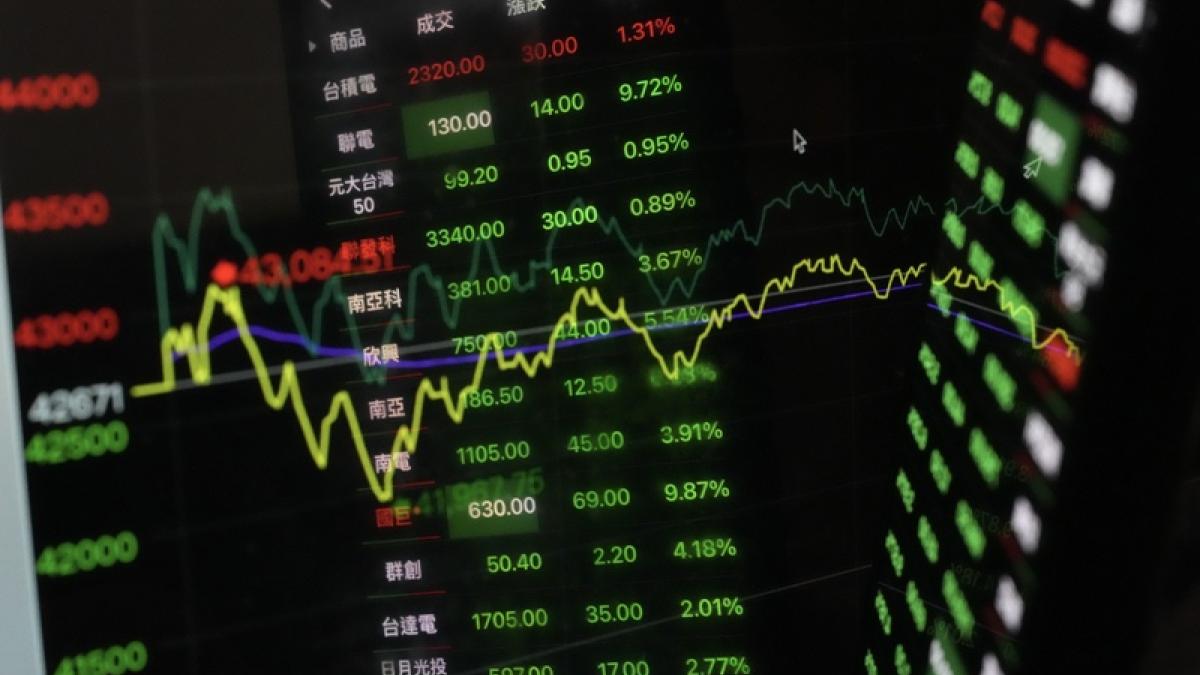
Taiwan's stock market has recently undergone a correction. Although the overall index decline isn't severe, many popular theme stocks have faced a 'halving' in value, leaving investors anxious. Experts believe that based on recent financial reports from global tech leaders, corporate earnings and AI capital expenditures remain robust. Investors should focus on seizing pullback opportunities rather than missing long-term growth trends due to short-term volatility.
Zhang Rongren, General Manager of FundRich, pointed out that the biggest market misconception recently is equating stock price corrections with weakening fundamentals. In fact, AI demand remains unchanged, and Taiwan's semiconductor supply chain competitiveness has not diminished. What has truly changed is market positioning and investor sentiment. AI-related stocks have seen remarkable gains over the past year. With valuations already high, any deleveraging or profit-taking can easily cause short-term price volatility, but this does not mean the long-term AI trend has ended.
"This downturn reflects a liquidity adjustment, not a shift in industrial demand," Zhang analyzed. One trigger for this correction was South Korea's regulatory tightening on single-stock leveraged ETFs. Local retail investors had heavily leveraged semiconductor blue chips like Samsung Electronics and SK Hynix through margin trading and leveraged ETFs. When regulators raised margin requirements and restricted these products, concerns arose about forced liquidations, causing the Korean stock market to plummet first, quickly spreading selling pressure to global semiconductor and AI-related stocks.
He noted that although Taiwan's market corrected in tandem with global semiconductor sell-offs, Taiwan holds a unique competitive advantage in the global AI supply chain—playing an irreplaceable role from foundry and IC design to advanced packaging, high-speed computing, and AI server manufacturing. As the world's four major cloud service providers continue expanding AI capital expenditures and enterprises globally accelerate the adoption of generative AI, Taiwan's tech industry will remain the biggest beneficiary. Thus, short-term volatility helps absorb excessive valuations, bringing the market back to fundamentals and offering long-term investors more reasonable entry points.
Whenever the market drops sharply, many investors instinctively think, "Sell first, buy back after it falls further," hoping to boost returns through market timing. However, the real challenge isn't selling—it's knowing when to buy back.
FundRich conducted a nearly century-long backtest using the S&P 500 total return index (including dividends) from the end of 1927 to July 2026, comparing two strategies: "buy and hold" versus "sell after a 10% drop from peak, buy back when index reclaims its quarterly moving average." The results show that over a 30-year holding period, the long-term holding strategy achieved an average cumulative return of 2241%, significantly higher than the 1707% from short-term trading—differing by 534 percentage points.
Zhang analyzed that while this strategy appears to avoid some losses, investors often miss the most crucial early rebound phase, which typically determines long-term investment performance. Historical experience repeatedly proves that the greatest market risk isn't short-term correction, but leaving the market and missing the compounding effect of subsequent recovery.
Zhang reminds investors that the long-term growth trend of the AI industry remains unchanged, and Taiwan's tech industry competitiveness continues to strengthen. Every major market shock caused by sentiment or liquidity offers long-term investors a valuable opportunity to accumulate quality assets. Instead of guessing the bottom, investors should establish disciplined strategies—such as dollar-cost averaging and phased investing. When the market returns to fundamentals and AI-driven momentum lifts Taiwan stocks again, positions accumulated at lower levels will be better positioned to generate long-term compounding returns.
More exclusive insights from Feng Media: ‧ Taiwan market opens high but fluctuates around 1,000 points; TSMC can't hold up? Three major institutions buy NT$500 million, foreign investors cover futures short positions ‧ NVIDIA and Microsoft losing favor? Retail investors abandon 'Tech Magnificent Seven,' seeking the next AI star ‧ Market alarm ringing? Managers' cash levels drop below 4%, triggering 'sell signal' amid AI boom bets
FACT BOX
- Source: PR Times
- Category: Survey