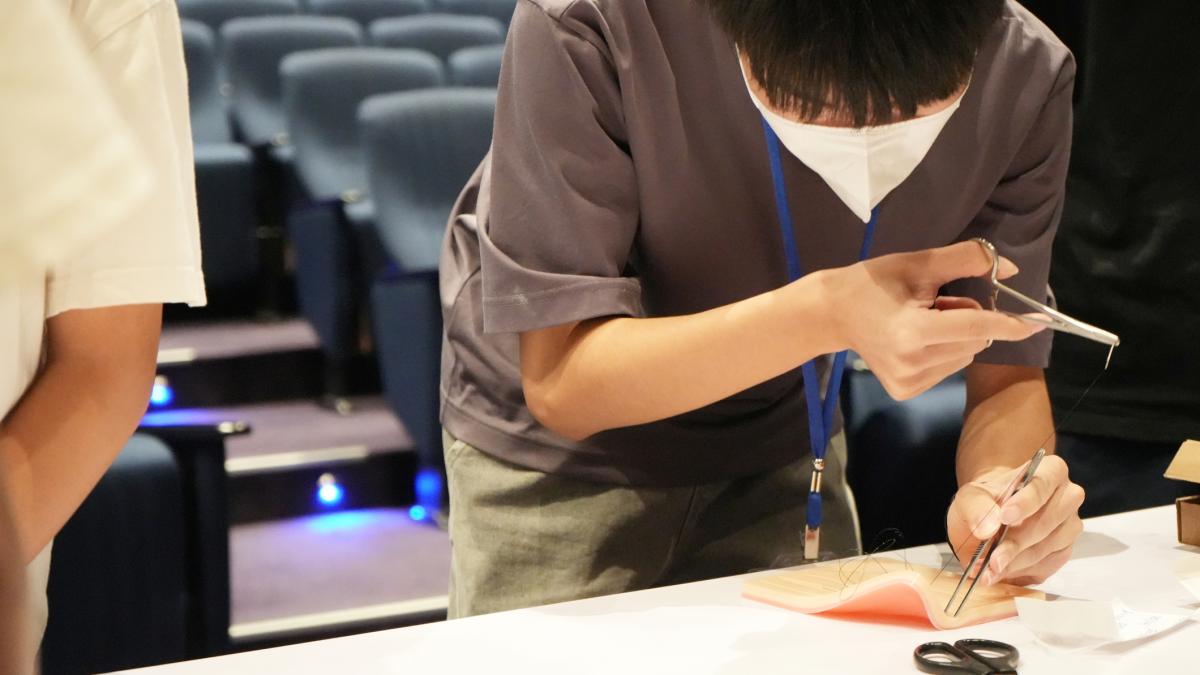
Plaster casts are no longer just white immobilizers wrapped around limbs after fractures, and wound suturing is no longer just a scene from medical dramas. Twenty-three high school students recently participated in the '2026 Innovative Bilingual Medical Experience Camp' hosted by Taipei Hospital, Ministry of Health and Welfare. They personally applied plaster casts, practiced suturing on silicone wound pads using needle holders, and entered the operating room to closely experience the fourth-generation Da Vinci surgical robotic system. Through these activities, they experienced the precision, patience, and responsibility required in medical professions, forming a more concrete vision for their future academic and career paths.
Kuo Hsien-hua, Special Assistant to the Hospital Director, stated that high school students are at a critical stage of academic and career exploration. Therefore, the program extended beyond theory to include clinical practice, emergency skills training, mental health education, and hospital site visits. Aligned with the National Development Council’s bilingual policy, the camp integrated common medical English terminology and bilingual interaction. 'We want students to understand that medical work requires not only technical expertise but also communication, teamwork, and a strong sense of responsibility,' Kuo emphasized.
A first-year student named A-Cheng (pseudonym) shared that the wound suturing practice left the strongest impression. 'I was amazed that the suturing needle was curved. I thought all you had to do was close the wound, but in practice, I realized how steady your hands must be, and how challenging the needle angle and knotting techniques are. I now have even greater respect for doctors.'
Students practicing plaster cast application. (Photo courtesy of Taipei Hospital)
Another highlight was the visit to the operating room to learn about the fourth-generation Da Vinci surgical robotic system. Students observed how surgeons use robotic arms to perform delicate procedures and explored the application of smart technology in minimally invasive surgery. Second-year student Hsiao-Hsuan said, 'Seeing the Da Vinci surgery in person was astonishing, and being able to operate it myself was so fun!'
Additionally, students practiced CPR (cardiopulmonary resuscitation) and AED (automated external defibrillator) use, building correct emergency response knowledge. They also learned emotional regulation, self-care, and stress management techniques, enhancing their self-care abilities and psychological resilience.
While a single day of experience may not immediately determine future career choices, it exposed students to the diverse aspects of medical work and deepened their understanding of how smart technology drives innovation in healthcare. The Innovative Bilingual Medical Experience Camp at Taipei Hospital is opening new possibilities for students’ career development.
FACT BOX
- Source: PR Times
- Category: Event
- Dates in source: 2026