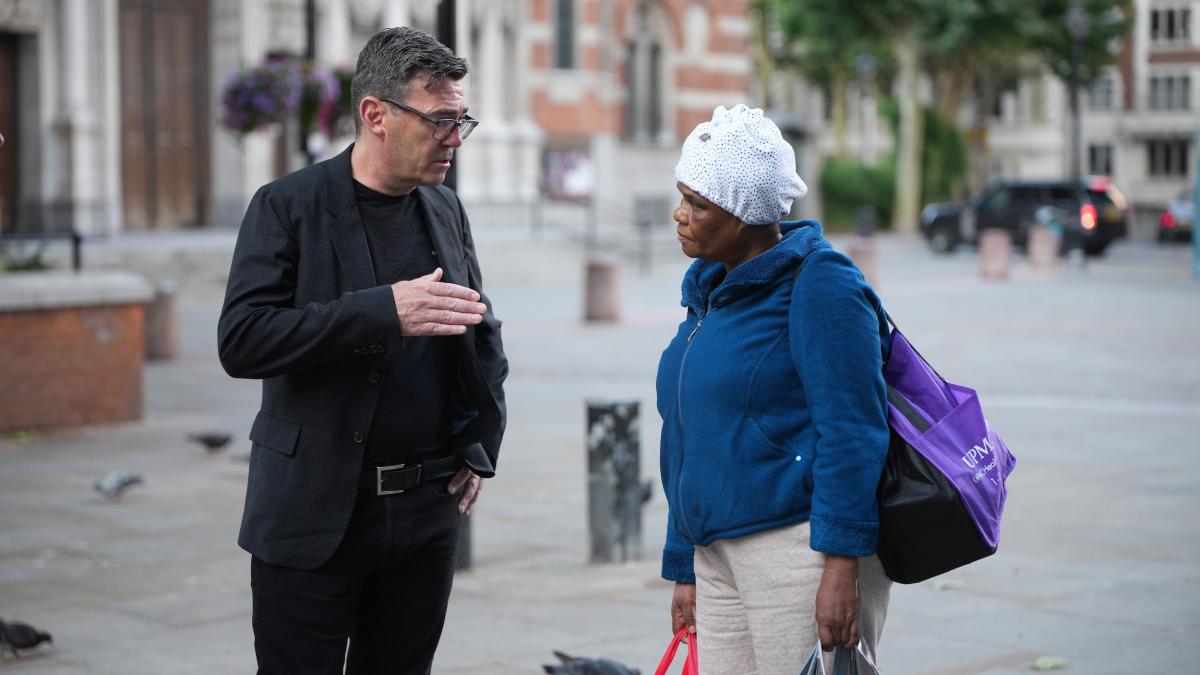
Rarely in recent years has someone become Prime Minister of the UK as Andy Burnham has—without undergoing close public scrutiny. Since the governing Labour Party ultimately chose to appoint its leader through a 'coronation' rather than a leadership election, there was almost no opportunity to debate his policy positions or governing style. The benefit of this approach is that it avoided a potentially damaging public split within the party; the downside is that the new leader and Prime Minister has not undergone sufficient political testing. Of course, we will soon find out what kind of Prime Minister he will be. But notably, beyond his decade as Mayor of Greater Manchester, Burnham is not widely known, meaning the public will gradually come to understand this new leader over the coming months.
On 20 July 2026, Burnham entered 10 Downing Street as the UK's new Prime Minister. (AP)
What we know about Burnham reveals someone who embodies both 'outsider' and 'insider' qualities. Like many contemporary politicians, he tends to emphasize his outsider status. He is seen as an outsider because he comes from a working-class family in northern England. Yet, he is also an insider: he graduated from the prestigious University of Cambridge and quickly entered politics, becoming a rising star in Tony Blair and Gordon Brown’s New Labour government.
In terms of personal image, Burnham deliberately cultivates the persona of an approachable, ordinary person with whom the public can identify. He enjoys drinking beer and eating fish and chips, frequently talks about football and music, and dresses in a noticeably more stylish manner than recent political figures.
Politically, Burnham has stated that as a teenager, he deeply resented Margaret Thatcher’s Conservative government in the 1980s, which pursued privatization and economic liberalization. He believes those policies led to deindustrialization in northern England, where he grew up, and damaged local morale.
As in the past, he openly identifies as centre-left. Like many European left-wing politicians, Burnham generally believes the state should play an active role and focus on society’s poorer members.
On 20 July 2026, King Charles III received Labour Party leader Burnham at Buckingham Palace and invited him to form a new government. (AP)
Burnham frequently criticizes the past 40 years of 'neoliberalism,' arguing it has failed ordinary people. However, he has never clearly defined what he means by neoliberalism, and he does not appear to be ideologically driven or particularly interested in policy details.
Will Burnham significantly change the UK’s foreign or domestic policies? The simple answer is: we don’t know, because he has said so little.
On domestic policy, he faces major constraints. The UK currently suffers from weak economic growth, high national debt, and both public spending and tax levels are already at historic highs. Although the Labour left wing hopes for greater government intervention in the economy and society, this will be difficult to achieve. The Burnham government is also bound by Labour’s commitments from the last general election, including not raising most taxes or significantly increasing borrowing.
Since being elected as Labour’s incoming leader, Burnham has proposed only one major initiative: further devolution, transferring more power and funding from London to regional areas. However, this idea remains highly abstract.
On foreign policy, Burnham has rarely spoken throughout his political career, so continuity with existing policies is far more likely than major changes. Foreign policy is typically shaped by geography, history, national interests, and the international situation, rather than party ideology or a leader’s personal preferences—making such continuity unsurprising.
Therefore, like Sir Keir Starmer, Burnham is expected to seek closer ties with the EU, but not too close, while continuing to emphasize the UK’s commitment to the rule of law, international norms, and multilateral institutions like the United Nations.
He will also work to maintain the special relationship with the United States, though he may not develop an especially close personal rapport with President Donald Trump—though he will certainly try.
On 20 July 2026, Burnham entered 10 Downing Street hand-in-hand with his wife, becoming the UK’s new Prime Minister. (AP)
Burnham will be the UK’s seventh Prime Minister in the past decade. This astonishing rate of leadership turnover alone underscores the immense challenges he faces. For him, there is both bad news and good news.
The bad news is that the economic and social problems that caused the previous six Prime Ministers to fall remain vast in scale.
The good news is that perhaps the appeal of populist parties on both the left and right—such as the Green Party and Reform Party—has peaked. Or at least, that may be the case.
Ultimately, Burnham remains full of unknowns. Is he, as some fear, merely a likable but underqualified politician? Or, as Labour MPs hope—albeit with varying degrees of optimism—will he become a truly significant political figure?
FACT BOX
- Source: PR Times
- Category: News