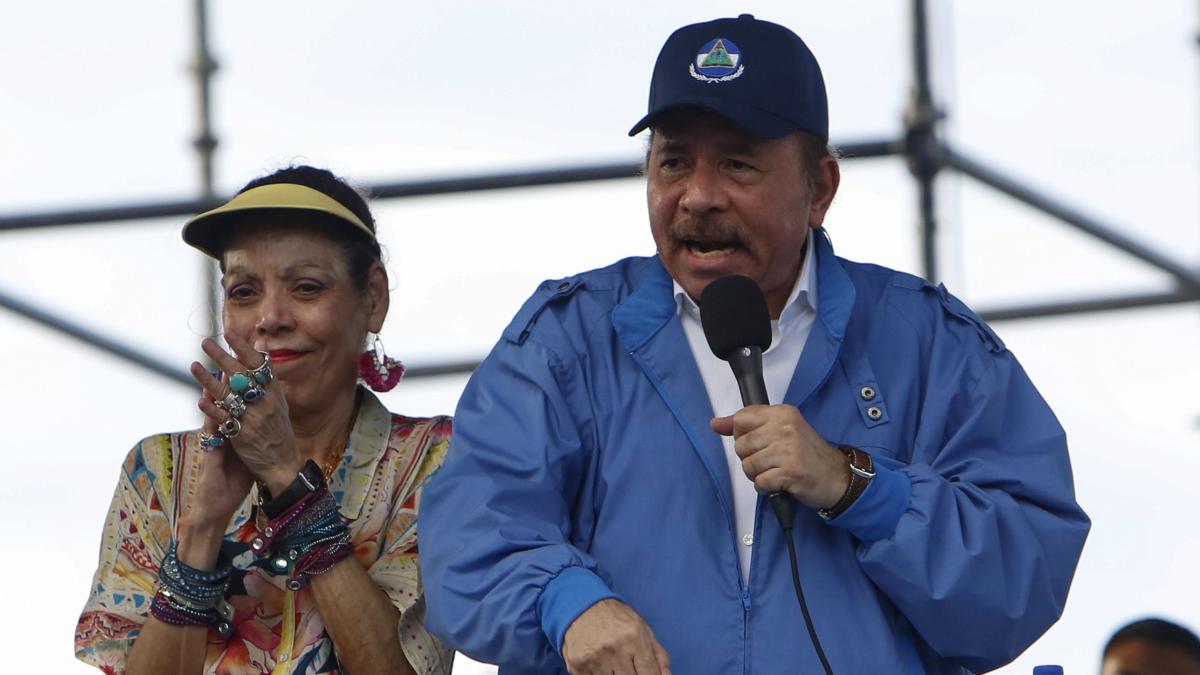
A shocking transformation has taken place in Nicaragua, a Central American nation. Daniel Ortega, the strongman president who has held power for nearly 20 years, recently delivered a speech at a Sandinista Revolution commemoration rally, officially declaring that Nicaragua will "no longer hold any elections." This decision not only cancels the next presidential election—previously postponed to November 2027 through constitutional amendments—but also completely shatters the final hopes of the opposition and the international community for a return to democratic governance. This move further consolidates the control of Ortega and his wife, Rosario Murillo, over the nation.
In his speech, Ortega fiercely criticized his long-time adversary, the United States: "There will be no more elections here. Those parties propped up by Yankees and puppet regimes attempting to return to power—this will never, ever happen again!"
In reality, since the outbreak of anti-government protests in Nicaragua in 2018, Ortega has chosen brutal repression to quell dissent, resulting in hundreds of deaths. The powerful couple has since clung tightly to military and political power. In the previous 2021 election, President Ortega had all credible opposition candidates arrested before the vote and forcibly declared himself the winner. That election result has never been recognized by the United States or the international community.
On July 23, 2018, anti-government protesters in Nicaragua held up the national flag and demanded President Ortega's resignation. (AP)
One-party dictatorship fully established
Juan Sebastián Chamorro, a former presidential candidate who was imprisoned in 2021 and later exiled to the United States in 2023, told foreign media that Ortega's remarks reveal his long-standing ambition to transform Nicaragua into a one-party authoritarian state similar to Cuba or China.
Tiziano Breda, a senior analyst at the independent conflict monitoring organization ACLED, believes that Ortega and Murillo clearly harbor extreme fear of democracy. Even the slightest political opening could trigger internal dissent and directly threaten their rule. Therefore, they have chosen the most direct and brutal method: canceling elections altogether, depriving the opposition of even the stage to compete, and eliminating the need to stage fake voting dramas.
According to civil society group statistics, at least 46 people remain imprisoned in Nicaragua for political reasons. In recent years, Ortega's government has forcibly shut down over 5,000 nonprofit and religious organizations, forced hundreds of thousands into exile, and in early July 2026, carried out a mass revocation of lawyers' licenses—an action the United Nations has described as a purge of the country's legal community.
Two breaks in diplomatic relations with Taiwan
The president mentioned in this article, Ortega, emerged from Nicaragua's prominent Sandinista National Liberation Front (FSLN). He first came to power in 1979 by overthrowing the Somoza family, which had monopolized Nicaraguan politics for decades. His leftist government immediately gained support from the Soviet Union and Cuba. The following year, he severed diplomatic ties with the Republic of China (Taiwan), citing its support for anti-government guerrillas.
President Tsai Ing-wen attended the inauguration ceremony for Ortega's third term. (AP)
President Ma Ying-jeou visited Nicaragua, a Central American ally, and toured the historic city by horse-drawn carriage. (AP)
His first term ended with defeat in the 1990 election. After a new government took office in 1990, Nicaragua restored diplomatic relations with Taipei. However, Ortega did not give up and continued challenging for the presidency until he won again in 2006. Since then, he has amended the constitution multiple times to allow himself to run for re-election indefinitely. Former President Chen Shui-bian and President Tsai Ing-wen both attended his inauguration ceremonies, while President Ma Ying-jeou visited the country during his term, though he reportedly faced a cold reception.
However, Nicaragua's relationship with Taiwan ended in 2021, when Ortega himself announced a second break in diplomatic ties and established relations with the People's Republic of China (Beijing).
FACT BOX
- Source: PR Times
- Category: News