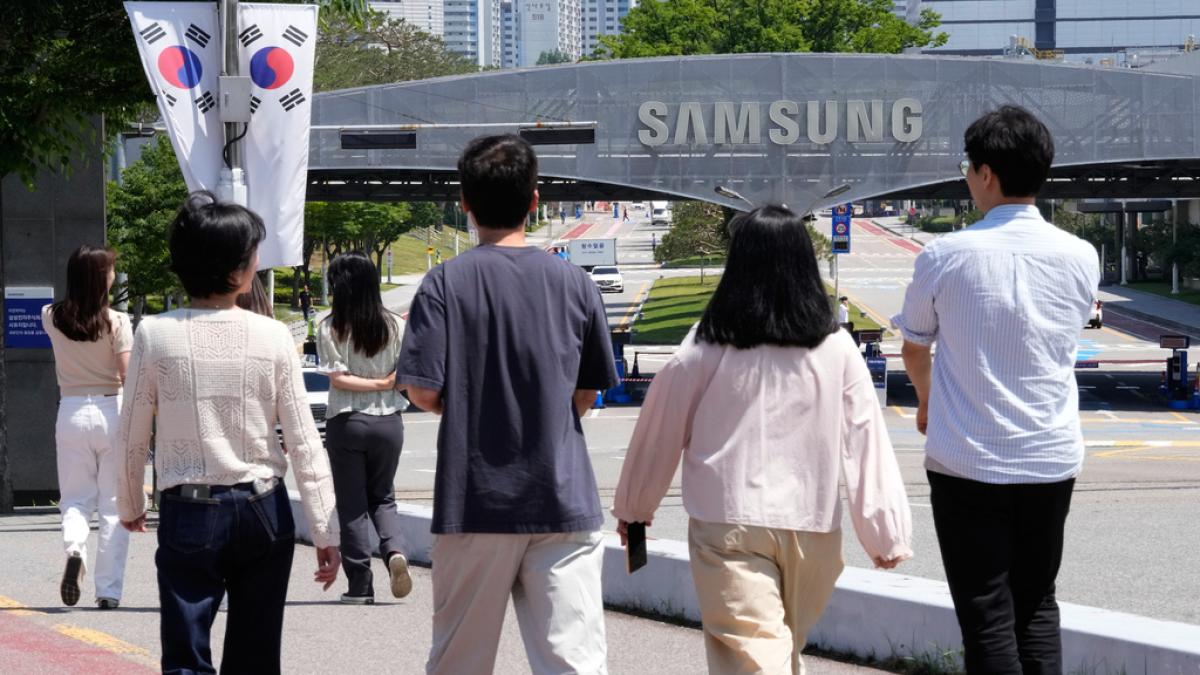
South Korea's top companies have experienced a dreamlike financial boom over the past three years, with both revenue and profits achieving double-digit explosive growth. However, this strong wave of profits, which has delivered outstanding performance in the stock market and employee bonus figures, has not translated into substantial employment opportunities. According to the latest analysis by the Korean institution Leaders Index, among the top 500 companies in South Korea, as many as 282 giant companies have seen their number of employees hired over the past three years remain almost stagnant and have not increased their workforce despite making money. The report cites survey data that these 282 large companies had a total of 1,299,333 employees at the end of 2023, which increased slightly to 1,302,191 by the end of 2025, with a growth rate of only 0.2%. However, during the same period, the total revenue of these companies increased significantly by 10.9%, reaching 3,684.3 trillion Korean won (approximately 80.66 trillion New Taiwan dollars), and profits also showed a geometric-level surge, increasing from 153.4 trillion Korean won three years ago to 277.7 trillion Korean won (approximately 6.08 trillion New Taiwan dollars), an 81% increase. The phenomenon of profits and employment being decoupled is particularly evident in the technology and semiconductor industries. Benefiting from the strong performance of giants such as Samsung Electronics (Samsung Electronics) and SK Hynix (SK hynix), the semiconductor-included electronics and information technology (IT) sector saw a 34.4% increase in revenue over three years, and profits surged by an astronomical figure of 2,740.5%. However, the total number of employees in this sector only increased by 1,727, with a growth rate of 0.6%. South Korean local traders are closely watching stock market changes. (AP) Due to the highly automated production lines and AI technology assistance in this industry, tech giants can continue to create even greater wealth without large-scale expansion of manpower. In contrast, industries such as automobiles, steel, batteries, and transportation, although their operating profits have declined, have chosen to expand their recruitment scale as their revenue expands. Among them, the shipbuilding and mechanical equipment industry has become the main recruiter for South Korea's new graduates, with the total number of employees increasing from 84,550 to 95,179 in three years, a 12.6% increase; the pharmaceutical and biotechnology industry has seen an 11.5% increase in employment population, ranking second. In stark contrast to the money-making glory of export manufacturing or semiconductor technology, many industries that are highly dependent on South Korea's domestic demand are now facing a severe employment winter. The most severely affected are the telecommunications industry, which, although the company's revenue and profits increased by 4.2% and 0.8% respectively, saw the total number of employees in the industry decrease by 6,358 over three years, a reduction rate of 17.6%. In addition, although the food and beverage industry saw nearly 4% revenue growth and a 2% increase in profits, the number of employees in the industry also showed a decreasing trend, decreasing by 2,730 over three years. Retail, banking, securities, and other domestic demand and financial sectors, regardless of the profit situation of their parent companies, generally showed zero growth or negative growth in employment numbers. On March 26, 2025, the opening ceremony of the Metaplant America factory in Georgia was held, and Hyundai Motor Group Chairman Jung Yu-seon and Republican Governor of Georgia Kemp (Brian Kemp) signed the IONIQ 9 electric vehicle production contract. (AP) As the industrial structure accelerates its transformation, while the South Korean government is considering how to expand the development of artificial intelligence (AI) and technology, social issues such as the extreme imbalance in domestic employment structure and the persistent high youth unemployment rate will also become the next thorny challenge for Seoul.
FACT BOX
- Source: PR Times
- Category: Survey