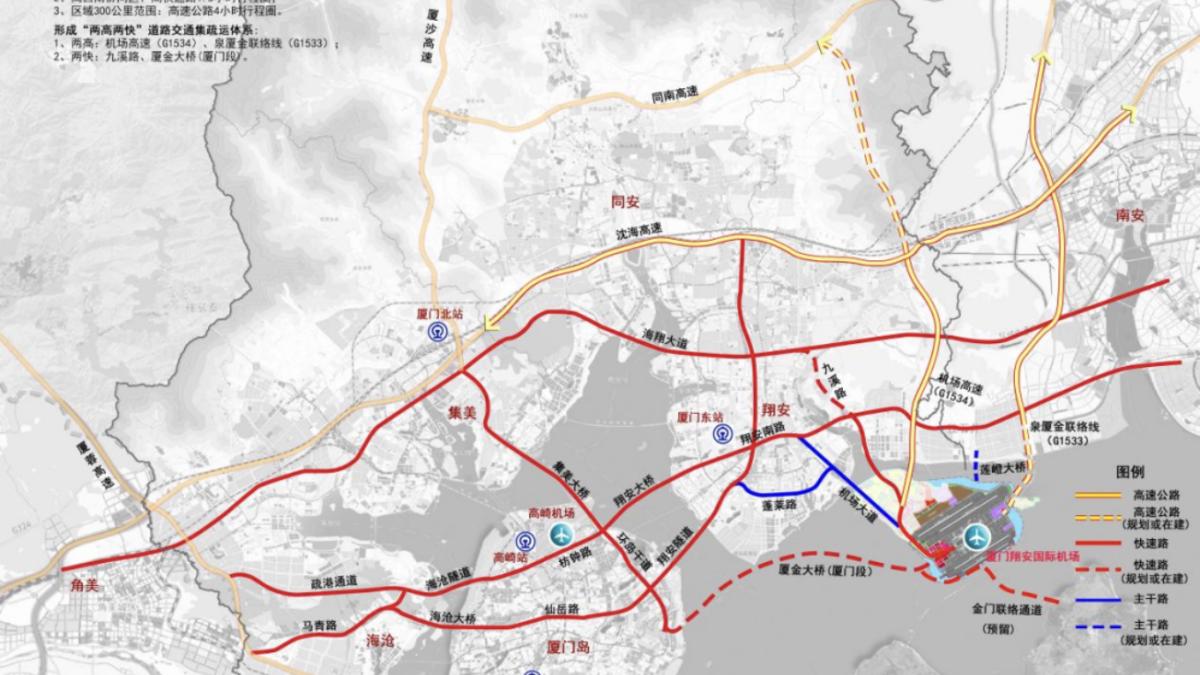
It's really close'—this is how Kinmen residents often describe Xiang'an Airport. Xiang'an Airport is a new airport in China's Xiamen, right across from Kinmen, less than 3 kilometers away, and is scheduled to officially start operations by the end of this year. A BBC Chinese reporter visited Kinmen and, from Guan'ao Beach on the northwest coast, could see Xiang'an Airport clearly across the sea, with its control tower, terminal, and runway clearly visible. The new airport is about to go into operation. Imaginary picture of Xiang'an Airport (Invest Xiamen official website). On clear days, through the camera's telephoto lens, the reporter could even capture scenes of vehicles moving inside the airport, showing that this newly built airport is about to go into operation. Kinmen was once one of Taiwan's most important military strongholds. In 1949, the Kuomintang and Communist forces fought fiercely here, and for the next few decades, the island was heavily garrisoned. Now, this airport, built by China through land reclamation and land creation over the past decade, has raised high concerns in Taiwan about military threats and regional security due to its sensitive location, and the overlap of routes between the two places has also raised concerns about flight safety. Close to Kinmen Xiang'an Airport is located in the southeast of Xiamen City, Daxi Island. Since 2013, China has been carrying out large-scale land reclamation and land creation between Daxi Island and Xiaodaxi Island, almost doubling the area of Daxi Island. After completion, the nearest point is less than 3 kilometers away. Official planning indicates that Xiang'an Airport will build four runways, with a terminal building area of 900,000 square meters, ultimately aiming for an annual passenger throughput of 85 million and a cargo and mail throughput of 2 million tons, and will have the ability to become an important aviation hub in the South China region. Xiang'an Airport will start operations in the first phase with a scale of two runways and an annual passenger throughput of 45 million, equivalent to the level of Taiwan's Taoyuan Airport under the first and second flight configurations. The planning also includes multiple 'exclusive facilities' connecting to Kinmen. In mid-June of this year, Ge Hongbin, vice general manager and chief engineer of Xiang'an Airport Construction Co., Ltd., the owner of Xiang'an Airport, revealed to the outside world that a 'dedicated channel' for Kinmen passengers has been planned inside the terminal building, and land for the 'Kinmen Terminal Building' has been reserved. The Chinese side also plans to build a cross-sea 'Xiaojin Great Bridge' to connect Xiamen, Daxi Island, and Kinmen, with the interface for extending to Kinmen already reserved. As early as 2007, the Fujian government decided to build a new large airport in the Minnan region to cope with the saturation and difficulty of expansion of Xiamen Gaoji and Quanzhou Jinjiang airports. In September 2019, the Civil Aviation Administration of China approved the overall planning of the new airport and positioned it as a regional hub and large airport. Over the years, the Taiwanese side has continuously paid attention to China's plan to reclaim land and build Xiang'an International Airport offshore from Kinmen. Taiwanese media have reported that in 2013, the Chinese government started the project without going through the existing cross-strait consultation mechanism and without notifying the Taiwanese side in advance. After the Democratic Progressive Party came to power in 2016, cross-strait communication channels were further restricted, and the Taiwanese side has repeatedly stated that Beijing has never provided relevant explanations and cannot grasp the detailed planning of Xiang'an Airport. 'Gray Zone' Strategy: Is the Real Pressure Coming from the Sea? The special geographical location of Xiang'an Airport has attracted high attention from the outside world. Multiple analyses point out that the operation of Xiang'an Airport may put pressure on the waters around Kinmen and further intensify the tension in the Taiwan Strait. Taiwan military expert and researcher at the Chinese Strategic Forefront Association, Jie Zhengxiang, analyzed for BBC Chinese that with the official operation of the airport, Chinese maritime patrol ships and public ships are highly likely to patrol the waters outside Kinmen on a regular basis and, under the name of 'protecting channel safety,' inspect, detain, and even board Taiwanese ships that come close. 'When this situation occurs, our maritime patrol ships may have to step forward to stop it. Although the tense situation may not escalate into a conflict, the tense situation of maritime law enforcement will inevitably increase,' he pointed out that cross-strait maritime law enforcement friction is very likely to increase. This kind of strategy to avoid direct military conflict and gradually change the status quo through continuous action is considered a commonly used means by the Chinese side in recent years in the cross-strait periphery and the South China Sea region. After the incident in 2024 where a Chinese speedboat illegally entered the waters of Kinmen for illegal fishing and capsized, the Chinese Taiwan Affairs Office stated that there are 'no restricted waters' in the Jin-Xia waters, and the Chinese maritime police also announced the start of regular law enforcement patrol actions in the waters. Beijing has long claimed sovereignty and jurisdiction over the entire Taiwan Strait. The Taiwanese side, based on Article 29 of the 'Act Governing Relations Between the People of the Taiwan Area and the Mainland Area,' has the Ministry of National Defense and the Coast Guard Administration set up 'prohibited' and 'restricted' waters around the outer islands of Kinmen and Matsu as law enforcement boundaries for maintaining maritime safety and order. Unauthorized Chinese ships are not allowed to enter. Jie Zhengxiang pointed out that the existence of Kinmen's prohibited and restricted waters highlights the gap between China's legal claims and actual jurisdiction. With the operation of Xiang'an Airport, China not only can put pressure on Taiwan at sea but also create a 'fait accompli' of jurisdiction. Can a civilian airport become a military base? Xiang'an Airport is officially positioned as a civilian airport, but its design also includes air freight logistics hub functions, with railway, road connections, large warehouses, and rapid transfer equipment. The outside world believes that these facilities also have military value. Satoru Nagao, a non-resident researcher at the Hudson Institute in Washington, analyzed for BBC Chinese that in peacetime, China can use Xiang'an Airport to deploy military aircraft to provoke Taiwan; if it enters a state of preparedness, it can concentrate resources under the name of 'civilian' and make Xiang'an Airport an important logistics hub. 'Xiang'an Airport is only 3 kilometers away from Kinmen and about 190 kilometers away from the main island of Taiwan. This means that the airport could become a logistics base for Chinese invasion forces.' However, he also pointed out that because Xiang'an Airport is too close to Taiwan, it is likely to become a target for counterattacks during wartime. Taiwan is purchasing and developing longer-range missiles and drones that can directly strike the airport from the main island. There are still significant shortcomings if Xiang'an Airport is to be converted for military use. Taiwan military expert Jie Zhengxiang also analyzed that if Xiang'an Airport is to support large-scale cross-sea operations or amphibious landing operations, there are obvious limitations. He pointed out that most of the storage facilities in the airport are for commercial use, lacking military protection standards, and no shelters are seen, making military aircraft or large transport aircraft vulnerable when they enter. He also mentioned that the HIMARS rocket system sold by the United States to Taiwan has a range of about 80 kilometers and can launch tactical missiles with a range of up to 300 kilometers. Taiwan can directly attack Xiang'an Airport from Kinmen or Taichung. 'In the initial stage of a military invasion of Taiwan, Xiang'an Airport may not be of much use. Only after the Chinese Communist Party has gained control of the air and sea power around Taiwan and successfully suppressed Taiwan's long-range strike firepower on the main island can it truly play a role.' Imminent flight safety concerns In addition to long-term military threats, Xiang'an Airport also brings more urgent challenges—flight safety. Analysts point out that in the context of cross-strait tensions, ensuring civil aviation safety and maintaining necessary technical communication may have a more direct impact on daily operations than military uses. In mid-June of this year, Xiang'an Airport completed its first flight inspection. This new Chinese airport, due to its proximity to the routes of Kinmen's Shangyi Airport, is only about ten kilometers away. If there is no well-planned arrangement, the routes of the two places may conflict. As early as 2017, Taiwan's Mainland Affairs Council had invited experts to hold a seminar in Kinmen to discuss the possible impact of the construction of Xiamen Xiang'an Airport. At that time, many experts pointed out that the routes of Xiang'an Airport and Kinmen Shangyi Airport were highly likely to overlap, and flight operations might interfere with each other. The Taiwanese government has repeatedly emphasized the principle that 'later-built airports must give way to existing airport routes' and is concerned that unilateral planning by the other side may compress flight safety. Lu Yanliang, the director of the Department of Aviation at Taiwan's Chiao Yang University of Science and Technology, told BBC Chinese that 'later-built airports must give way to existing airport routes' is a common safety logic in civil aviation operations. 'The planners and builders of new airports have the responsibility and obligation to assess the impact on the operating capacity and safety isolation surplus of surrounding existing airports and propose mitigation measures in the early design stage.' Lu Yanliang pointed out that when the routes and terminal control areas of the two airports overlap highly, it will bring potential risks to airspace safety and test the coordination ability of the two governments in air traffic control. He explained that Xiang'an mainly deals with large jet aircraft, while Kinmen Shangyi has more propeller aircraft and medium-sized jet passenger aircraft. The influence of airflow must be accurately calculated when different aircraft types operate at similar altitudes; when the weather is bad or visibility is poor, the proximity of runway directions can also test the judgment of pilots; if both sides simultaneously initiate emergency go-around procedures, it is necessary to ensure absolute isolation of the route design and aircraft position. Lu Yanliang emphasized that the use of airspace should not be decided unilaterally. The coordination of new and old airports must rely on the joint negotiation of professional technical personnel from both sides, such as establishing direct hotlines, adopting strict flight sequence isolation standards, and interfacing radar information to enable the air traffic control system to play a conflict warning function, so as to ensure the safety margin. Chen Chui-cheng, the minister of Taiwan's Mainland Affairs Council, accepted an exclusive interview with BBC Chinese and said that the civil aviation units on both sides are still communicating through existing mechanisms, and the Taiwanese government will ensure the normal operation of Kinmen Shangyi Airport and flight safety will not be affected. Previously, the Mainland Affairs Council pointed out that after learning in 2015 that the Chinese side planned to build a new Xiang'an Airport, it had repeatedly requested the Chinese side to provide relevant data and negotiate on some issues, but the other side has never responded. The Chinese mainland official authorities have not yet responded positively to the issue of route coordination. Chen Binhua, a spokesman for the Taiwan Affairs Office, recently replied to media inquiries, only saying that they support Kinmen to share Xiang'an Airport, and this will help improve the welfare of the people of Kinmen.
FACT BOX
- Source: PR Times
- Category: 其他