On the streets of Guangzhou, amid the humid summer heat, a quiet microcosm of China's intellectual property governance unfolds—a tug-of-war between luxury brand boutiques and street vendors selling counterfeit goods. Following recent trademark enforcement actions by Louis Vuitton (LV), part of the LVMH group, another LVMH-owned brand, Tiffany & Co., has now filed a lawsuit against Chinese sanitary pad brand ALFFANY (Aifuni), accusing it of trademark infringement. This case has once again brought the trademark battle between international brands and Chinese domestic companies into the spotlight.
The case has already entered administrative litigation at the Beijing High People's Court. Tiffany is seeking to invalidate the ALFFANY trademark and has requested multiple e-commerce platforms to delist related products. In response, ALFFANY argues that its name is derived from the Chinese words for 'mugwort' (ai cao) and 'care for you' (ai hu ni), and was not intended to ride on Tiffany's brand recognition.
The 'ALFFANY' trademark was registered by Shanghai Shili Brand Management Co., Ltd. (formerly Haitao Shanghai), covering categories such as daily chemical products, clothing, footwear, and headwear. The phonetic similarity to 'TIFFANY' has been a point of contention. The dispute has lasted eight years, with Tiffany repeatedly filing oppositions and requests to invalidate the trademark.
Ms. Liu, the brand manager of ALFFANY, told media outlets that the company focuses exclusively on the sanitary pad market. She emphasized that the brand name was inspired by the concept of mugwort, with a homophonic play on 'ai hu ni' (care for you), aiming to convey care for women. She denied any intention to piggyback on an international luxury brand's popularity. 'We operate in a completely different category; there should be no confusion among consumers,' she said. She also revealed that the brand is now under pressure to be delisted from platforms and may face civil compensation.
If LV's lawsuit signaled a tightening of brand boundaries by luxury companies, Tiffany's dispute with a sanitary pad brand suggests that international brands are now extending their trademark protection into consumer goods sectors with no direct competitive overlap.
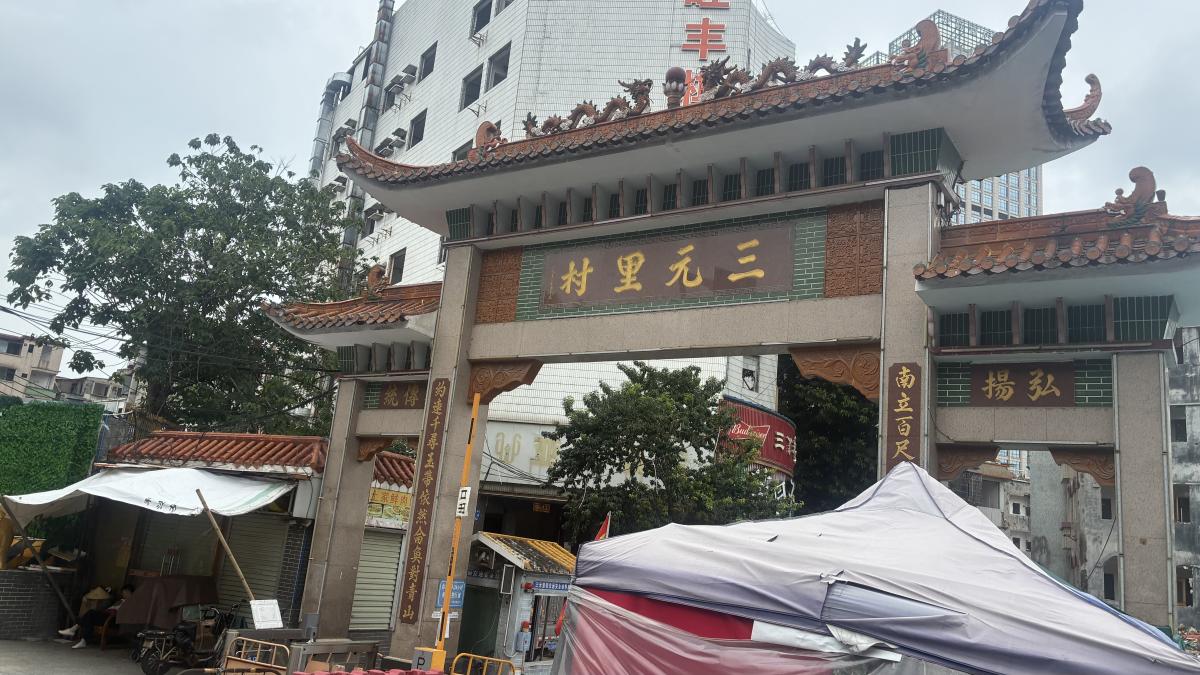
However, as international brands use legal tools to reinforce their brand identities, Sanyuanli in Guangzhou—a district once dubbed the 'World Capital of Handbags'—is quietly transforming.
Has the LV incident made Chinese consumers more cautious?
A recent visit by reporters to Tianhe Parc in Guangzhou, a high-end shopping mall housing several international luxury boutiques, revealed noticeably thinner foot traffic at LV-related counters compared to nearby domestic brand stores, even on weekends. Several young female customers admitted, 'The recent controversies have been widely reported; we’re more cautious now and don’t want to buy anything controversial.' Multiple consumers said they are paying closer attention to such news.
Tianhe Parc in Guangzhou is a relatively upscale shopping mall (Photo: Tian Chang)
'It’s definitely had some impact. With all these recent headlines, I’m thinking twice before buying,' said a young shopper. Another respondent frankly stated she is reconsidering the boundaries between brands: 'Whether I carry one or not is my personal choice.'
In the past, the aggressive strategies of international brands in China shaped consumer preferences—chasing 'how close it looks' to the original. But now, consumers are increasingly asking, 'Can I buy this with peace of mind?' Carrying a luxury bag once symbolized middle-class status in China. But after a series of 'PR scandals' involving major international brands in China, many consumers now feel, 'We shouldn’t let foreigners easily profit from our spending.'
As a result, labels like 'high imitation' and 'A-grade replica' are gradually being reevaluated in the context of China’s 40+ years of reform and opening-up. In the past, 'Guangzhou-made' goods from places like Beijing’s Xiushui Street were considered the gold standard of counterfeits. But as Chinese entrepreneurs began facing cross-border intellectual property lawsuits, they realized this path was unsustainable.
This brings us to a pivotal location: Sanyuanli, Guangzhou.
Sanyuanli: A Place Witnessing Modern Chinese History and the Rise of the 'World’s Factory'
Many know Sanyuanli for its leather goods. But this land entered Chinese history in 1841 during the First Opium War.
When British troops invaded Guangzhou, local villagers spontaneously organized armed resistance in Sanyuanli—an event known as the 'Sanyuanli Anti-British Uprising,' recognized as the first large-scale popular resistance against foreign aggression in modern Chinese history.
The Sanyuanli Anti-British Memorial Hall in Guangzhou. Like other temples in China, it requires the display of the national or party flag (Photo: Tian Chang)
Over a century later, reform and opening-up brought another transformation. Starting in the 1980s, numerous Hong Kong-funded and private factories entered Guangzhou, and Baiyun District gradually developed China’s most complete leather goods industrial chain. From raw leather, hardware, zippers, design, prototyping, manufacturing, to export and wholesale—all could be completed within a few kilometers.
Centered on Guihuagang and Ziyuangang, dozens of large markets emerged, including Zhonggang Leather Goods City, Yifa Leather Goods City, and Baiyun World Leather Goods Trading Center. Thousands of merchants gathered here, exporting products to Europe, the Americas, the Middle East, Africa, and Southeast Asia. 'Guangzhou leather goods' became a renowned brand, earning the nickname 'China’s Sanyuanli, the World Capital of Handbags.'
However, in recent years, as China intensifies crackdowns on intellectual property infringement, this traditional 'brand' is undergoing profound transformation. Reporters visiting a local leather goods market found a noticeable decline in high-end LV replicas. Several shop owners, speaking anonymously, said, 'With APEC approaching, enforcement in Guangzhou is strict. If you need goods, you have to go to Hunan.'
A logistics company near Guangzhou’s Thirteen Factories. Every afternoon, goods from merchants are packed and shipped worldwide (Photo: Tian Chang)
When asked under the pretense of purchasing, reporters observed that some replica backpacks were nearly indistinguishable from authentic ones—some even surpassing originals in craftsmanship and materials. Yet, under regulatory pressure, many replica-focused stores are gradually building their own brands, shifting from imitation to innovation.
Near Sanyuanli Metro Station in Guangzhou, another scene emerged. With summer vacation starting, young people carrying luggage gathered at the station exits. The nearby Sanyuanli Village is also facing demolition plans, designated as a model for Guangzhou’s 'urban village' redevelopment. A vendor near the station mentioned that the future is uncertain, and conflicts arising from demolition are not uncommon.
A Qing Dynasty restoration monument displayed in a museum in Sanyuanli, Guangzhou (Photo: Tian Chang)
A KFC employee near the metro station told reporters that July and August are peak hiring seasons for factories. 'Many come during summer break. These two months, the metro exits are full of job seekers.'
These young people may not know about the trademark dispute between TIFFANY and ALFFANY, nor care who LV sued. But the factories they enter represent the frontline of China’s brand transformation.
From Imitation to Branding: Legal Action Is Just the Beginning
For Chinese enterprises, the real challenge isn’t just avoiding trademarks—it’s building new brands that stand on their own, without relying on associations with international names.
From the quiet luxury counters at Guangzhou’s Tianhe Parc, to the vanishing high-end replicas in Sanyuanli, to the influx of young laborers into factories during summer—the invisible thread of industrial evolution is emerging.
I have come to a clear realization in Guangzhou: 'Made in China' once reached the world through imitation. Now, as international brands extend trademark battles into the sanitary pad market, a new era is beginning. The market no longer demands 'how similar it looks,' but rather 'how different it is,' and ultimately, 'how uniquely it stands on its own.'
FACT BOX
- Source: PR Times
- Category: News
- Organizations: LVMH