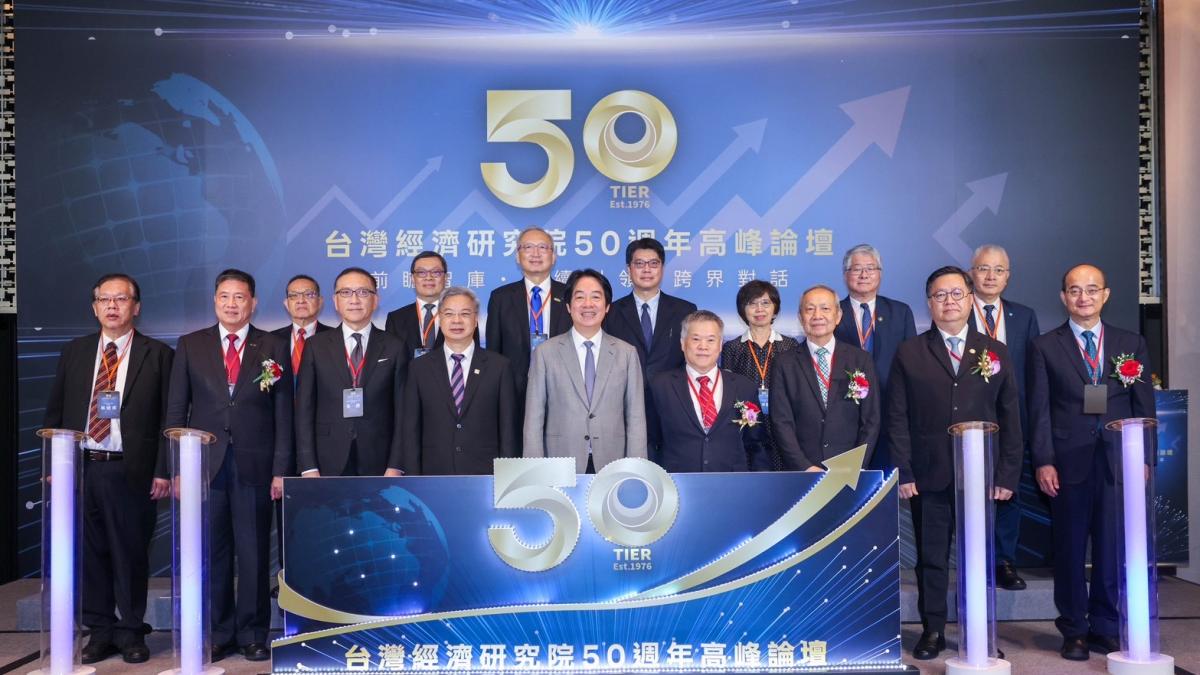
The Taiwan Institute of Economic Research (TIER) has witnessed and participated in all the important milestones of Taiwan's transformation from a light industrial economy to a global technology hub since its establishment in 1976. Facing the new landscape brought by geopolitical restructuring, energy security, and AI, TIER held its 50th anniversary summit titled 'Not just 50, Next 50: Towards a Resilient Life and Industrial Era.' The summit brought together representatives from the government, academia, and industry to jointly chart the development direction for Taiwan's next 50 years. The summit was co-hosted by TIER Chairman Chung-shu Wu and President Chien-yi Chang. The event was attended by Taiwan's top leaders, including President Lai Ching-te, who delivered a speech of encouragement. Economic Affairs Minister Mei-ching Kung and Vice Chairman Yi-chueh Wu of China Trust Financial Holding (Stock) Company also attended to witness this historic milestone, marking TIER's 50th anniversary. The high-level dialogue invited representatives from the government, academia, and industry, including Economic Affairs Minister Mei-ching Kung, Quanta Computer CTO Chia-yen Chang, Innolux Corporation Chairman Shuang-lang Peng, and former Google Taiwan Managing Director Li-feng Chien, to discuss Taiwan's future development strategies from three aspects: new economy, new infrastructure, and new resilience. President Lai Ching-te emphasized that TIER has not only been Taiwan's first private think tank but has also long supported the government in promoting industrial policies. From joining the WTO, participating in APEC, to responding to the U.S. reciprocal tariffs, TIER has provided important decision-making support. Facing the AI era, the government will promote the 'AI New Ten Major Constructions,' focusing on national computing power, sovereign AI, talent cultivation, and balanced development. It will also invest resources in silicon photonics, quantum computing, and robotics, three key technologies, while helping SMEs introduce AI and accelerate digital transformation to create an AI living circle, enhancing Taiwan's long-term competitiveness and sustainable development. Economic Affairs Minister Mei-ching Kung emotionally recalled that the knowledge and experience accumulated during his 27 years of service at TIER were important nutrients for his entry into public service. He pointed out that Taiwan's economic growth rate reached 8.7% and 9.6% in recent years, setting a new high in nearly 40 years. This achievement comes from the long-term layout of forward-looking infrastructure and industrial policies, laying the foundation for the return of Taiwanese businesses and AI development in terms of computing power, energy, and land. In the future, the government will continue to strengthen economic resilience and add 11 billion NT dollars to support the upgrading and transformation of SMEs. China Trust Financial Holding Vice Chairman Yi-chueh Wu stated that the initial intention of establishing TIER was to create a professional think tank that is rooted in the private sector, possesses independence, objectivity, and academic depth. National competitiveness comes not only from corporate innovation and government governance but also from think tanks using professional research to respond to the challenges of the times. They not only analyze the present but also foresee the future, propose policy recommendations, help society find solutions, and become an important force in promoting national continuous progress. Dr. Chung-shu Wu recalled that in the 1970s, Taiwan was facing diplomatic difficulties and the global oil crisis. Under the vision and courage of Mr. K. Y. Hip, TIER was jointly funded by Taiwan Cement and China Trust's Mr. K. Y. Hip to establish the Taiwan Institute of Economic Research, attracting professional talents to provide policy recommendations to the government and enterprises, laying the foundation for TIER's professional, objective, and practical research spirit. Dr. Wu stated that Taiwan has now transformed from traditional light industry into a global technology hub, facing a critical moment of transformation in the era of AI and high-performance computing. In the past, Taiwanese businesspeople created an economic miracle with the spirit of going global with just a business card. TIER President Chien-yi Chang stated that Taiwan's industrial spirit has evolved from hard work and perseverance to resilience. True resilience is not about stubbornly adhering to the old path but the ability to quickly correct and rise again after falling. Amidst Taiwan's per capita GDP entering the ranks of high-income countries and its economy showing strong growth momentum, Taiwan is facing challenges such as global supply chain restructuring, energy security, and an aging society. As the national economic think tank, TIER has also transformed from merely analyzing and observing to helping the government and enterprises chart survival and profit paths in highly uncertain environments, becoming a strategic engine. Presidential Advisor Bo-zhi Chen delivered a special lecture titled 'Transformation and Resilience Path of Taiwan's Economy in the Global Context.' He used the Taiwanese proverb 'Sweet potatoes are not afraid of falling to the ground and rotting, branches and leaves are passed down from generation to generation' as a core metaphor to deeply interpret resilience, which should not be narrowly interpreted as enduring pressure but lies in 'regeneration' and 'creating new life.' Chen Bo-zhi emphasized that the economic system is a highly interrelated organic whole. When facing the restructuring of the global supply chain, Taiwan must establish a coordination mechanism for mutual support and burden-sharing among blocks. The important responsibility of think tanks is to help the government clarify the importance of overall relevance, formulate countermeasures for industrial block conflicts, so that Taiwan's industries can not only survive shocks in adversity but also, through flexible adjustments, fill gaps and create new value. Facing the rapid changes in the global economy, the forum, with 'new economy, new infrastructure, and new resilience' as its main axis, invited leaders from the government, academia, and industry to provide forward-looking and practical views, offering advice for the re-upgrading of Taiwan's industries and national development. In the aspect of value-oriented transformation of the new economy, the industrial logic must shift from 'cost efficiency' to 'value creation.' Economic Affairs Minister Mei-ching Kung stated that the government will continue to guide through policies to strengthen cooperation with the U.S., Europe, and the international supply chain, helping enterprises establish an indispensable node position in the fragmented trade camp. Google Taiwan's former Managing Director Li-feng Chien pointed out that Taiwan is not only the global center of semiconductors but should also grasp the discourse power of AI applications and digital transformation through connections with the international talent ecosystem. Regarding the layout of the new infrastructure ecosystem of software and hardware integration, Quanta Computer CTO Chia-yen Chang reminded, based on Quanta's practical experience in entering the AI medical ecosystem, that infrastructure is no longer just hardware. Data governance, talent pool, AI computing power, and a forward-looking regulatory environment are the 'soft infrastructure' that supports industrial upgrading. The government and enterprises need to jointly regard them as the foundation for promoting technological innovation and scaled development to ensure that industrial upgrading will not be limited by insufficient environmental support. In the survival strategy of new resilience integration, Innolux Corporation Chairman Shuang-lang Peng shared Innolux's experience of transforming from panel manufacturing to a smart solution service provider, serving as a practical model for enterprises facing 'new resilience.' Facing tariff barriers and geopolitical risks in logistics, resilience means that enterprises must incorporate national security, energy, manpower, and operational efficiency into the decision-making model when deploying overseas. In the future, resilience will not only come from supply chain layout but also from technological innovation, cross-border cooperation capabilities, and the ability to adapt to different markets and institutional environments. This is also the advantage of the flexibility and integration capabilities that Taiwanese enterprises have accumulated over the long term. 'Not just 50, Next 50' aims to elevate Taiwan's resilience to a global benchmark. Regarding Taiwan's economic vision and blueprint for the next ten years, Peng Shuang-lang pointed out that Taiwan's future competitiveness lies in technological capabilities, AI digital governance, and ESG development. Facing the challenges of carbon reduction and carbon accounting for SMEs, the government should take the lead, with private sector cooperation, to jointly establish a public carbon data platform, allowing enterprises to share resources, reduce transformation costs, and enhance the sustainable development capabilities and global competitiveness of industries. Chien Li-feng emphasized that Taiwan is transitioning from 'the island of engineers' to 'the island of international capital.' The key in the future lies in learning to use capital leverage to create greater value. Facing the challenge of a low birth rate, AI agents, robots, and the global Taiwanese business network will become important forces, expanding Taiwan's economic influence through technology and remote management. Chang Chia-yen pointed out that Taiwan's past success in hardware manufacturing tends to form a thinking inertia, but the AI era requires breaking away from existing frameworks and rethinking Taiwan's value with a broader vision. In the future, starting from global issues such as health and the environment, using AI to solve social problems, and proactively creating the next stage of development direction. Kung Mei-ching pointed out that Taiwan has established its global position through contract manufacturing. In the AI era, Taiwan should not only be positioned as a hardware supplier but also extend its advantages in basic infrastructure to the data and application ends, combine with global market demand, expand the influence of technology, and create a broader space for economic development. This high-level forum is not only a milestone for TIER's 50th anniversary but also a turning point for Taiwan's industry to define the game actively. Through in-depth dialogue among various sectors of the government, academia, and industry, a strategic blueprint is outlined for Taiwan to transition from passive adaptation to active offense, demonstrating that Taiwan is actively breaking away from vulnerability in geopolitics and great power competition. By establishing a flexible and in-depth cross-domain cooperative industrial ecosystem, the benefits of the AI technology wave are diffused from the top of technology to all walks of life. Chang Chien-yi emotionally summarized in his closing remarks that TIER's outstanding achievements over the past fifty years have always been rooted in its insistence on practical research and the long-term trust and entrustment of the government, academia, and industry. Looking ahead to the next fifty years, TIER will continue to serve as a promoter, transforming Taiwan's existing technological advantages into institutional leadership and ecosystem scale, elevating this unique 'resilience' into a common standard for the global industry, helping enterprises pursue long-term development opportunities, and continuing to write the legend of Taiwan's economy.
FACT BOX
- Source: PR Times
- Category: Event