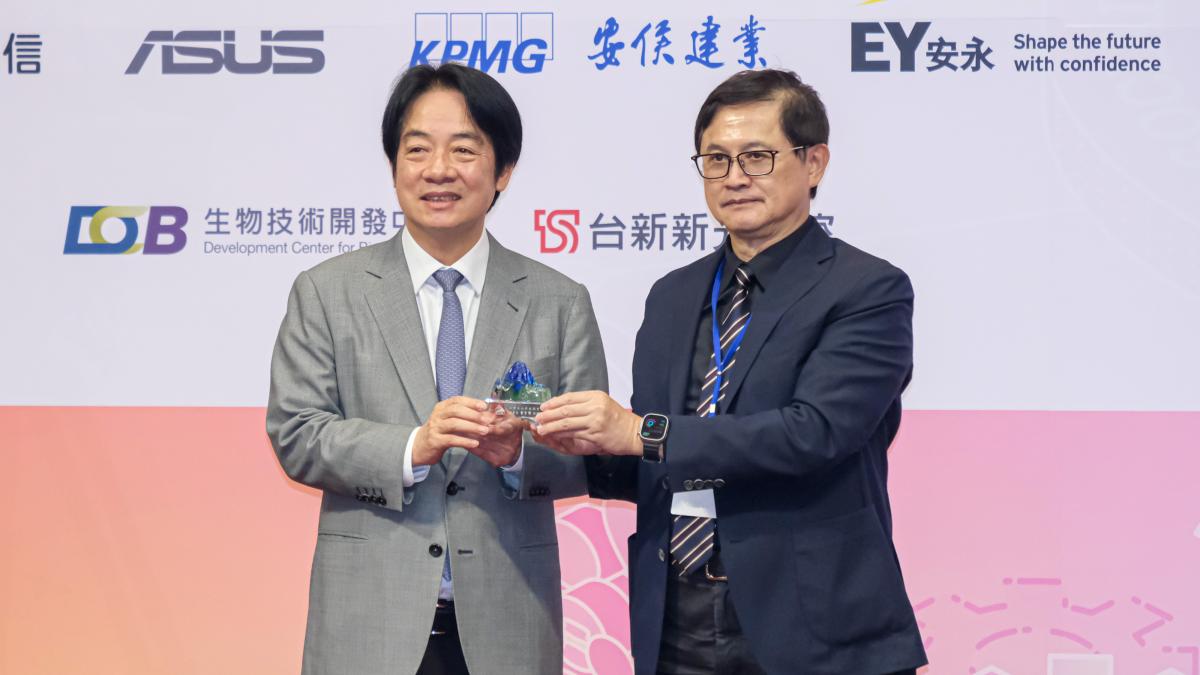
As the AI wave sweeps the globe and nations compete for semiconductors, artificial intelligence, and talent, where should Taiwan build its next phase of competitiveness? The Taiwan Yushan Technology Association held its 13th First General Meeting of Representatives today (21), with Chairman Tong Tzu-hsien and President Lai Qingde offering answers from different perspectives.
Tong emphasized that technology must not remain confined to laboratories; only through a complete ecosystem integrating law, finance, and venture capital can innovation truly reach the world. President Lai highlighted that Taiwan's recent economic performance and rising international competitiveness are fundamentally supported by its democratic system and education. He stated that the government will continue to promote educational equity and talent development as the cornerstone of Taiwan's future competitiveness.
The Yushan Tech Association's general meeting, chaired by Tong, brought together around 400 participants from industry, government, academia, and research. In addition to President Lai's keynote address, Academia Sinica President Chen Chien-jen delivered a special lecture titled 'Taiwan's Resilience in a Global Shift: Technology, Health, and Sustainable Governance,' and Sun Cui-feng, lead performer of Ming Hwa Yuan Opera, shared insights on 'A Century-Old Troupe: Advancing into the Next Generation,' exploring Taiwan's development path through the lenses of technology, governance, and culture.
Tong stated that the Yushan Tech Association, now 36 years old, serves not only as a platform for knowledge sharing and member exchange but also as a vital bridge connecting global Chinese tech entrepreneurs, industrial managers, and investors. He stressed that if knowledge remains confined to offices, meeting rooms, or laboratories, it will never leave the mind. Only through a comprehensive industrial ecosystem can ideas become reality.
'If technology stays in the study, the office, the conference room, or the laboratory, then knowledge remains in the mind,' Tong said. Once a researcher has an idea or a prototype emerges from the lab, it requires support from intellectual property, international law, finance, accounting, and venture capital to develop into tangible products and services and succeed in global markets.
He believes this cross-domain collaboration is precisely why Taiwan's tech industry has developed rapidly over the years. This is also why the association's board and members span diverse fields such as technology, academia, finance, law, and venture capital—to strengthen Taiwan's international competitiveness through interdisciplinary cooperation.
On the origin of the association's name, Tong explained that Yushan symbolizes Taiwan's identity and pursuit of excellence. As Taiwan's highest peak and the tallest in East Asia, he hopes Taiwan will continue striving for excellence not only in technology but across all fields. Citing the latest international competitiveness rankings, he noted that Taiwan ranked 4th globally in the IMD World Competitiveness Ranking this year, and among countries with populations over 20 million, it has ranked 1st for six consecutive years.
'Taiwan should have confidence in itself and deserves recognition,' Tong said, emphasizing that these international rankings reaffirm Taiwan's globally acknowledged competitiveness. The industry should continue to unite and amplify the impact of knowledge exchange and collaboration.
President Lai spoke from a broader perspective on Taiwan's rising competitiveness. He noted that Taiwan's GDP growth reached 8.76% in 2025, 5.6% the previous year, and 14.55% in the first quarter of this year, with full-year projections indicating sustained high growth. Combined with Taiwan's best-ever 4th place in the IMD World Competitiveness Ranking, these achievements reflect the collective efforts of the Taiwanese people.
'Why has Taiwan's economy been able to progress continuously?' Lai asked. Beyond corporate efforts and public diligence, he emphasized that democracy and education are the most critical factors. Democracy safeguards people's rights and property, enabling stable economic development, which in turn supports cultural and artistic growth, creating a virtuous cycle.
On education policy, Lai highlighted the government's ongoing efforts to promote educational equity, including full tuition waivers for high schools and vocational institutions, subsidies for private universities, dormitory support, rental assistance, and TPASS transportation subsidies. The goal is to reduce household education burdens. 'As long as a child wants to study, the government must support their access to education,' he said, aiming to ensure every child has a fair chance to develop.
Beyond educational equity, Lai outlined talent development initiatives such as the 0-to-18-year-old Growth Fund and the 15-to-30-year-old Youth Overseas Dream Fund, aiming to provide youth with diverse learning and international exchange opportunities. He also expressed hope to collaborate with businesses on education and employment expos to attract top global talent to study and work in Taiwan, meeting the growing human resource demands of Taiwan's expanding industries.
As president, his key responsibilities include safeguarding national security, upholding democratic freedoms, and building a fairer, more competitive environment for the next generation. 'I hope every child born and raised in Taiwan can bravely pursue their dreams, making Taiwan their ideal dreamland,' he said.
While Tong and Lai approached the topic from different angles—Tong on 'how technology can leave the lab' and ecosystem building, and Lai on the importance of democracy, educational equity, and talent cultivation—both converged on the same theme: in an era of accelerating AI and global competition, Taiwan must not only strengthen its technological capabilities but also simultaneously build a robust talent environment and institutional foundation to elevate its international competitiveness in the next phase.
FACT BOX
- Source: PR Times
- Category: Event