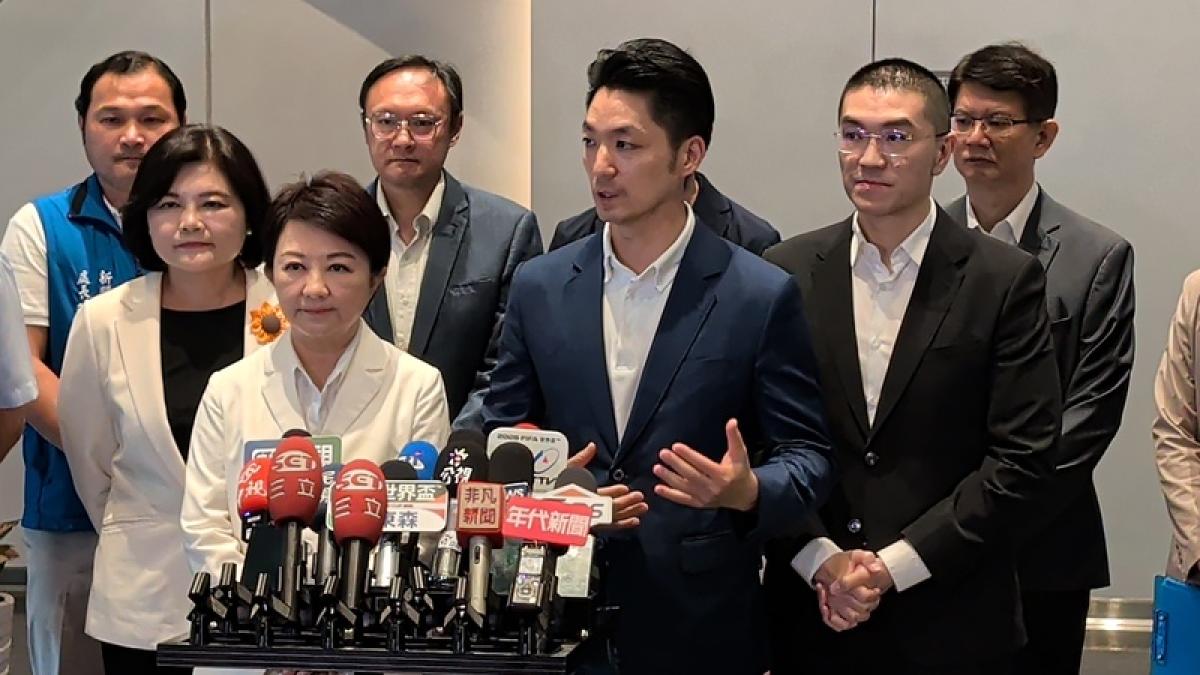
This year marks a local election cycle in Taiwan, and the Zhonglian Oils carcinogenic oil scandal continues to escalate, triggering not only a food safety crisis but also a political storm. Taipei Mayor Chiang Wan-an recently rallied the public to take to Ketagawa Avenue on July 25, demanding justice from the Lai administration. Taichung Mayor Lu Hsiu-yen and other KMT-affiliated local leaders have also voiced support.
In response, former Minister Chang Ching-sen posted on Facebook on the 20th under the title 'Chiang Wan-an's Food Safety March: Competing for Leadership, Undermining Lu Hsiu-yen,' arguing that while politicians' actions appear righteous on the surface, they are fundamentally driven by power calculations—specifically, the pursuit of the presidency.
Why did Chiang call for a mass protest on July 25? What did he say?
As the tainted oil scandal intensified, Chiang posted on Facebook on the 17th titled 'Forcing Me to Eat Poisonous Oil, Forcing Me to the Streets,' calling on the public to gather on Ketagawa Avenue on July 25 to voice their demands. He emphasized that food safety is national security. When the tainted oil scandal affected the entire nation, a DPP spokesperson said, 'No one forced you to eat it,' which Chiang labeled as arrogance and a refusal to apologize. Over half a month since the incident began, the central government has still failed to provide the public with the truth. How many batches of tainted oil entered the market and were consumed between April and June? 'President Lai Qingde must apologize, and Premier Cho Jung-tai must resign to take responsibility!'
Is the July 25 Ketagawa protest only about food safety? Does Chiang have political motives?
Chang Ching-sen believes Chiang’s high-profile call for a food safety march, while framed as seeking justice for the people, is in fact a politically calculated 'two-for-one' strategy. Chang argues Chiang’s primary goal is to position himself as the KMT’s sole unifying leader while eliminating Lu Hsiu-yen, his most significant potential rival in the 2028 presidential race. He further notes that in Taiwan, food safety is a political liability for local leaders, and since the tainted oil scandal is centered in Taichung, Lu’s administration bears direct responsibility for oversight and inspection. Chiang is fully aware of this.
Is Chiang targeting 2028? Could Lu be damaged by the food safety scandal?
Chang points out that for Lu Hsiu-yen, the best strategy is to contain the crisis quickly. However, Chiang is deliberately escalating the issue into a nationwide political showdown—'deliberately stirring the pot that shouldn’t be stirred, pouring oil on the fire.' Once food safety becomes a national political battleground, the DPP will inevitably 'besiege Wei to rescue Zhao,' redirecting all attacks toward the Taichung City Government at the epicenter. Lu is likely to suffer serious political damage—a perfect example of Chiang’s sophisticated 'using others’ knives to kill' strategy.
Premier Cho Jung-tai, backed by the central government machinery, is hard to topple with a single blow. But if the food safety march ignites a nationwide firestorm, Lu—whose responsibility cannot be denied—can be legitimately pushed into the fire. Chang further argues that if the Green Camp (DPP) fully targets Lu, she could be severely wounded in the scandal, potentially eliminating her from the 2028 presidential race early. With no other KMT figure capable of challenging Chiang’s rise, who could possibly stop him from claiming the mantle?
Chang concludes: 'As a Taipei citizen, what I see is not a mayor fighting for food safety, but a chess master with deep political ambitions eyeing 2028. Objectively, this march, framed as speaking for the people, is in fact a precise internal party purge.'
FACT BOX
- Source: PR Times
- Category: News