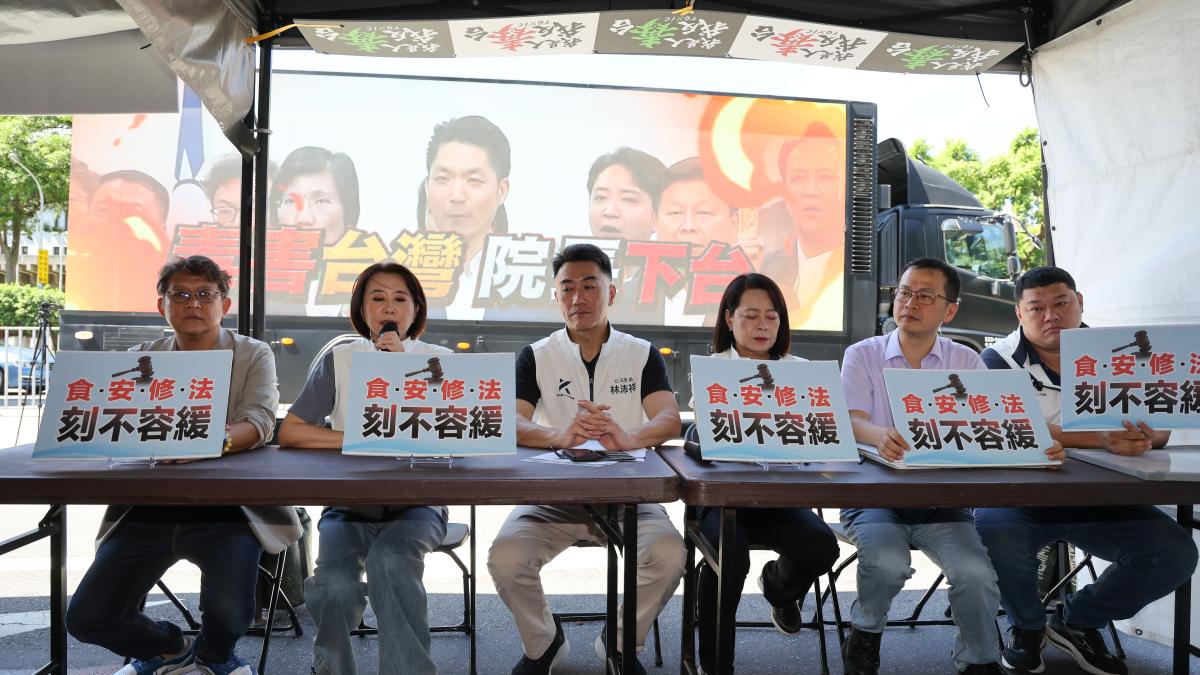
During the recent tainted oil scandal, Democratic Progressive Party (DPP) spokesperson Wu Cheng, in a live online broadcast, responded to Huang Yang-ming's accusation—"I'm a victim here, can't I raise my voice? I didn't know I'd end up eating (tainted oil)!"—by bluntly saying, "It's not like I forced you to eat it, why are you yelling at me? If there's a problem now, we'll deal with it!" The DPP later issued a press release stating that Wu's controversial remark was an emotional outburst in response to a media personality's charged accusation, not intended to target the general public. However, they acknowledged that the public comment was unduly emotional and poorly worded, and Wu expressed deep self-reflection and offered an apology.
It's not uncommon for party spokespersons to slip into emotional language during heated media exchanges. Behind such emotional remarks lies not only a person's genuine reaction to conflict but also the ruling party's true mindset toward the tainted oil incident: Why should we, the ruling party, be held responsible for a problem we didn't directly cause? This is the real logic behind Wu's statement—a deflection of responsibility typical of those in power, and a microcosm of the ruling party's consistently arrogant attitude in times of crisis.
Looking back at past food safety scandals—the 2011 plasticizer incident, the 2014 substandard oil scandal, and now the Chung Lien Oils contamination—the cycle is familiar: public panic, government investigation, legal reforms, and then a return to normalcy. While questionable food products may still circulate in the market, their exposure largely depends on corporate self-reporting and public whistleblowing. The government often only intervenes after the fact. This latest tainted oil incident was also triggered by Nan Chiao's internal testing and reporting, prompting the government to act only afterward.
This incident once again reveals that no matter how strict the regulations and laws are, the timing of reporting remains in the hands of corporations. Our food safety system is this fragile. While legal reforms to plug loopholes are certainly worth discussing, the more critical issue is the government's attitude toward systemic vulnerabilities.
At the outset of the incident, the government announced recall figures, inspection results, and penalty progress, emphasizing various remedial measures already taken—appearing proactive on the surface. But when public opinion shifted toward accountability, the ruling party chose not to acknowledge gaps in central oversight. Instead, they redirected blame to local governments, accusing Taichung City—where Chung Lien Oils is based—of inadequate supervision, digging up political donation records to attack the opposition, and criticizing Taipei Mayor Chiang Wan-an for not attending a food safety meeting. They turned a public health crisis into an election-year political battleground.
This blame-shifting logic mirrors the psychological structure behind Wu Cheng's remark: "It's not like I forced you to eat it." The ruling party deflects responsibility onto victims and the opposition. The real issue isn't a single slip of the tongue, but the ruling party's choice to replace institutional repair with political mobilization and to cover governance failures by attacking political rivals. When accountability is always directed outward, there's no motivation for reform, and social issues are quietly forgotten once the storm passes.
Amid an election year, such a large-scale food safety panic is bound to make the ruling party feel aggrieved. But such feelings are unjustified. The public entrusts food safety to the government because it expects the government to act as a gatekeeper and guarantor. When certified food turns out to be unsafe, the public naturally holds the government accountable—not parsing whether the failure was central or local.
Political mudslinging between ruling and opposition parties may be an inevitable norm during crises. But uttering "It's not like I forced you to eat it" crosses the line of acceptable debate, exposing an arrogance that disregards public trust. Arrogance is not an innate trait but a mindset bred by prolonged power and lack of effective oversight. Wu Cheng's outburst is merely the tip of the iceberg. What truly needs scrutiny is how the entire ruling team views public trust. If crises are routinely navigated through ideology and political maneuvering, then arrogance becomes justified in their eyes. And what can make the ruling party abandon its arrogance is not internal moral awakening or self-reflection, but the people taking action and loudly demanding that the arrogance be withdrawn.
*Author is a management school student
FACT BOX
- Source: PR Times
- Category: News