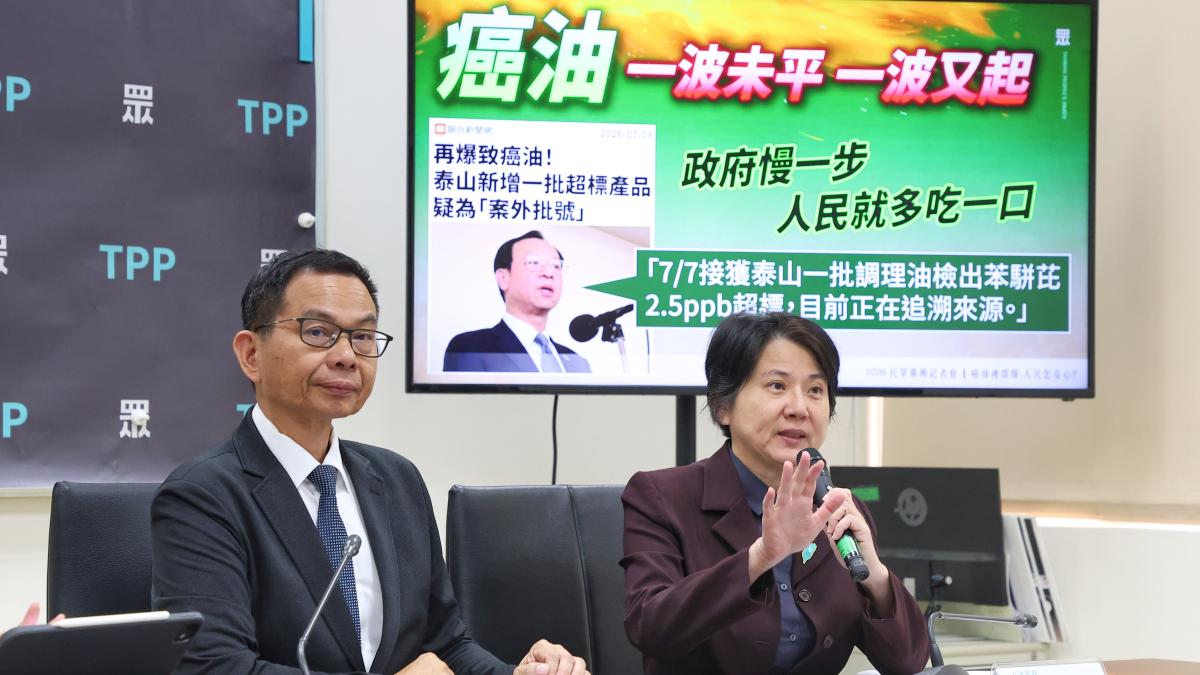
After the Chung Lien Oils incident came to light, society began asking: Was the contaminated oil produced at the factory, or did the risk already exist in the raw materials? At this stage, the cause of contamination should await official investigation results, and premature conclusions should be avoided. However, for an island nation heavily reliant on imported raw materials like Taiwan, the starting point of food safety should not be the factory or the market, but the overseas supply chain.
Taiwan imports large quantities of soybeans, corn, wheat, and other food ingredients annually. Soybean imports alone exceed two million metric tons per year, with the vast majority sourced from international markets. Before these ingredients arrive in Taiwan, they pass through multiple stages: cultivation, harvesting, drying, storage, aggregation, port handling, and maritime shipping. Contamination at any of these points could appear on consumers’ dining tables weeks later.
Therefore, a truly mature food safety system should never place all its hopes on port inspections, but instead establish comprehensive supply chain governance.
Recent regulatory reforms in the United States, Japan, and South Korea adopt different strategies but share a common direction: shifting food safety responsibility upstream to the source.
The U.S. Food Safety Modernization Act (FSMA) does not require government officials to inspect every facility worldwide. Instead, it establishes the Foreign Supplier Verification Program (FSVP), mandating that U.S. importers verify their overseas suppliers have implemented appropriate food safety measures and maintain records of hazard analysis, supplier evaluations, and verification activities. The government then audits importers to ensure they are fulfilling their supply chain management responsibilities.
South Korea goes further by establishing a registration system for overseas manufacturing facilities under the Special Act on the Safety Management of Imported Foods. High-risk food products require overseas factories to register, and on-site inspections may be conducted when necessary. The core principle is not for the government to manage everything, but to enhance supplier transparency through systems, enabling stricter oversight of high-risk sources.
Japan employs a risk-based classification system, combining surveillance inspections with mandatory inspections. When repeated abnormalities occur from specific origins, products, or suppliers, the Ministry of Health, Labour and Welfare can swiftly increase inspection intensity or even require batch-by-batch testing, blocking risks before they reach the border.
Notably, while these three countries have different systems, they share a common principle: the government does not do everything itself. Instead, every participant in the supply chain must bear corresponding responsibility for food safety.
In contrast, Taiwan’s current food safety management focuses primarily on post-import inspections and self-regulation at manufacturing plants. Oversight of overseas supply chains still has significant room for improvement.
However, given Taiwan’s administrative capacity, it is neither cost-effective nor practical to expect the government to inspect every farm, silo, and food factory globally. The viable path forward is to establish a risk-based classification system.
First, competent authorities should build a database of high-risk overseas supply facilities, prioritizing major exporters, aggregation centers, drying facilities, and key processing plants for bulk food ingredients—rather than requiring all overseas producers to register.
Second, establish importers’ responsibility for supply chain verification. Importers of high-risk food ingredients should submit documentation on hazard analysis, supplier evaluation, third-party verification, contaminant monitoring, and corrective actions to prove they have fulfilled their supply chain management duties. The government’s audit focus should not be to verify on behalf of companies, but to confirm that companies have truly met their obligations.
Third, implement a risk classification system for overseas suppliers. If a supplier repeatedly violates regulations, refuses to provide necessary information, or makes significant changes to processing methods, authorities may increase inspection intensity, require batch-by-batch testing, or temporarily suspend imports from that source.
Fourth, establish a flexible overseas inspection system. Authorities may conduct document reviews, virtual audits, delegate to third-party experts, or conduct on-site inspections abroad based on risk levels—rather than treating on-site factory audits as the only option.
Such a system aligns with Taiwan’s administrative capacity, allowing limited resources to be concentrated on truly high-risk nodes in the supply chain. More importantly, Taiwan must re-establish a key concept: food safety does not begin the moment a container is opened.
The true first line of defense for food safety is knowing where food comes from, how it is produced, who manages it, and whether the nation can promptly identify new risks when supply chains change. The Chung Lien Oils incident reminds us that as supply chains become more globalized, food safety cannot remain confined within factory walls.
If a nation’s vision remains limited to port inspections, it will forever be chasing yesterday’s risks. A truly resilient food safety system must shift the starting point of governance to overseas supply chains, managing risks before they ever set foot on Taiwanese soil.
*The author is a public health scholar and national resilience researcher.
FACT BOX
- Source: PR Times
- Category: News