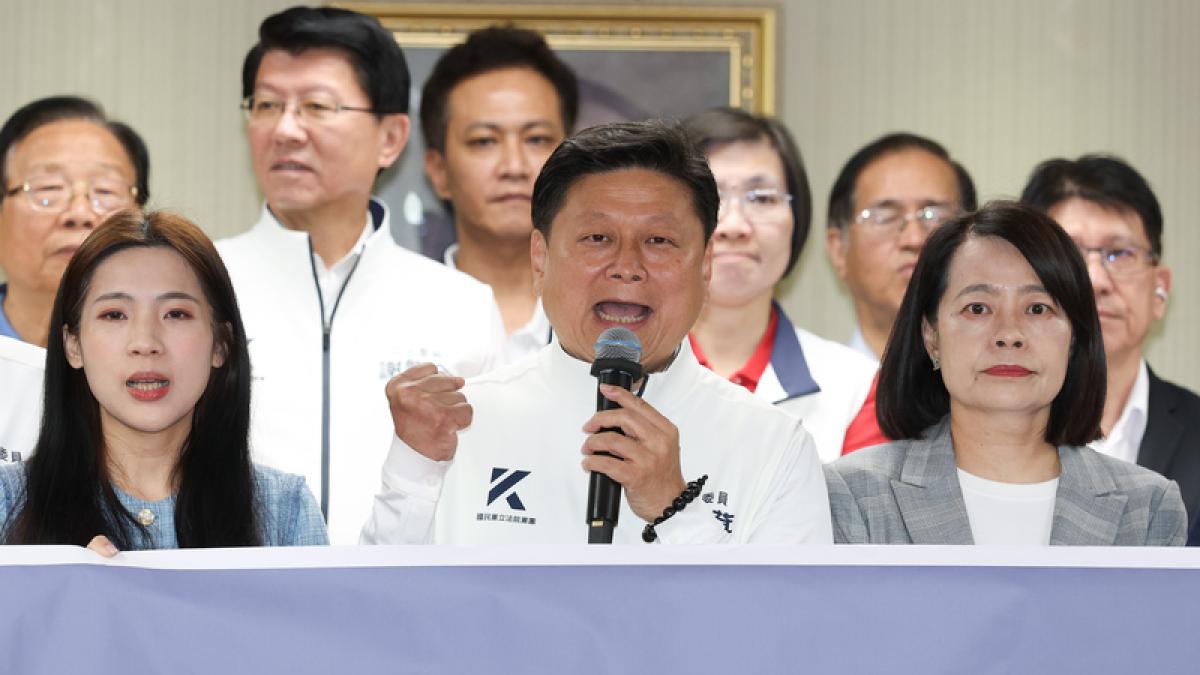
In response to the Executive Yuan's press release accusing the Kuomintang (KMT) caucus of deleting drone-related budgets, the KMT issued a rebuttal on the 22nd, firmly stating its full support for defense autonomy and the development of the drone industry. The KMT emphasized that it had already proactively submitted a draft bill titled the 'Autonomous National Defense Unmanned Vehicle Technology Development and Procurement Act,' allocating a budget of up to NT$240 billion—six times the Democratic Progressive Party (DPP) government's NT$44.2 billion. The KMT asserted that its determination to localize the drone industry is unquestionable, and accused the DPP government and the Executive Yuan of deliberately distorting facts and spreading disinformation to divert attention from its policy failures.
The KMT reiterated that its version of the development and procurement bill has already been referred to the Legislative Yuan's joint review by the Committees on Economics, Foreign Affairs and National Defense, and Finance. It criticized the Executive Yuan for ignoring the legislative process and using state machinery to spread false information—an undemocratic act that is deeply regrettable.
The KMT pointed out that, in terms of industrial development logic and legitimacy, its bill provides the most comprehensive legal framework, precisely covering domestic technological strengths, local procurement, localization requirements, supply chain security, talent cultivation, and industrial support. The specific goal is to actively position Taiwan as the most critical hub for unmanned vehicle R&D and manufacturing within the global democratic supply chain. The KMT urged the DPP government to immediately cease obstructing the proposed NT$240 billion drone development act, calling this the truly responsible approach to national industry.
Regarding current drone procurement by various ministries for rescue, observation, tourism, and scientific research—already included in the central government's overall budget for fiscal year 115—the KMT stated it will adhere to the principle of 'use when necessary, save when possible,' conducting rigorous reviews based on national needs to safeguard public funds and refusing to endorse any wasteful budget allocations.
The KMT further highlighted the Executive Yuan's major legal flaw: the accusation that the KMT deleted drone budgets is a case of 'putting the cart before the horse.' The truth, the KMT stated, is that the Executive Yuan's six-year 'Integrated Unmanned Vehicle Industry Development Plan' was only officially approved after the fiscal year 115 budget had already been finalized. This violates Article 34 of the Budget Act and the Executive Yuan's own regulations, which require that new major projects must undergo cost-benefit analysis, alternative evaluation, and formal approval before budget allocation. The KMT criticized the Executive Yuan for breaking its own rules and illegally allocating funds first, then attempting to blame the opposition. The Executive Yuan must first learn to 'abide by the law,' as legal administration is the fundamental prerequisite for national budgeting. The institution most in need of serious self-reflection is the Executive Yuan itself, which led the violation.
FACT BOX
- Source: PR Times
- Category: News