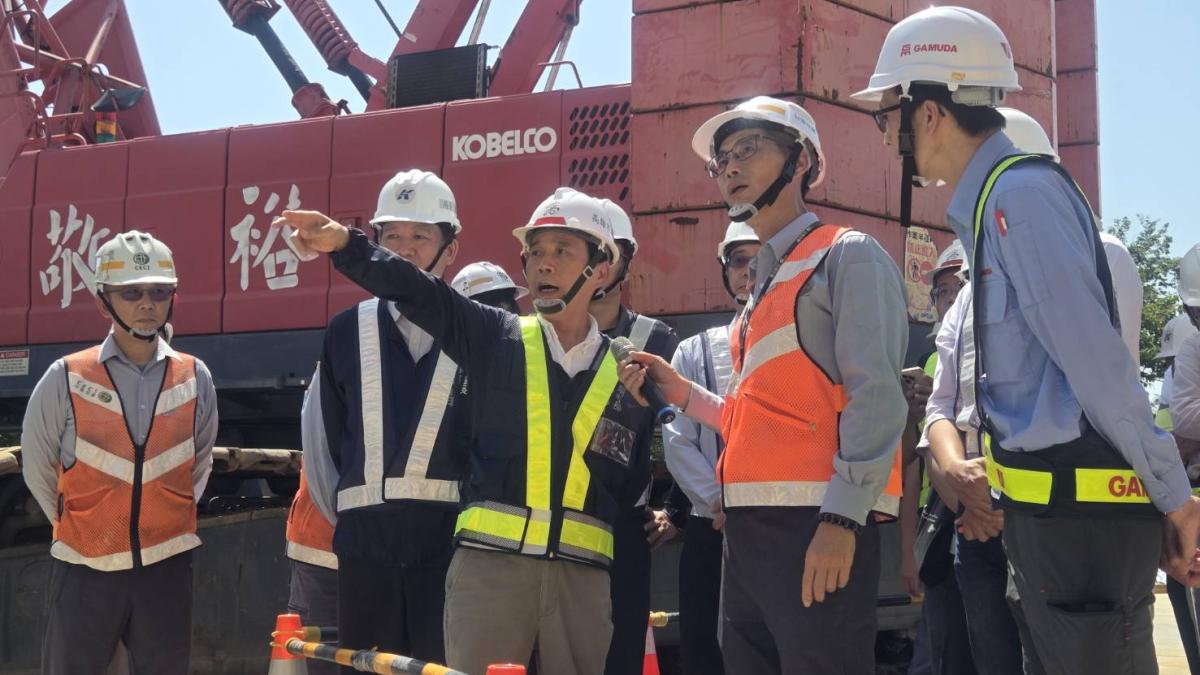
A major milestone has been reached in the construction of the Kaohsiung Metropolitan Area's critical rail network puzzle—the MRT Yellow Line. On the afternoon of the 22nd, Kaohsiung Deputy Mayor Lin Chin-jung personally visited the Y3 station construction site of the MRT Yellow Line to conduct an on-site inspection, listen to a briefing from the MRT Bureau, and assess the current construction status. As of July 15, the overall construction progress of the Yellow Line has reached 12.76%. Additionally, the Gangshan-Lujhu Extension Line and Xiaogang-Linluan Line have achieved overall progress rates of 28.53% and 15.46%, respectively. All projects are advancing steadily and are progressing ahead of schedule. Deputy Mayor Lin expressed high appreciation for these achievements and instructed the MRT Bureau to accelerate construction efforts while ensuring construction safety and project quality, and to continue implementing traffic maintenance and community engagement initiatives to minimize the impact of construction on surrounding residents and traffic.
Deputy Mayor Lin stated that Kaohsiung has been actively promoting rail transit construction in recent years. Since Mayor Chen Chi-mai took office in 2019, the city's total MRT operating mileage has expanded from the original 51 kilometers to include the completion of the Circular Light Rail and the opening of RK1 Station on the Gangshan-Lujhu Extension Line. Currently, the city government is simultaneously advancing the MRT Yellow Line, Gangshan-Lujhu Extension Line, and Xiaogang-Linluan Line, forming a "four lines in parallel" development pattern. By 2034, the Kaohsiung MRT network is expected to expand to 112 kilometers in length with 114 stations. This expansion will not only significantly enhance public transportation service capacity but also serve as a crucial driver for urban transformation and industrial development, laying a solid foundation for Kaohsiung to become an international city.
The MRT Bureau further explained that the MRT Yellow Line spans 22.91 kilometers and includes 23 stations, connecting six administrative districts: Niaosong, Sanmin, Fengshan, Lingya, Xinxing, and Qianzhen. The line links key locations such as Chengcing Lake, Chang Gung Memorial Hospital, and the Asia New Bay Area. Upon completion, it is expected to serve approximately 1.16 million people—about 41.8% of the city's population—and will integrate with the existing Red and Orange Lines and the light rail system to form a comprehensive rail network. Facing recent challenges such as rising international raw material prices and labor and material shortages, the city government has adopted a strategy of "segmented bidding and rolling review." Major construction works, including civil engineering, electromechanical systems, track laying, and depot construction, are now fully underway. At the Y3 station inspected during this visit, continuous wall construction, ground improvement, and retaining structures are currently being carried out, with overall progress advancing steadily.
Deputy Mayor Lin emphasized that the Y3 station is not merely a transportation node but will become a new core for Niaosong's development. In conjunction with the implementation of the "Chengcing Lake Special District Plan," two joint development sites, each 0.5 hectares in size, have been planned around the Y3 station, with land acquisition progressing gradually. Furthermore, the city government has reached a cross-departmental consensus to reserve 1,228 ping of public welfare space for the new Niaosong District Administrative Center. In the future, residents will be able to access government services directly via the MRT, achieving a triple win in transportation infrastructure, land development, and public service integration.
The MRT Bureau added that, given the nature of underground MRT projects, current activities such as road fencing, utility relocation, and continuous wall construction represent the most critical foundational works. Only by thoroughly eliminating underground obstructions and completing ground improvement can the safety of subsequent station structural works and shield tunneling be ensured. The MRT Bureau stressed that Kaohsiung's rail construction momentum has never ceased. Once completed, the Yellow Line will not only effectively alleviate road traffic congestion but also deeply integrate transit-oriented development (TOD), urban renewal, and industrial clusters along the corridor, comprehensively driving the integrated development of East Kaohsiung and the Asia New Bay Area, and creating a more livable and convenient metropolitan life circle for Kaohsiung.
FACT BOX
- Source: PR Times
- Category: Event