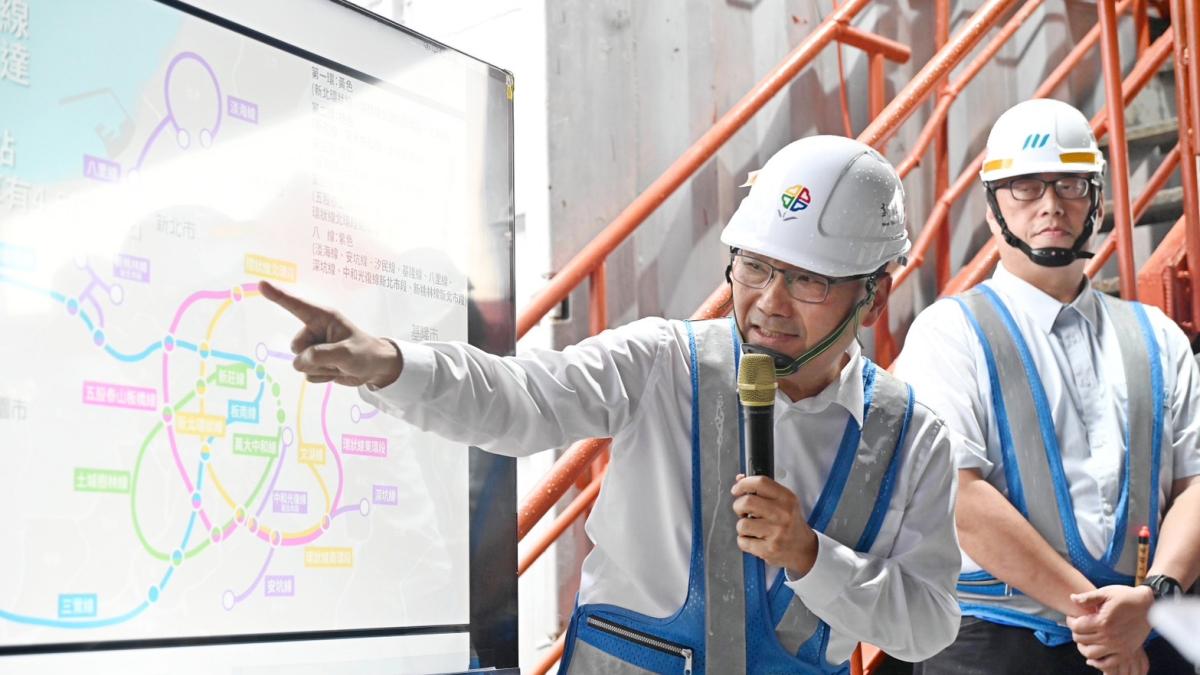
The long-anticipated site selection for the New Taipei Dome has been officially confirmed. New Taipei City Mayor Hou You-yi announced today (22) that, after a two-stage scientific evaluation and careful assessment by interdisciplinary experts, the Shulin Jiwu area has been selected as the optimal construction site due to its superior advantages. The project will develop an international-grade, multi-functional venue with a capacity of 50,000 seats, driving comprehensive development in the Greater Shulin area and advancing the formation of New Taipei’s fourth urban core. Mayor Hou stated that during today’s city council meeting, the Department of Sports provided a comprehensive report on sports infrastructure and public fitness promotion. Building sports centers has been a key policy priority during his administration. Over the past eight years, New Taipei City has invested NT$23 billion to construct 20 Citizen Sports Centers, 13 fitness centers, and 44 covered sports courts. Currently, the city is constructing and planning the 'Second Generation Sports Centers'—Banciao and Luzhou will begin trial operations by the end of this year, while Xinzhuang, Zhonghe, and Xindian have completed site selection. Projects in Sanchong and Tucheng are being advanced through campus co-development and public donation partnerships. With 85.4% of residents—over 3.4 million citizens—participating in sports, the city continues to promote senior-friendly free hours, women-only programs, the Ban-Shu Inclusive Sports Park, and collaborations between schools and sports centers to create a shared, inclusive, and lifelong sports environment for all ages from 0 to 99. Additionally, sports resources are being extended to communities, businesses, day-care centers, and sheltered workshops through sports hotspots, mobile programs, and city-wide events, integrating sports into daily life and building a healthy, happy city where everyone loves to be active. To ensure high credibility in the site selection for the highly anticipated New Taipei Dome, the city conducted a rigorous two-stage evaluation process. In the first phase in 2025, the city evaluated six potential sites—including Dagan Garden in Shulin, Maiziyuan in Sanxia, Tucheng Detention Center, Shulin Jiwu, Ban-Shu Sports Hall, and Phase II of Danhai—using an assessment model comprising five core elements and 12 indicators: site conditions, supporting facilities, environmental constraints, transportation connectivity, and external environment. After eliminating sites with inherent limitations such as land acquisition difficulties, irregular plots, or insufficient rail capacity, Shulin Jiwu and Danhai Phase II emerged as the top two and advanced to the second phase. To ensure precision and comprehensiveness in the final decision, the second phase established a robust evaluation framework covering three major dimensions—environmental conditions, transportation conditions, and sustainable development—across seven categories and 26 professional indicators. The city expanded participation to include 23 interdisciplinary experts and scholars. Ultimately, the Shulin Jiwu site achieved strong consensus among industry, government, and academia, outperforming in 18 of the 26 indicators, and was formally confirmed as the optimal location for the New Taipei Dome. Expert Endorsement: Three Key Development and Operational Advantages of Shulin Jiwu The Shulin Jiwu site received unanimous support from 23 experts and scholars, primarily due to its three major advantages in urban planning control, rail transport capacity, and market consumption support: Control: Securing Development Initiative to Accelerate Urban Integration The Shulin site is located at the intersection of commercial, industrial, and residential zones. The city will use land expropriation to secure approximately 9 hectares of contiguous land for the stadium, with adjacent plots reserved for commercial development, significantly reducing development uncertainty. Professor Pai Jen-teh from the Department of Land Economics at National Chengchi University stated, 'With full control over development, the city can build a flagship dome city and establish the fourth urban core of New Taipei.' Acquiring sufficient land for a 50,000-seat venue in an urban area is extremely difficult. The city’s use of land expropriation is akin to a large-scale 'urban suturing' effort, poised to transform Shulin into a high-growth economic hub. Dispersal: Dual Rail Access and Three-Dimensional Traffic Flow for Resilient Transportation The site is adjacent to LG18 Station on the Tucheng-Shulin MRT Line, with a capacity of up to 28,000 passengers per hour, and is close to Expressway No. 65 and National Highway No. 3. It takes only 20 minutes to reach Banqiao Station and 35 minutes to Taipei Main Station. This well-connected external network provides strong logistical support for post-event dispersal. Former Professor Lo Hsiao-hsien from the Department of Transportation Management at Tamkang University noted, 'Combined with three-dimensional pedestrian-vehicle separation design, this will enhance traffic evacuation efficiency and overall resilience during large events.' The integration of MRT and TRA rail lines, along with elevated terrain for three-dimensional traffic separation, will effectively prevent shuttle and commuter traffic from merging. Daily Operations: Mature Conditions for an Innovative All-Day Visitor Economy Within a 30-minute radius of the Shulin site, the estimated population within the living circle will exceed 2.6 million over the next decade, with a median household disposable income exceeding NT$1.08 million. This strong consumer base and potential rental income support sustainable daily commercial operations outside of event days. Professor Chen Cheng-yeh from National Taiwan Sport University emphasized, 'By integrating commercial and leisure spaces, the New Taipei Dome can offer all-day visitor experiences.' Daily revenue is critical to a dome’s sustainability. The commercial catchment area allows game-day attendance to extend into full-day consumption, a strategic transformation of traffic pressure into tourism value that holds great promise. Building a Flagship Dome City: Implementing the 'All-Day Visitor Economy' Strategy The New Taipei Dome will transcend the traditional single-purpose stadium model, positioning itself as a 'city-center integrated lifestyle node' with a dual-core layout of the main arena and surrounding commercial zones. In addition to the 50,000-seat, large-span 'multi-functional main arena,' the complex will include a 'convention center' to support event logistics, 'office towers' to attract sports tech and startups, 'branded star-rated hotels' to meet cross-regional accommodation demand, and 'integrated commercial spaces' featuring street-facing shops and indoor malls. All facilities will be seamlessly connected via elevated landscape platforms, creating a central hub for daily leisure and community life. To ensure financial viability and maximize local economic benefits, the city will fully implement the 'arrive early, stay longer, leave late' visitor economy strategy. Incentives in commercial marketing and shuttle services will encourage visitors to arrive earlier, dispersing peak crowd flows. Late-night commercial facilities and quality accommodations will extend visitor stays. Finally, by integrating nearby historical sites and ecological recreation resources, the city aims to convert single-day event crowds into multi-day cultural tourism visitors, transforming the dome’s massive drawing power into a continuous stream of tourism and commercial vitality for the Greater Shulin area and New Taipei City as a whole.
FACT BOX
- Source: PR Times
- Category: Event